

The best cyber security certifications in India help freshers build job ready skills and land roles such as SOC analyst, vulnerability analyst, and junior penetration tester. This guide lists fresher friendly certifications, explains who they suit, and shows how to convert a certificate into interviews and job offers.
Why cyber security certifications matter for freshers
Yes, certifications validate practical skills employers expect and help freshers stand out in screening tests. The best cyber security certifications in India show hands on competence and provide structured labs you can demo in interviews.
Employers hiring entry level security roles often prioritise demonstrable skill over generic credentials. A targeted certificate plus a small project or lab report gives you that proof and improves your chances of being shortlisted.

CEH v13 (Certified Ethical Hacker) — Industry standard for offensive skills
CEH v13 teaches offensive security fundamentals and practical techniques used in penetration testing. It is recognised by many employers and works well for entry level roles when combined with lab practice.
- Who it suits: Freshers who want to learn ethical hacking, penetration testing, and vulnerability assessment.
- What you learn: Reconnaissance, scanning, exploitation basics, web application vulnerabilities, and report writing.
- Duration and cost: Typical instructor led courses run 3 to 12 weeks; exam and training fees vary by provider.
- Jobs: Junior penetration tester, vulnerability analyst, red team intern.
- Appin option: See Appin’s CEH v13 AI powered course with practical labs and placement support.
CompTIA Security+ Core security fundamentals for beginners
CompTIA Security+ covers baseline security skills and is ideal for beginners who want a vendor neutral foundation. It is widely accepted for entry level security roles across employers.
- Who it suits: Students and graduates without prior security experience.
- What you learn: Network security, threat management, identity and access control, and basic incident response.
- Jobs: SOC analyst, security support engineer, junior security analyst.
Cisco CyberOps Associate: Security operations and monitoring
Cisco CyberOps Associate prepares freshers for security operations center tasks and monitoring tools used by large employers. It focuses on detection, investigation, and basic response workflows.
- Who it suits: Candidates aiming for SOC roles and incident monitoring positions.
- What you learn: Security monitoring, host and network analysis, intrusion detection, and tool workflows.
- Jobs: SOC analyst, security monitoring associate.
EC Council Certified SOC Analyst (CSA): Practical SOC skills
CSA is a focused SOC training and certification that teaches log analysis, threat hunting basics, and SIEM workflows. It is designed to be fresher friendly and practical.
- Who it suits: Freshers targeting SOC analyst positions with hands on tool exposure.
- What you learn: SIEM usage, log correlation, case management, and incident documentation.
- Jobs: SOC analyst, security operations trainee.
eJPT / eLearnSecurity Junior Penetration Tester: Hands on pentesting
eJPT focuses on practical penetration testing tasks and lab based assessments. It is more hands on than theory heavy exams and is valued by recruiters looking for proof of practical ability.
- Who it suits: Learners who want project based proof of pentesting skills.
- What you learn: Lab exercises on scanning, exploitation, and reporting.
- Jobs: Junior pentester, security intern, vulnerability analyst.
Bug bounty diploma programs and practical bug hunting
Bug bounty training teaches real world testing and responsible disclosure workflows and is highly practical for freshers. Success in bug bounty programs is strong evidence of capability.
- Who it suits: Candidates who prefer hands on testing and earning while learning.
- What you learn: Web application testing, recon, exploitation, and vendor disclosure processes.
- Appin option: Consider Appin’s bug bounty diploma program for guided labs and mentorship.
- Jobs: Bug hunter, vulnerability analyst, junior pentester.
Cloud and vendor credentials for security support
Cloud and vendor certs such as AWS Cloud Practitioner with security modules or Azure fundamentals with security give freshers an edge for cloud security support roles. These credentials complement core security certificates and broaden opportunities.
- Who it suits: Graduates aiming for cloud security support or junior DevSecOps roles.
- What you learn: Cloud identity, network security in cloud, and basic best practices.
- Jobs: Cloud security support, cloud operations with security focus.
How to choose the right certification as a fresher
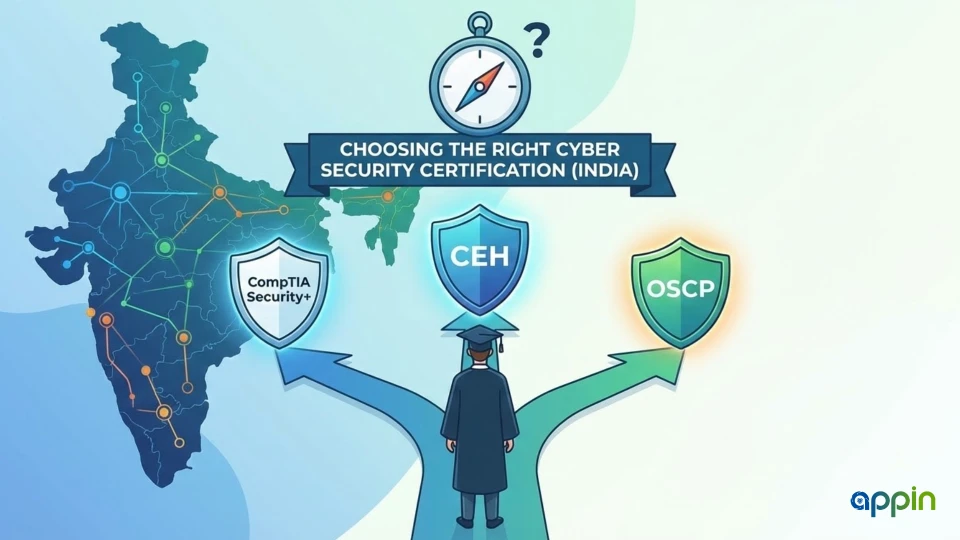
Choose certificates that include hands on labs, clear project deliverables, and career support. The best cyber security certifications in India for freshers are those that let you show practical work in interviews.
- Start with fundamentals: CompTIA Security+ or CyberOps for a broad base.
- Add a practical offensive track: CEH v13 or eJPT to demonstrate applied testing skills.
- Build a portfolio: Publish lab reports, GitHub notes, or bug bounty write ups you can discuss in interviews.
- Use targeted courses: Pick SOC or cloud security credentials depending on the role you want.
Roadmap: 6 month plan to go from zero to job ready
Yes, a structured 6 month plan can move you from beginner to interview ready by pairing a fundamentals cert with a practical project. Consistency and real labs are the keys.
- Months 1 to 2: Study networking basics and complete CompTIA Security+ or equivalent.
- Months 3 to 4: Take a CEH v13 or eJPT style course with labs and finish one guided penetration testing project.
- Months 5 to 6: Join a bug bounty program or SOC internship, document findings, and prepare resume and interview projects
Invest time in one clear certification path and validate your learning with small, sharable projects. The best cyber security certifications in India are the ones that let you prove skill quickly and connect you to hiring pipelines.
Start with fundamentals, add practical labs, and document everything you do. Recruiters respond to demonstrated ability, not just certificates, so make your learning visible and practice interviews with peers.
Which certification is best for absolute beginners?
CompTIA Security+ and Cisco CyberOps Associate are strong beginner friendly choices that teach fundamentals and SOC workflows employers expect. They provide a broad base before you specialise.
Can freshers get jobs with only a certification?
Yes, if the certification includes labs and you can show projects or bug reports. Pair a certificate with a clear portfolio and targeted applications for the best results.
How much time should I spend on labs versus theory?
Spend at least 60 percent of your study time on hands on labs and practical tasks to build demonstrable skill. Theory is useful, but labs create interview evidence and real problem solving experience.
