

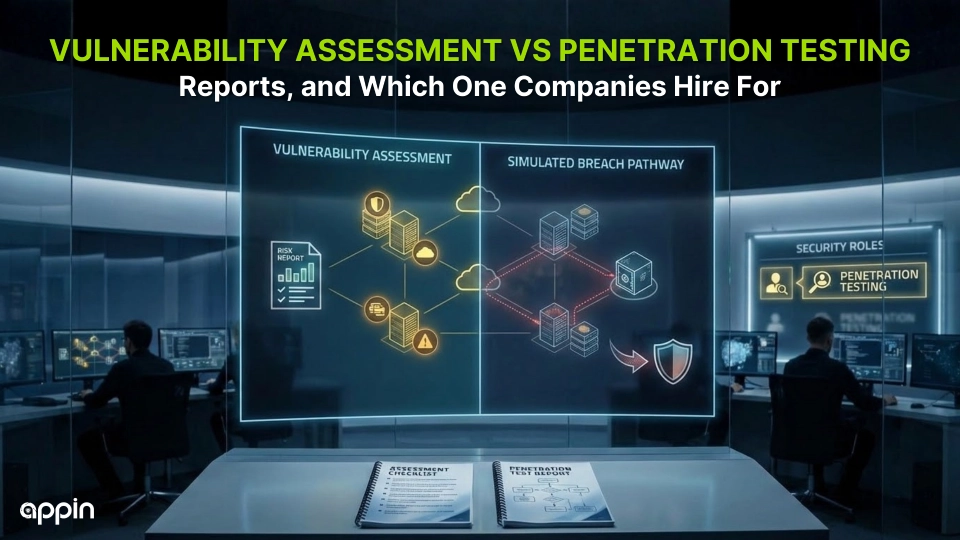
Vulnerability Assessment vs Penetration Testing: Differences, Reports, and Which One Companies Hire For
Vulnerability assessment vs penetration testing is one of the most common points of confusion for students entering cybersecurity in India, and it is also one of the most important distinctions to understand before you choose a career path, pick certifications, or apply for your first job.
VAPT is often used as a combined term (Vulnerability Assessment and Penetration Testing), which makes the two disciplines sound like the same thing. They are not. The methodology is different, the tools overlap but serve different purposes, the reports look different, and the job market for each has a distinct structure.
This guide covers both disciplines in plain terms: what each one involves, how the reports differ, which tools each role uses, what the salary gap looks like, and which one Indian companies hire for more at the entry level. By the end, you will have a clear picture of which path fits your background, goals, and timeline.
What Is Vulnerability Assessment and What Does a Vulnerability Assessment Engineer Do in India?
Vulnerability Assessment is the systematic process of identifying, classifying, and prioritising security weaknesses in systems, networks, and applications, and a Vulnerability Assessment Engineer is the professional responsible for running, analysing, and reporting on this process.
Understanding what is vulnerability assessment in cybersecurity means understanding its scope. A VA engineer scans an organisation’s infrastructure using automated tools, reviews the results for false positives, assigns severity ratings to each finding, and produces a structured report that tells the organisation what needs to be fixed and how urgently.
What a VA Engineer does day to day:
- Runs vulnerability scans using tools like Nessus, Qualys, or OpenVAS against agreed-upon targets
- Reviews scan results to validate findings and remove false positives
- Assigns CVSS severity scores (Critical, High, Medium, Low) to each vulnerability
- Cross-references findings against CVE databases to identify known exploits and patches
- Produces a vulnerability assessment report with remediation recommendations
- Re-scans after patches are applied to verify fixes were effective
VA does not involve actively attacking or exploiting the weaknesses found. The role stops at identification and reporting. This is the key distinction that separates it from penetration testing, which is covered in the next section.

What Is Penetration Testing and What Does a Penetration Tester Actually Do in India?
Penetration Testing is the practice of actively attempting to exploit security vulnerabilities in an authorised environment to determine what an attacker could actually achieve, and a penetration tester is the security professional who conducts this simulated attack.
Understanding what is penetration testing in cybersecurity means understanding that it goes significantly further than vulnerability assessment. A penetration tester does not just find weaknesses. They attempt to exploit those weaknesses, chain vulnerabilities together to escalate privileges, and demonstrate the real-world impact of a successful attack.
What a Penetration Tester does day to day:
- Conducts reconnaissance and scanning on agreed-upon scope using tools like Nmap and Burp Suite
- Attempts to exploit identified vulnerabilities using frameworks like Metasploit in authorised environments
- Chains multiple vulnerabilities together to demonstrate lateral movement or privilege escalation paths
- Documents each step of the attack path with screenshots and technical evidence
- Produces a detailed penetration test report covering attack narrative, proof of exploitation, and business impact
- Presents findings to technical and non-technical stakeholders in debrief sessions
The ethical hacking career in India built around penetration testing requires a deeper offensive security skill set than VA, which is why it commands higher salaries at senior levels but also has more demanding certification and experience requirements at entry level.
What Are the Key Differences Between Vulnerability Assessment and Penetration Testing in Cybersecurity?
The core difference between vulnerability assessment and penetration testing is depth of engagement: VA identifies and reports weaknesses, while penetration testing actively exploits them to prove impact.
This distinction affects everything: the methodology, the tools, the output, the time required, and the skill set needed. Students who understand this difference can make a much more informed decision about which path to pursue and which certifications to prioritise.
Vulnerability Assessment vs Penetration Testing: Side-by-Side Comparison
| Dimension | Vulnerability Assessment | Penetration Testing |
| Core Objective | Identify and categorise weaknesses | Exploit weaknesses to prove real-world impact |
| Approach | Mostly automated scanning with manual review | Manual attack simulation with tool support |
| Depth | Broad coverage across entire infrastructure | Deep focus on specific targets or attack paths |
| Exploitation | No active exploitation | Active exploitation in authorised environments |
| Output | Vulnerability report with severity ratings | Pentest report with attack narrative and proof of exploitation |
| Typical Duration | 1 to 5 days depending on scope | 1 to 4 weeks depending on complexity |
| Skill Level Required | Beginner to intermediate | Intermediate to advanced |
| Common Tools | Nessus, Qualys, OpenVAS, Tenable | Metasploit, Burp Suite, Nmap, SQLMap |
| Who Commissions It | Most mid-size and enterprise companies regularly | Companies needing compliance or deep security validation |
| Entry Level Salary India | ₹3.5 to ₹6 LPA | ₹4 to ₹7 LPA |
The difference between VA and PT is not that one is better than the other. They serve different purposes and are often used together in a full VAPT engagement where VA covers the breadth and penetration testing confirms the depth of exposure.
What Does a Vulnerability Assessment Report Look Like Compared to a Penetration Testing Report?
A vulnerability assessment report lists identified weaknesses with severity ratings and remediation steps, while a penetration testing report adds an attack narrative, exploitation evidence, and business impact analysis that a VA report does not include.
The report difference reflects the engagement difference. VA tells you what is vulnerable. A pentest report tells you what an attacker could do with those vulnerabilities and how far they could go.
Report Structure Comparison:
| Section | Vulnerability Assessment Report | Penetration Testing Report |
| Executive Summary | Overview of findings by severity | Summary of attack paths and business risk |
| Scope | Systems and networks assessed | Agreed target scope and testing boundaries |
| Methodology | Scanning tools and process used | Attack phases: reconnaissance, exploitation, post-exploitation |
| Findings | Vulnerability list with CVE references and CVSS scores | Vulnerabilities exploited with step-by-step proof |
| Evidence | Scanner output and screenshots | Exploitation screenshots, command output, data accessed |
| Risk Rating | Per-vulnerability CVSS score | Per-finding business impact rating |
| Remediation | Fix recommendations per vulnerability | Short-term fixes and strategic recommendations |
| Retest Plan | Verification scan after patching | Confirmation of remediation effectiveness |
For students learning report writing in cybersecurity training, understanding the vulnerability assessment report format versus the penetration testing report structure helps you produce the right deliverable for the right engagement from day one on the job.
Which Tools Do Vulnerability Assessment Engineers Use Compared to Penetration Testers in India?
Vulnerability Assessment Engineers primarily use automated scanning platforms, while penetration testers rely more heavily on manual exploitation tools and attack frameworks, though there is meaningful overlap between both toolsets.
The tools you learn signal to employers which discipline you are prepared for. A resume listing only Nessus and Qualys positions you for VA roles. A resume listing Metasploit, Burp Suite, and SQLMap alongside Nmap positions you for penetration testing roles. Students who understand this distinction choose tools that match their target role rather than learning randomly.
Tools by Discipline:
| Category | Vulnerability Assessment Tools | Penetration Testing Tools |
| Scanning and Discovery | Nessus, Qualys VMDR, OpenVAS, Tenable.io | Nmap, Masscan |
| Web Application Testing | Nikto, Acunetix | Burp Suite, OWASP ZAP, SQLMap |
| Exploitation | Not used in VA | Metasploit Framework, ExploitDB |
| Password Attacks | Not used in VA | John the Ripper, Hashcat, Hydra |
| Reporting | Dradis, Serpico (basic) | Dradis, Serpico, custom pentest report templates |
| Network Analysis | OpenVAS network scans | Wireshark, Tcpdump |
| Shared Tools | Nmap (for discovery), Burp Suite Community (for web checks) | Same tools, deeper usage |
The vulnerability assessment tools list centres on automated platforms that provide consistent, repeatable results across large infrastructure. Penetration testing tools for beginners like Metasploit and Burp Suite require hands-on practice in lab environments to use effectively because they demand manual technique, not just configuration.
How Much Do Vulnerability Assessment Engineers and Penetration Testers Earn in India in 2026?
Entry-level penetration testers in India earn slightly more than entry-level VA engineers, but the salary gap widens significantly at mid and senior levels where experienced penetration testers command premium compensation.
The penetration tester salary in India grows faster over time because the skill set is harder to replace and the supply of qualified senior penetration testers remains limited. Vulnerability assessment jobs in India, while more numerous at entry level, have a lower salary ceiling at the senior stage.
Salary Comparison by Experience Level and Location:
| Experience Level | Vulnerability Assessment Engineer | Penetration Tester |
| Entry Level (0 to 2 years) | ₹3.5 to ₹6 LPA | ₹4 to ₹7 LPA |
| Mid Level (2 to 5 years) | ₹6 to ₹10 LPA | ₹8 to ₹14 LPA |
| Senior Level (5+ years) | ₹10 to ₹15 LPA | ₹14 to ₹20 LPA |
| Tier 1 City Premium | 20 to 30% above average | 25 to 35% above average |
| MNC or Remote Premium | 20 to 40% above local | 30 to 50% above local |
Both roles offer significantly better starting salaries than general IT support or development roles at the same experience level. For students in Tier 2 cities like Indore, even entry-level VA salaries represent a meaningful career step up, with growth potential that accelerates with certifications and hands-on experience.
Which Cybersecurity Role Do Indian Companies Hire More For, Vulnerability Assessment or Penetration Testing?
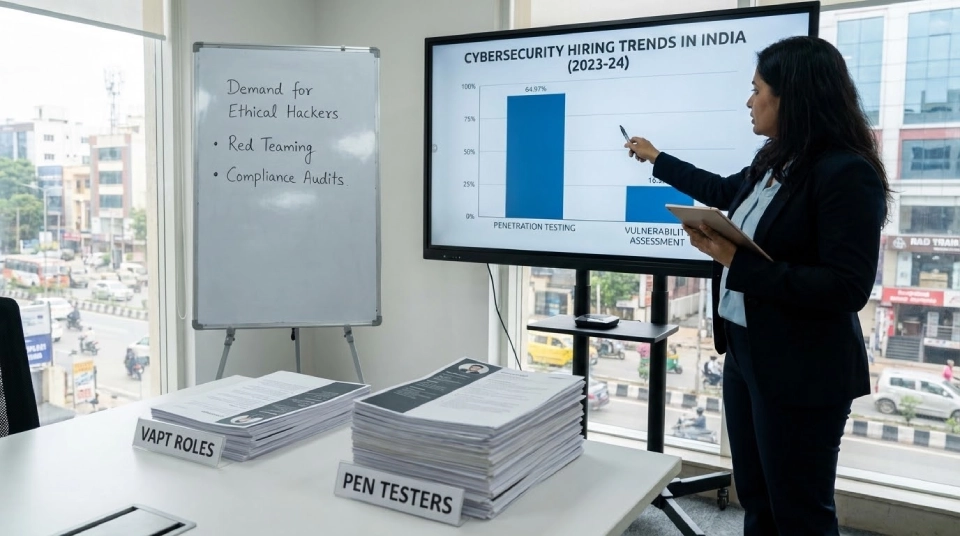
Indian companies hire more frequently for Vulnerability Assessment roles than for Penetration Testing roles at the entry level, because VA is required continuously across more industry sectors while penetration testing is typically a project-based engagement.
This is a practical reality that students should factor into their job search strategy. VA roles are available year-round at IT services companies, BFSI organisations, healthcare providers, and government entities. Penetration testing roles are more concentrated in security consulting firms, MSSPs, and technology product companies that operate dedicated red teams.
Hiring Distribution by Sector:
| Sector | VA Roles Available | Penetration Testing Roles Available |
| IT Services (TCS, Infosys, Wipro) | High | Low to Medium |
| BFSI (Banks, Insurance, NBFC) | Very High | Low |
| MSSPs (Managed Security Services) | High | High |
| Security Consulting Firms | Medium | High |
| Government and Defence | Medium | Low (cleared roles) |
| Technology Product Companies | Medium | Medium to High |
| Healthcare and Pharma | Medium | Low |
For students starting their cybersecurity jobs in India 2026 job search, targeting BFSI and IT services companies for VA roles gives the widest opening. For penetration testing roles, MSSPs and security consulting firms like KPMG, Deloitte, and specialised boutique firms are the most active hirers.
The VAPT career path in India often starts with a VA role, builds foundational skills and experience, and then transitions into penetration testing as certifications and lab skills develop. This is not a rule but it is the most common trajectory among working security professionals in India.
Which Certifications Do You Need for Vulnerability Assessment vs Penetration Testing Careers in India?
For vulnerability assessment roles, CompTIA Security+ and vendor certifications like Qualys VMDR or Tenable Nessus Professional are the most commonly requested. For penetration testing roles, CEH is the most requested entry-level certification, with OSCP as the benchmark for mid-level and senior positions.
CEH certification for penetration testing appears in Indian job postings more than any other offensive security credential at the junior level. This is because CEH covers both attack methodology and tool proficiency in a structured curriculum that employers trust as a screening standard. Many students also find that CEH knowledge improves their VA work because understanding how attacks are executed makes vulnerability reports more accurate and prioritised.
Certification Map by Career Path:
| Career Path | Entry-Level Certification | Mid-Level Certification | Advanced Certification |
| Vulnerability Assessment | CompTIA Security+ | Qualys VMDR, Tenable Nessus Pro | CISSP, CISM |
| Penetration Testing | CEH, CompTIA Security+ | OSCP, CompTIA PenTest+ | OSEP, CRTE |
| Both Paths | CompTIA Security+ (universal baseline) | CEH (improves both roles) | Specialisation based on role |
Some certifications like CompTIA Security+ and CEH provide value across both disciplines, which is why they consistently appear at the top of job postings for both VA and penetration testing roles in India.
Should You Start with Vulnerability Assessment or Go Directly into Penetration Testing as a Fresher in India?
For most freshers in India, starting with Vulnerability Assessment is the more practical first step because VA roles are more widely available, have lower technical entry barriers, and build the foundational knowledge that makes penetration testing significantly easier to learn next.
This is not a universal answer. The right starting point depends on your background.
If you have a BTech or BSc CS background with networking and Linux exposure: You can enter penetration testing directly. Your existing technical foundation means the jump to CEH, Metasploit, and Burp Suite is manageable without going through VA first.
If you come from BCA, BCom, BSc General, or a non-tech background: Starting with VA makes more sense. VA introduces you to scanning tools, network concepts, and vulnerability classification in a structured way before you take on the more complex offensive techniques that penetration testing requires.
If you are unsure which to choose: Start with CompTIA Security+ as your first certification. It is relevant for both paths, builds your foundational knowledge, and keeps both options open while you figure out which direction suits you better.
The VAPT career path in India rewards students who build systematically rather than jumping to advanced skills before the foundation is solid. An ethical hacking career in India built on VA experience followed by penetration testing certifications is one of the most well-trodden and successful routes in the field.
If you want structured training that covers both VA methodology and penetration testing with hands-on lab practice and placement support, explore Appin’s certified ethical hacking training to check available courses and batch schedules in Indore.
Conclusion
Vulnerability assessment and penetration testing are not competing disciplines. They are complementary skills that together make up a complete VAPT capability. VA is the wider entry door with more job openings across more sectors. Penetration testing has the higher salary ceiling and more demanding skill requirements.
Most successful cybersecurity professionals in India have knowledge of both, regardless of which they specialise in.
Choose your starting point based on your background, build the foundational certifications, and grow from there. If you want structured training with placement support to start that journey, enquire with Appin Indore to check the next available batch.
