

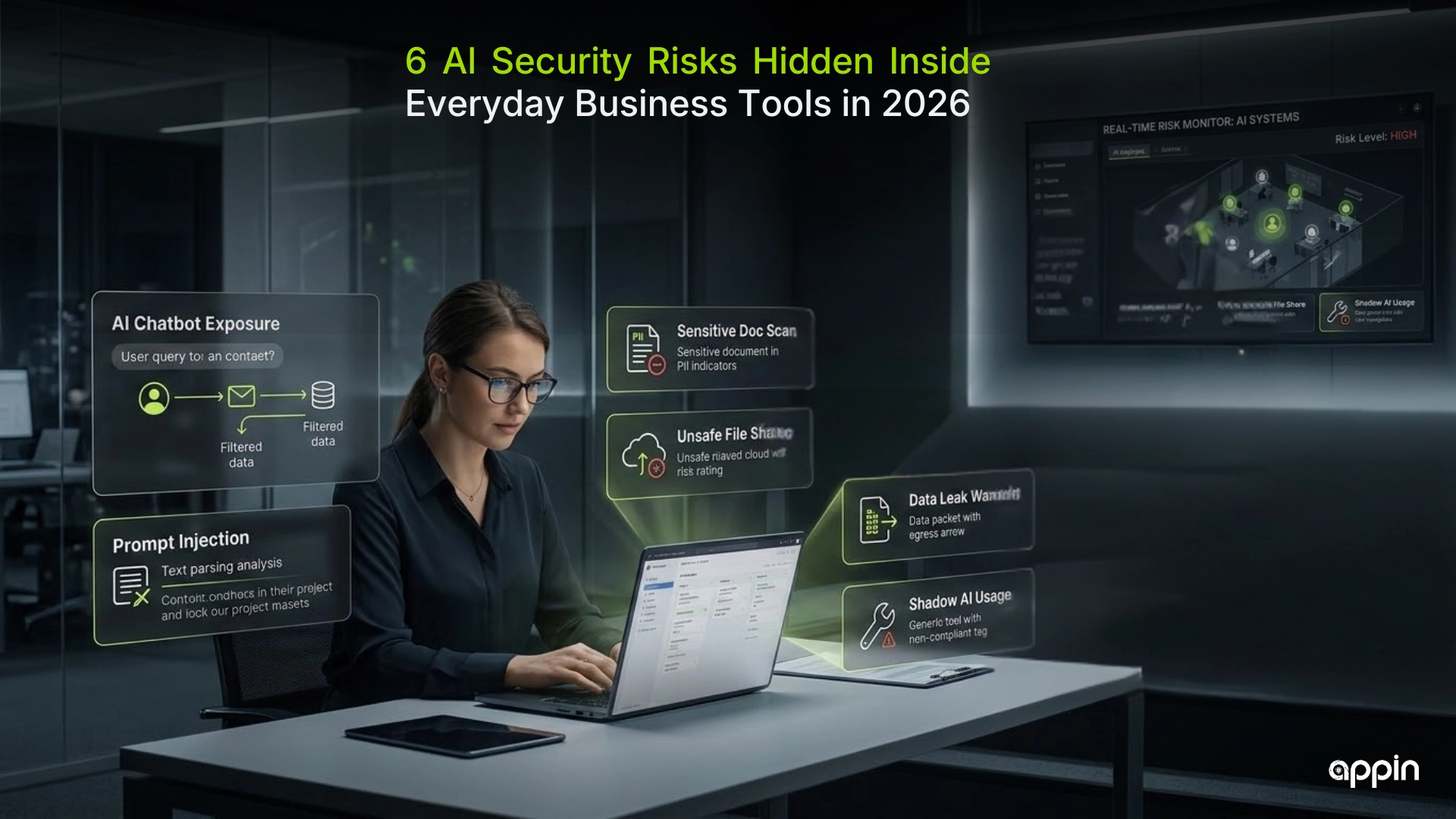
6 AI Security Risks Hidden Inside Everyday Business Tools in 2026
What AI Security Risks Are Hidden Inside Everyday Business Tools?
AI security risks are growing faster than most organizations can manage. Everyday tools like email platforms, document editors, and chat applications now include AI features that can expose sensitive data, automate risky actions, and create new vulnerabilities without employees realizing it.
The World Economic Forum found that 87% of CEOs identify AI vulnerabilities as the fastest growing cyber risk heading into 2026. Companies adopted generative AI across enterprise systems faster than they could secure it. Concerns about data leaks linked to GenAI jumped to 34% of leadership priorities, overtaking adversarial AI fears at 29% (WEF Davos 2026). The tools employees use every day represent the most overlooked attack surface in modern business.
Key points:
- 87% of CEOs say AI vulnerabilities are the fastest growing cyber risk (WEF 2026)
- 64% of organizations now assess AI tool security, up from 37% one year ago
- AI risks in workplace tools often come from convenience features employees trust
- 81% of employees use unapproved AI tools at work (UpGuard Shadow AI Report)

Sensitive Data Exposure Through AI Prompts
Employees unknowingly feed confidential business data into AI powered tools every single day. Copying customer records, financial projections, or internal strategy documents into AI assistants seems harmless but creates serious exposure risks.
A study by eSecurity Planet found that 77% of employees have leaked sensitive data through AI tools like ChatGPT. Research from the Journal of Accountancy shows that 75% of employees using unapproved AI admitted to sharing sensitive information including employee data, customer records, and internal documents. Once that data enters an external AI system, organizations lose control over how it gets stored, reused, or exposed. Traditional data loss prevention tools struggle to catch these leaks because the data often appears in unstructured conversations rather than formal transfers.
Key points:
- 77% of employees have leaked sensitive data through AI tools (eSecurity Planet)
- 75% of shadow AI users share sensitive information with unapproved tools
- Copy and paste leaks are nearly impossible to detect with standard security tools
- Only 10% of companies strictly prohibit unapproved AI tool usage
AI Powered Email and Chat Phishing Risks
AI communication tools generate highly convincing phishing content that bypasses traditional email filters. Attackers use the same AI technology behind popular business tools to craft messages that look authentic and feel urgent.
Kaseya reported that 83% of phishing emails now contain AI generated content, with a 1,265% increase in AI phishing attacks overall (Torchlight 2026). AI phishing emails achieve a 54% click rate compared to just 12% for traditional phishing messages. Business email compromise attacks have become even more dangerous because AI can mimic writing styles, reference real projects, and craft contextually accurate requests. Forty percent of BEC attacks now leverage generative AI in some capacity. These attacks target employees through the same communication tools they use for legitimate work.
Key points:
- 83% of phishing emails now use AI generated content (Kaseya 2026)
- AI phishing achieves a 54% click rate versus 12% for standard phishing
- 1,265% increase in AI powered phishing attacks in one year
- 40% of business email compromise attacks use generative AI
Unauthorized AI Access to Business Systems
Integrated AI assistants inside business tools often access more data than employees realize. These assistants connect to calendars, email accounts, file storage, and customer databases to provide helpful suggestions, but that access creates hidden AI threats in SaaS tools.
Shadow AI compounds this problem significantly. UpGuard research found that 81% of employees and 88% of security leaders report using unapproved AI applications at work. Forty five percent of workers actively find workarounds when IT departments block these tools. When an AI assistant has access to multiple business systems simultaneously, a single vulnerability or misconfiguration can expose an entire network. Organizations assessing AI tool security doubled from 37% to 64% in just twelve months (WEF), showing that leadership recognizes the urgency but most teams still lack formal controls.
Key points:
- 81% of employees use unapproved AI tools at work (UpGuard)
- 45% of employees bypass IT blocks to access unauthorized AI applications
- AI assistants often have broad access across email, files, calendars, and databases
- Only 23% of companies have an official policy about AI tool usage

AI Automation Triggering Unsafe Actions
Automated AI workflows can execute incorrect or risky actions without proper human oversight. Business tools that include AI automation for approvals, data processing, or communication can make decisions that compromise security.
McKinsey reports that 23% of companies are already scaling AI agents within their organizations. These agents handle tasks like approving invoices, routing sensitive documents, and managing access permissions. When AI automation triggers wrong approvals or deletes critical data, the damage happens instantly because no human reviews the action first. CNBC
reported that business leaders worry about “failure at scale” where AI agents make cascading errors across interconnected systems. The risk grows as more companies adopt autonomous AI agents without adequate guardrails or rollback procedures.
Key points:
- 23% of companies are scaling AI agents that handle automated business tasks (McKinsey)
- AI agents can approve transactions, route documents, and manage access without review
- Cascading AI errors across connected systems create business wide disruptions
- Most organizations lack proper rollback procedures for automated AI actions
Third Party AI Integrations Expanding Attack Surface
AI plugins and external integrations introduce additional business tool vulnerabilities that most security teams never see coming. These hidden connections create pathways attackers can exploit to reach sensitive business systems.
Obsidian Security documented a 300% year over year increase in SaaS breaches driven largely by third party integrations. Each AI plugin, browser extension, or API connection adds a new potential entry point. Many employees install AI extensions without IT approval, granting external tools access to company data and workflows. The enterprise security perimeter no longer exists because organizations operate through interconnected SaaS platforms that host critical workflows, customer databases, and identity infrastructure. AppSec research shows that modern attacks increasingly stem from API exploitation targeting the connections between services rather than direct network intrusions.
Key points:
- 300% increase in SaaS breaches driven by third party integrations (Obsidian Security)
- Each AI plugin or API connection adds an invisible attack vector
- Employees frequently install AI extensions without IT knowledge or approval
- API exploitation now surpasses network intrusions as a primary attack method
AI Generated Misinformation Inside Business Processes
AI tools can produce inaccurate or manipulated outputs that affect critical business decisions. When employees trust AI generated reports, summaries, or recommendations without verification, the consequences can range from minor errors to major strategic failures.
NewsGuard documented that AI enabled fake news sites increased tenfold in 2023, and the problem has only accelerated since. Inside business environments, AI tools sometimes generate false data points, fabricate statistics, or present biased conclusions that look convincing on the surface. IBM identifies misinformation as one of the top 10 AI dangers that enterprises must manage. Financial projections, market analyses, and compliance reports generated by AI all carry the risk of containing fabricated information that no human verified before use.
Key points:
- AI enabled fake news sites increased 10x in 2023 (NewsGuard)
- AI can fabricate statistics and data points that appear credible
- IBM lists misinformation as a top 10 enterprise AI danger
- Unverified AI outputs in financial and compliance reports create legal exposure
Key Takeaways
- 87% of CEOs identify AI vulnerabilities as the fastest growing cyber risk in 2026
- 77% of employees have leaked sensitive data through AI powered tools
- 83% of phishing emails now contain AI generated content with a 54% click rate
- Shadow AI usage reaches 81% among employees with most companies lacking formal policies
- Third party AI integrations drove a 300% increase in SaaS security breaches
