

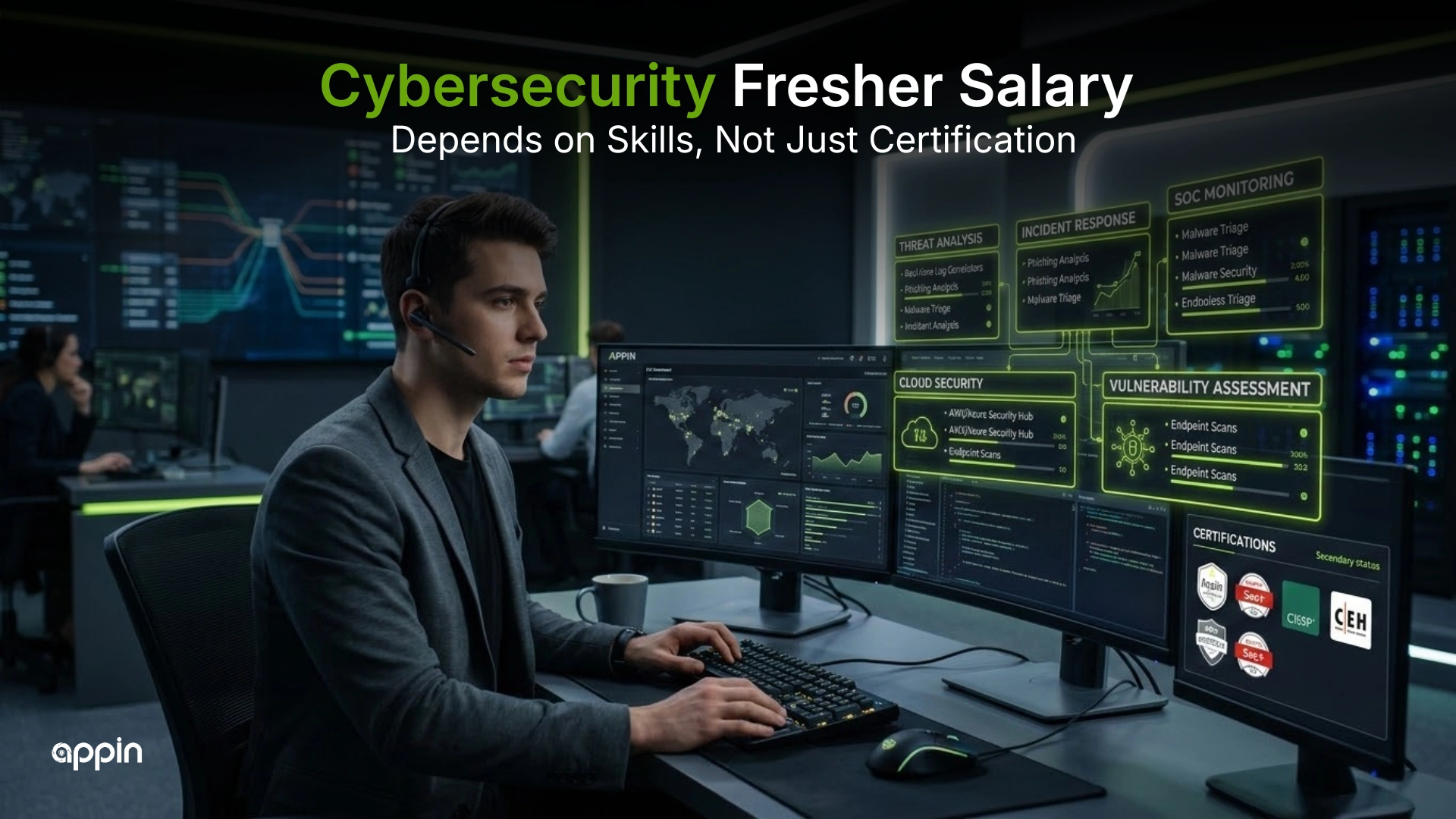
Cybersecurity Fresher Salary Depends on Skills, Not Just Certification: Here’s Why
Many students think, “I completed a certificate, so why is my cybersecurity fresher salary still basic?”
The honest answer is simple. Certification can help you enter the interview room, but practical skills decide how confidently you perform inside that room. Employers want to see whether you can use tools, understand alerts, explain findings, and solve beginner level security tasks.
This blog explains why salary depends on usable ability, not just a certificate name on your resume.
Why does certification alone not guarantee a higher cybersecurity fresher salary?
Certification alone does not guarantee a higher cybersecurity fresher salary because employers also check whether you can apply the knowledge in real tasks.
A certificate proves that you completed structured learning. It does not automatically prove that you can read logs, use tools, explain vulnerabilities, or write a basic report.
Employers usually ask practical questions like:
- Can you explain an Nmap scan result?
- Can you identify a weak HTTP header?
- Can you read a failed login log?
- Can you explain SQL injection in simple words?
- Can you document a finding clearly?
This is why cybersecurity certification vs skills is not a battle. Certification helps, but skills create trust.
What do employers really check before offering a fresher salary?
Employers check whether a fresher understands security basics, tools, reporting, and beginner level problem solving.
For cyber security fresher jobs, companies do not expect you to know everything. They expect you to understand the basics properly and show that you can learn fast.
The skills needed for cybersecurity fresher jobs usually include:
- Networking basics
- Linux and Windows fundamentals
- Log reading ability
- Tool familiarity
- Vulnerability understanding
- Communication skills
- Documentation ability
- Interview confidence
A fresher who explains clearly often performs better than someone who only lists course names.
Why do two certified cybersecurity freshers get different salary offers?
Two certified freshers get different salary offers because one may only have a certificate, while the other can show labs, projects, reports, and tool practice.
Imagine two students from Indore applying for the same SOC or VAPT fresher role.
Candidate A has a certificate but no lab reports. Candidate B has a certificate, Nmap practice screenshots, a small web testing report, basic Linux notes, and a clear explanation of tools.
Recruiters will usually trust Candidate B more because there is proof of work. This proof improves interview confidence and can support a better offer.
Which practical skills can improve cybersecurity fresher salary?
Practical cybersecurity skills that can improve cybersecurity fresher salary include networking, Linux, web security, log analysis, vulnerability assessment, and basic incident response.
The best skills for cybersecurity freshers are not random tool names. They are basics that connect to real tasks.
Focus on:
- TCP IP basics
- DNS, HTTP, ports, and protocols
- Linux commands
- Windows event basics
- OWASP Top 10
- Vulnerability scanning
- SIEM and log analysis
- Report writing
- Basic scripting awareness
If you want to plan early, ethical hacking course after 10th vs 12th can help you understand when to start building these basics.
How do tool skills affect cybersecurity fresher salary?
Tool skills affect cybersecurity fresher salary because employers prefer candidates who can start practicing real tasks faster.
Knowing a tool name is not enough. You should know what the tool does, why it is used, and how to explain its output.
Beginner tools may include:
- Nmap for scanning
- Wireshark for traffic analysis
- Burp Suite for web testing
- Kali Linux for lab practice
- SIEM basics for SOC roles
- Vulnerability scanners for assessment
For example, saying “I know Nmap” is weak. Saying “I used Nmap in a lab to identify open ports and explain possible service risks” sounds stronger.
Why are hands-on labs more valuable than only watching tutorials?
Hands on labs are more valuable because they help students make mistakes, fix problems, and understand how cybersecurity tasks work in real scenarios.
Tutorials can show you steps, but labs build confidence. When a command fails, when a scan gives confusing output, or when a report needs evidence, you learn better.
Labs help you create:
- Interview examples
- Resume projects
- Tool screenshots
- Report samples
- Practice notes
- Stronger technical explanations
This is why practical work improves your profile more than passive learning.
How do cybersecurity projects help freshers get better salary offers?
Cybersecurity projects help freshers get better salary offers because they give employers visible proof of applied learning.
You do not need huge projects in the beginning. Small, well documented projects are enough to show seriousness.
Beginner project ideas include:
- Vulnerability assessment report
- Web application testing project
- Basic network scan report
- Log analysis case study
- Phishing awareness simulation
- CTF writeup
- SIEM alert investigation demo
A simple project with clear screenshots, findings, severity, and remediation steps can make your resume look more job ready.
Why does report writing affect fresher salary and selection?
Report writing affects selection because cybersecurity professionals must explain technical findings clearly to teams, managers, and clients.
A student may find a vulnerability, but if they cannot explain it, the value becomes limited. In real work, your report helps others understand the risk and fix it.
A good beginner report includes:
- Finding name
- Affected system or page
- Severity
- Evidence screenshot
- Simple explanation
- Suggested fix
- Retest note
Technical skill plus documentation is stronger than technical skill alone.
What salary range should cybersecurity freshers expect in India?
Cybersecurity fresher salary in India commonly depends on role, city, skill level, and interview performance.
As a realistic estimate, cybersecurity salary for freshers in 2026 often falls around ₹3 LPA to ₹6 LPA for many beginner roles. Stronger freshers with labs, tools, communication, and role clarity may see better offers, especially in metro cities.
The entry level cybersecurity salary in India can also change by role. SOC L1, junior VAPT, cybersecurity analyst, and support based security roles may not pay the same.
When comparing roles, remember that SOC analyst L1 vs L2 matters because responsibility level affects pay.
For broader salary benchmarks, entry level cybersecurity salary in India can help you compare fresher expectations more clearly.
What interview mistakes make certified freshers look less job ready?
Certified freshers look less job ready when they cannot explain basic concepts, tool outputs, or practical use cases clearly.
Common mistakes include:
- Giving memorized answers
- Having no lab examples
- Listing tools without understanding them
- Weak networking basics
- Not explaining vulnerabilities clearly
- No clarity on SOC, VAPT, or ethical hacking roles
- Overconfidence without practice
If an interviewer asks “What did you test in your lab?” and you cannot answer, the certificate alone may not help.
Does CEH or any cybersecurity certification still matter for freshers?
Yes, cybersecurity certification still matters, but it works best when combined with practical skills, labs, tools, and project evidence.
Certifications like CEH v13, CHFI, Bug Bounty Diploma, Diploma in Information Security, and the 6 month Diploma in IT Security and Ethical Hacking can support your profile when backed by real practice.
If you are asking is CEH enough to get a cybersecurity job, the answer is no by itself. CEH can help, but employers also check whether you can apply concepts safely and clearly.
This is why cybersecurity job salary after certification still depends on skill depth.
What should freshers build before expecting a higher cybersecurity salary?
Freshers should build a skill portfolio before expecting higher salary offers.
If you want to know how to increase a cybersecurity fresher’s salary, start by building proof of work.
Build:
- 2 to 3 practical projects
- Basic tool practice
- Simple reports
- Lab screenshots
- CTF or practice writeups
- Resume with proof
- Interview ready explanations
This portfolio shows that you are not only certificate ready. You are closer to job ready.
