

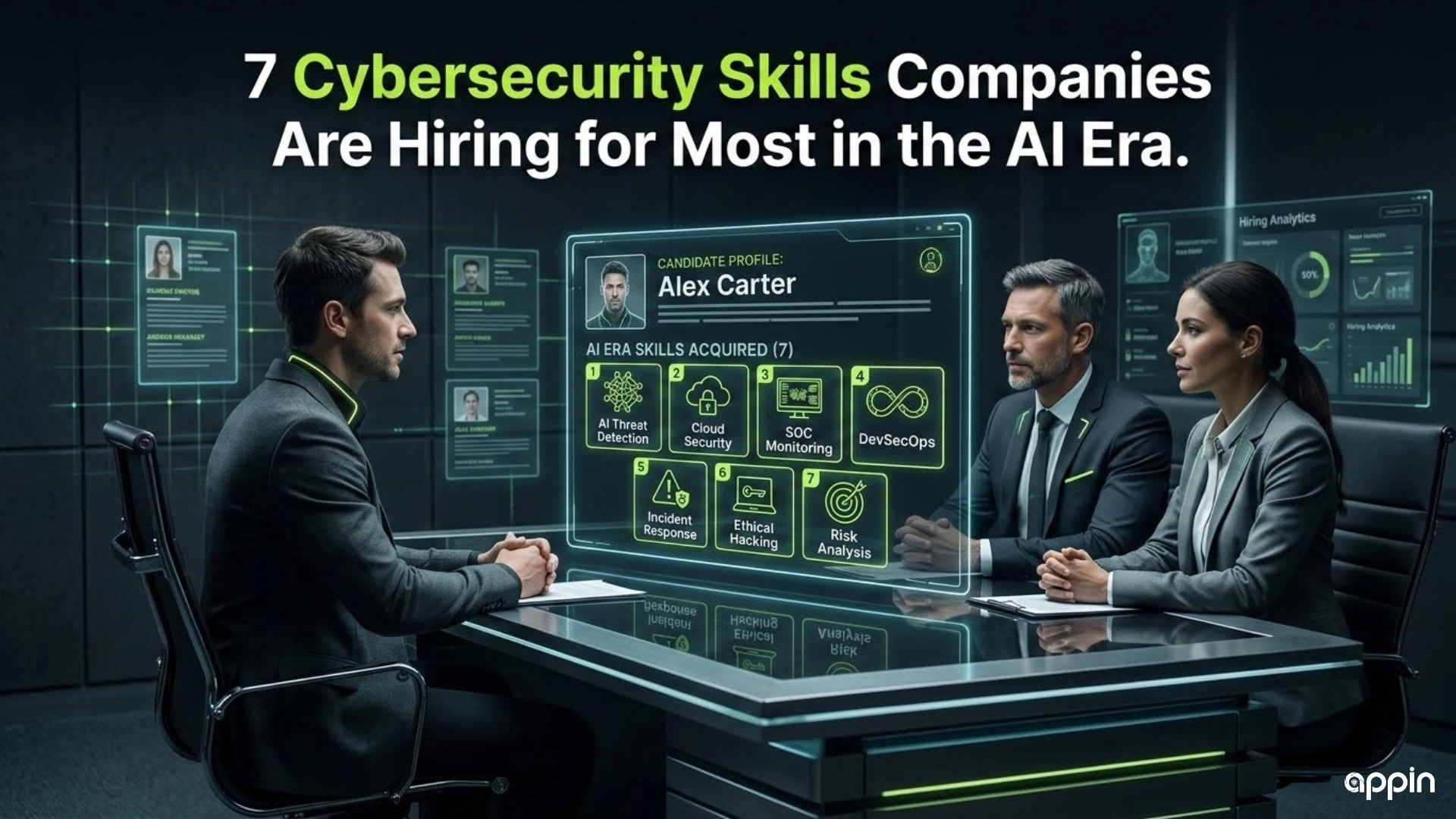
7 Cybersecurity Skills Companies Are Hiring for Most in the AI Era
What Cybersecurity Skills Are Companies Hiring for Most?
Cybersecurity skills are in higher demand than ever as organizations face record breaking cybercrime costs and a massive global talent shortage. Companies are actively hiring professionals who combine traditional security knowledge with AI era expertise to defend against increasingly sophisticated threats.
The global cybersecurity workforce gap reached 4.8 million professionals according to ISC2 research. Networks and cybersecurity rank as the second fastest growing skill category globally, just behind AI and big data (DestCert 2026). Two out of three organizations report moderate to critical skills shortages, and only 15% feel confident they have the talent needed today (C4 Tech Services 2026). These AI era cybersecurity jobs demand a blend of cloud expertise, automation knowledge, and security fundamentals that go far beyond basic IT skills.
Key points:
- Global workforce gap stands at 4.8 million unfilled cybersecurity roles (ISC2)
- Cybersecurity is the second fastest growing skill category worldwide
- 66% of organizations report moderate to critical cybersecurity skills shortages
- Cybercrime costs projected to reach $12.2 trillion annually by 2031 (Cybersecurity Ventures)

Cloud Security and Multi Cloud Protection
Businesses urgently need experts who can secure cloud environments and remote infrastructure. Cloud security has become the most sought after specialization as organizations move their entire operations to AWS, Azure, and Google Cloud platforms.
Cloud Security Architect ranks as the number one most in demand cloud role with 22% of all cloud hiring focused on this position (LinkedIn Cloud Hiring Trends 2025). Professionals with skills in AWS security, Azure governance, and multi cloud architecture command premium salaries. The Certified Cloud Security Professional certification holders earn an average of $148,000 per year (Cybersecurity Ventures 2026). Companies need people who understand cloud compliance frameworks, container security, and infrastructure configuration because misconfigured cloud environments remain one of the leading causes of data breaches.
Key points:
- Cloud Security Architect is the most in demand cloud role at 22% of all cloud hiring
- CCSP certification holders earn an average of $148,000 annually
- Multi cloud expertise across AWS, Azure, and GCP commands premium pay
- Cloud misconfiguration remains a leading cause of enterprise data breaches
AI and Machine Learning Security
Companies want professionals who understand both the defensive and offensive sides of AI in cybersecurity. Attackers now use AI to generate phishing emails, create deepfakes, and automate attacks, which means defenders must know how these AI era cybersecurity jobs work from both perspectives.
Entry level positions requiring AI skills nearly doubled from the previous year according to Georgetown University CSET research. Employers increasingly look for candidates who can protect AI models from manipulation, detect deepfakes and AI generated content, and evaluate AI security risks. The Bureau of Labor Statistics projects 29% growth for information security analysts through 2034, with AI related cybersecurity positions growing even faster. Understanding how attackers weaponize AI while building defenses against those same techniques has become one of the most valuable differentiators in the job market.
Key points:
- Entry level roles requiring AI skills nearly doubled year over year (Georgetown CSET)
- BLS projects 29% growth for information security analysts through 2034
- AI security roles include model protection, deepfake detection, and risk analysis
- Employers want people who understand both AI powered attacks and AI driven defense
Threat Detection and Security Operations
Organizations need analysts who can detect and respond to attacks quickly using modern security operations center tools. The top cybersecurity skills employers want in SOC roles have shifted from manual monitoring to AI assisted threat hunting and automated investigation.
SOC analysts use SIEM platforms to correlate alerts from dozens of security tools and identify genuine threats among thousands of daily notifications. Threat hunters proactively search networks for signs of compromise rather than waiting for automated alerts. Real time incident analysis requires understanding network traffic patterns, endpoint behavior, and cloud activity logs. Fortinet 2026 research found that organizations are leaning heavily on AI to fill security gaps, but skilled analysts remain essential for validating AI findings and handling complex attacks that automated systems cannot fully resolve.
Key points:
- SIEM monitoring and threat hunting rank among the top hired SOC skills
- AI assisted investigation reduces alert triage time but needs human validation
- 90% of cybersecurity teams report skills gaps beyond staffing shortages (ISACA)
- Hands on lab experience is valued more than traditional degrees by employers
Identity and Access Management
Protecting digital identities and controlling access to business systems has become a major hiring priority across every industry. The identity and access management market is projected to grow from $25.34 billion in 2026 to $77.92 billion by 2034, reflecting how critical this specialization has become.
The US IAM market alone will reach $11.09 billion by 2030 at 8.6% annual growth (MarketsandMarkets). Organizations need professionals skilled in multi factor authentication implementation, privileged access management, and zero trust security frameworks. Passwordless authentication using biometrics and security keys is becoming the new standard, with Optimal IdM reporting that organizations are rapidly adopting FIDO2 and WebAuthn protocols to eliminate phishing vulnerable passwords. Professionals who can design and implement identity centered security architectures are among the most recruited specialists in the field.
Key points:
- Global IAM market growing from $25.34B to $77.92B by 2034 (Fortune Business Insights)
- Passwordless authentication is rapidly becoming the enterprise standard
- Privileged access management and zero trust are top hiring priorities
- IAM roles span every industry including finance, healthcare, and government

Incident Response and Digital Forensics
Businesses need experts who can investigate and contain cyber attacks quickly to minimize damage. The cost of a data breach reached $4.88 million on average in 2025 (IBM), making fast and effective incident response one of the most financially valuable cybersecurity skills.
Incident response professionals handle malware investigation, breach containment, and evidence collection that may be used in legal proceedings. Digital forensics experts analyze compromised systems to determine how attackers entered, what data they accessed, and how to prevent similar intrusions. Organizations with mature incident response teams save an average of $2.66 million per breach compared to those without according to IBM research. These roles require strong analytical thinking, knowledge of forensic tools, and the ability to work under extreme pressure during active security incidents.
Key points:
- Average data breach cost reached $4.88 million (IBM Cost of a Data Breach Report)
- Mature incident response capabilities save organizations $2.66 million per breach
- Digital forensics skills include malware analysis, evidence collection, and breach investigation
- Incident response roles require both technical expertise and calm decision making under pressure
API and Application Security
Modern businesses require professionals who can secure APIs and applications against the most common attack vectors. Software systems in 2026 are more interconnected than ever, and APIs have become the primary target for attackers seeking to access sensitive data.
API related breaches have driven a 300% increase in SaaS security incidents according to Obsidian Security research. Application security professionals need skills in API vulnerability testing, secure coding practices, and web application firewall configuration. OWASP continues to highlight API security risks including broken authentication, excessive data exposure, and insufficient rate limiting as top threats. Companies building AI powered applications face additional risks because AI models often process sensitive data through API connections that traditional security tools may not monitor effectively.
Key points:
- API vulnerabilities drove a 300% increase in SaaS security breaches
- Secure coding and API testing are among the fastest growing skill requirements
- OWASP API Security Top 10 highlights broken authentication and data exposure as key risks
- AI powered applications create new API attack surfaces that need specialized monitoring
Security Automation and AI Driven Defense
Companies use automation to improve threat response speed and handle the massive volume of daily security alerts. Security automation has become essential because human teams simply cannot manually investigate the thousands of alerts generated every day.
SOAR (Security Orchestration Automation and Response) platforms allow teams to automate repetitive tasks like alert enrichment, ticket creation, and initial investigation steps. Over 350 SOAR related positions were listed on Indeed in early 2026, showing steady demand for automation skills. The field is evolving beyond traditional SOAR toward what Torq calls SecOps automation, which uses AI agents to handle more complex decision making. Professionals who can build automated security workflows, configure AI powered threat detection rules, and integrate multiple security tools into unified platforms are among the most valuable hires in the current market.
Key points:
- Over 350 SOAR automation positions listed on job boards in early 2026
- Security automation reduces mean time to respond from hours to minutes
- SecOps automation is replacing traditional SOAR with AI agent driven workflows
- Automation skills command premium salaries because they multiply team capacity
What Skills Do Freshers Need to Enter Cybersecurity?
Cybersecurity skills for freshers in India have become a clear pathway into one of the fastest growing technology careers. India’s cybersecurity job market could reach 280 billion rupees by 2025, growing at 18.33% annually (ElectroIQ 2026).
Freshers entering the field should focus on networking fundamentals, operating systems, ethical hacking basics, and at least one recognized certification. CompTIA Security+ remains the most recognized baseline certification and pairs well with hands-on IT experience (Reddit Cybersecurity Community 2026). A fresher with a CEH or CompTIA Security+ certification earns 15 to 25% more than an uncertified peer from day one (BeinCareer 2026). Entry level positions in India pay between 4 and 6 LPA with room for quick advancement. Home lab projects, documented troubleshooting experience, and GitHub repositories are valued more than traditional degrees by many employers.
Key points:
- India cybersecurity market growing at 18.33% annually toward 280 billion rupees
- CompTIA Security+ is the most recognized entry level certification globally
- Certified freshers earn 15 to 25% more than uncertified peers
- Hands on lab projects and practical experience matter more than formal degrees
Key Takeaways
- The global cybersecurity workforce gap stands at 4.8 million professionals (ISC2)
- Cloud security architects earn an average of $148,000 and represent the top hiring demand
- AI security skills are the fastest growing requirement with entry level demand nearly doubling
- IAM market growing to $77.92 billion by 2034 making identity protection a premium skill
- CompTIA Security+ remains the best starting point for freshers entering the field
