


Best Certifications for Your First SOC Analyst Job (L1/L2): A 2026 Roadmap
SOC analyst certifications are the most direct path to getting your first Security Operations Centre job in India, but most students do not know which ones to prioritize or in what order to earn them. This roadmap gives you a clear answer.
The SOC Analyst role is one of the fastest-growing entry-level cybersecurity positions in India right now. Companies across banking, IT services, and government sectors are actively hiring at the L1 and L2 levels. The problem is that hundreds of students apply for the same openings, and those with the right certifications and hands-on skills consistently move to the shortlist first.
This 2026 SOC analyst roadmap covers everything you need: what the job actually involves, which certifications employers look for, the right order to earn them, the technical skills you need beyond certifications, and a pre-application checklist to confirm you are genuinely ready before you send your first resume.
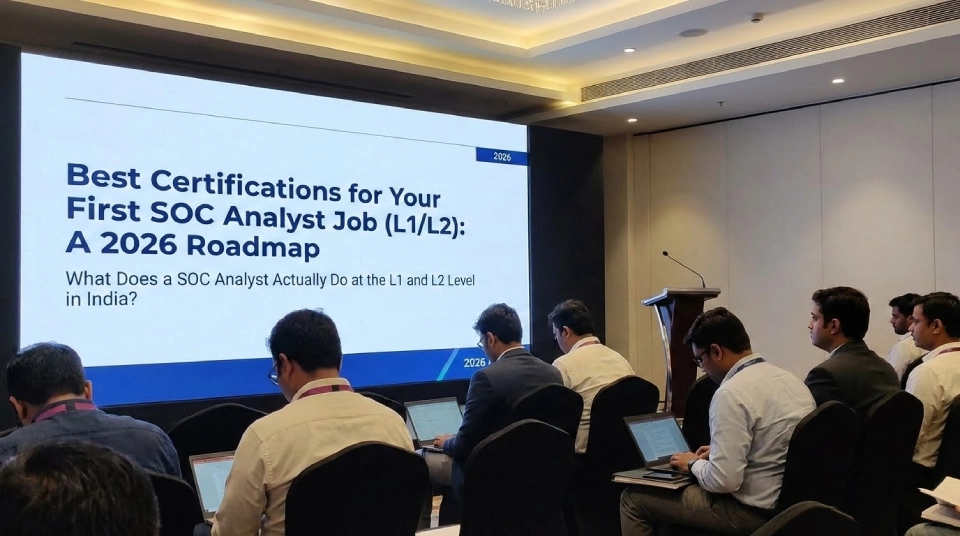
What Does a SOC Analyst Actually Do at the L1 and L2 Level in India?
A SOC Analyst monitors, detects, and responds to security threats inside an organisation’s network, with L1 and L2 roles having distinct responsibilities that require different skill levels.
L1 SOC Analyst (Entry Level):
- Monitors security alerts from SIEM platforms in real time
- Triages incoming alerts to separate genuine threats from false positives
- Escalates confirmed incidents to the L2 team with initial documentation
- Follows standard playbooks for common threat scenarios
- Logs and tracks incidents in ticketing systems
L2 SOC Analyst (Junior to Mid Level):
- Investigates escalated incidents with deeper log and traffic analysis
- Identifies attack patterns, threat actors, and the scope of a breach
- Performs containment actions and coordinates with response teams
- Produces detailed incident reports and post-incident analysis
- Mentors L1 analysts on complex alert scenarios
Understanding this distinction matters before you start planning your certifications. L1 roles are available to fresh graduates with foundational security knowledge. L2 roles require a combination of certifications, tools experience, and some months of hands-on exposure, either from an L1 role or structured lab training.
Cybersecurity jobs in India at the SOC level are growing across sectors like BFSI, IT services, and defence, making this one of the most stable entry points into a security career.
What Is the Average SOC Analyst Salary in India for L1 and L2 Roles in 2026?
The average SOC analyst salary in India for L1 roles ranges from ₹3.5 to ₹6 LPA, while L2 roles typically pay between ₹6 and ₹10 LPA depending on the company, city, and certifications held.
Salary Breakdown by Level and Location:
| Role | Tier 1 Cities (Mumbai, Bengaluru, Pune) | Tier 2 Cities (Indore, Bhopal, Nagpur) |
| L1 SOC Analyst | ₹4.5 to ₹6 LPA | ₹3.5 to ₹5 LPA |
| L2 SOC Analyst | ₹7 to ₹10 LPA | ₹6 to ₹8 LPA |
| L2 with CEH or CySA+ | ₹9 to ₹12 LPA | ₹7 to ₹9 LPA |
Certified professionals consistently earn 25 to 40% more than uncertified candidates at the same experience level. Entry level SOC analyst jobs in India also come with faster salary growth than general IT support roles, with many L1 analysts moving to L2 compensation within 18 to 24 months.
For students from Tier 2 cities, even the entry-level SOC salary range represents a significant step up from general IT or BPO starting packages. The certification investment pays back within the first year of employment in most cases.
Which Certifications Do Employers Actually Look for When Hiring SOC Analysts in India?
Employers hiring SOC analysts in India most commonly look for CompTIA Security+, EC-Council’s Certified SOC Analyst (CSA), and CompTIA CySA+ as their primary screening certifications for L1 and L2 roles.
Based on current Indian job postings across Naukri, LinkedIn, and company career pages, here is how the most relevant certifications compare:
SOC Analyst Certification Comparison Table:
| Certification | Level | Primary Skill Covered | Exam Cost (approx.) | Employer Demand in India |
| CompTIA Security+ | Beginner | Security fundamentals, threat analysis | ₹25,000 to ₹30,000 | Very High |
| EC-Council CSA (Certified SOC Analyst) | Beginner to Intermediate | SOC operations, SIEM, log analysis | ₹20,000 to ₹25,000 | High |
| CompTIA CySA+ | Intermediate | Threat detection, incident response | ₹28,000 to ₹35,000 | High |
| CEH (Certified Ethical Hacker) | Intermediate | Ethical hacking, attack techniques | ₹35,000 to ₹45,000 | Medium to High |
| CompTIA Network+ | Beginner | Networking fundamentals | ₹20,000 to ₹25,000 | Medium (prerequisite value) |
CompTIA Security+ is the single most requested certification in L1 SOC job postings in India. It signals that you understand core security concepts, threat categories, and basic incident response workflows, all of which L1 analysts use daily.
The EC-Council CSA is the most role-specific option. It is designed specifically for SOC operations and covers SIEM platforms, log analysis, and incident response in a structured format. For students who want a certification built directly around the SOC Analyst job description, CSA is the most focused starting point among all SOC analyst certifications.
What Is the Right Order to Earn SOC Analyst Certifications as a Fresh Graduate in India?
The correct certification order for fresh graduates is: networking fundamentals first, then security fundamentals, then SOC-specific certifications, then advanced options for L2 progression.
Skipping the foundational steps and jumping straight to CEH or CySA+ is one of the most common and costly mistakes students make. Without understanding how networks operate and how basic threats work, advanced certification content becomes difficult to retain and even harder to apply in a real SOC environment.
4-Stage SOC Analyst Certification Roadmap:
| Stage | Certification | Timeline | Purpose |
| Stage 1: Foundation | CompTIA Network+ or equivalent networking course | Month 1 to 2 | Understand TCP/IP, routing, protocols, network architecture |
| Stage 2: Security Fundamentals | CompTIA Security+ | Month 2 to 4 | Core threat knowledge, cryptography, access control, incident basics |
| Stage 3: SOC Specific | EC-Council CSA or CompTIA CySA+ | Month 4 to 7 | SIEM operations, log analysis, alert triage, SOC workflows |
| Stage 4: L2 Progression | CEH or CompTIA CASP+ | Month 8 to 12 | Attack techniques for better defence, senior analyst readiness |
The network security fundamentals stage is often skipped by students who come from non-IT backgrounds. This is a mistake. L1 SOC analysts read network logs, analyse traffic, and identify anomalies every day. Without a baseline understanding of how networks work, even basic alert triage becomes guesswork.
This SOC analyst roadmap for 2026 is designed to take you from zero to job-ready in under a year, provided you combine certification study with consistent hands-on lab practice at each stage.
Is CEH Certification Useful for Getting a SOC Analyst Job or Is It Only for Pentesters?
CEH certification is genuinely useful for SOC analyst roles, particularly at the L2 level, because understanding how attacks are executed makes you significantly faster and more accurate when detecting and responding to them.
The common misconception is that CEH is only for penetration testers. In practice, L2 SOC analysts who understand attacker techniques like enumeration, privilege escalation, and lateral movement can identify these patterns in logs much faster than analysts who only know the defensive side.
How CEH adds value in SOC roles:
- Helps analysts recognise attack sequences in SIEM alerts, not just isolated indicators
- Improves threat hunting accuracy because you understand what attackers are trying to achieve at each stage
- Strengthens incident reports with precise attack classification
- Opens the career path from L2 SOC Analyst to penetration tester or red team roles
- Signals to employers that you understand both attack and defence perspectives
CEH certification for SOC analyst roles is particularly relevant if your goal is to move beyond L1 monitoring into L2 investigation and eventually into offensive security or threat intelligence. It is not a requirement to land your first L1 job, but it becomes a strong differentiator at the L2 stage and beyond.
What Technical Skills Do SOC Analysts Need Beyond Certifications to Get Hired in 2026?
Certifications prove your knowledge, but employers also screen for hands-on technical skills during interviews, and candidates who can demonstrate practical experience consistently get hired over those who only hold paper certifications.
The most in-demand practical skills for SOC analyst roles in India right now are SIEM tool experience, log analysis, basic scripting, and familiarity with threat frameworks.
Certification Skills vs. Hands-On Skills Employers Look For:
| Certification-Based Knowledge | Hands-On Practical Skills |
| Threat categories and attack types | Splunk or IBM QRadar log queries |
| Cryptography and access control | Wireshark packet analysis |
| Incident response theory | Python scripting for log automation |
| Network security concepts | MITRE ATT&CK framework mapping |
| Vulnerability assessment principles | Alert triage in a live SIEM environment |
| Compliance and governance basics | Incident ticketing (ServiceNow, JIRA) |
SIEM tools for SOC analysts are the most critical practical skill to develop. Splunk is the most commonly used platform across Indian IT companies and MNCs. Even basic proficiency, such as writing search queries and building simple dashboards, makes you significantly more employable than a candidate who has only studied theory.
Start building these skills in parallel with your certifications, not after you finish them. Free Splunk training is available on Splunk’s official website and takes around 6 to 8 hours to complete the foundational course.

How Long Does It Take a Fresh Graduate to Get a SOC Analyst Job After Starting Certification Training in India?
Most fresh graduates in India can complete foundational SOC analyst certifications and land their first L1 role within 6 to 9 months, provided they combine certification study with consistent hands-on lab practice.
Students who only study for the exam without building practical skills typically take 3 to 5 months longer to get hired, because they struggle at the technical interview stage even after clearing certifications.
Month-by-Month Timeline from Training to First Job:
| Month | Activity | Milestone |
| Month 1 to 2 | CompTIA Network+ or networking fundamentals | Understand networks well enough to read logs |
| Month 2 to 4 | CompTIA Security+ study and exam | First recognised certification cleared |
| Month 4 to 6 | EC-Council CSA or CySA+ + SIEM lab practice | SOC-specific cert + Splunk basics complete |
| Month 6 to 7 | Resume building, mock interviews, job applications | Active job search begins |
| Month 7 to 9 | Interview rounds and offer | First L1 SOC role secured |
Information security jobs for freshers at the L1 level are available across BFSI, IT services, and managed security service providers (MSSPs) in India. MSSPs in particular hire in batches and are open to fresh graduates who hold Security+ or CSA certifications with demonstrated lab experience.
Should Fresh Graduates Join a Cybersecurity Training Institute to Prepare for SOC Analyst Roles?
For students without a prior networking or IT security background, joining a structured training institute delivers faster and more consistent results than self-study alone.
The practical reason is simple. Self-study works well if you already have a BTech in Computer Science or prior experience with Linux, networking, or scripting. For students from BCA, BSc, BCom, or non-tech backgrounds, structured training removes three major barriers that slow down self-learners:
- Lab access: Pre-configured environments where you can practice SIEM tools, log analysis, and incident response without spending time on setup
- Curriculum structure: A guided path that covers networking fundamentals before jumping into certifications, so you build knowledge in the right order
- Exam eligibility: EC-Council accredited training waives the 2-year experience requirement for CEH and CSA exams, which is critical for fresh graduates who cannot wait
The decision comes down to your background and how quickly you want to be job-ready. Students with no prior security exposure who join structured training consistently reach the job application stage 2 to 3 months faster than those who self-study.
If you are looking for structured, lab-based training to prepare for your first SOC analyst role, explore Appin’s cybersecurity certification programs to check course options, batch schedules, and placement support available in Indore.
What Does a Complete SOC Analyst Certification Checklist Look Like Before Your First Job Application?
You are ready to apply for your first SOC analyst job when you can confirm readiness across three areas: certifications, practical skills, and resume preparation.
Use this checklist before submitting your first application.
Certification Readiness:
- Completed CompTIA Security+ or EC-Council CSA (minimum one recognised certification)
- Understand the exam domains and can explain core concepts without referring to notes
- Familiar with at least one advanced SOC analyst certification to mention as in progress
Practical Skills Readiness:
- Completed hands-on practice with a SIEM tool (Splunk or IBM QRadar)
- Can perform basic log analysis and identify anomalous traffic patterns
- Understand incident response workflows and MITRE ATT&CK framework mapping
- Practiced alert triage scenarios in a lab environment
Resume and Interview Readiness:
- Resume lists certifications, tools used, and lab projects, not just educational qualifications
- Can explain a simulated incident response scenario during a technical interview
- Researched the specific SIEM and tools used by your target employers
- Applied to MSSP companies, which are the most active fresh graduate hirers for SOC roles
This checklist reflects what L1 SOC hiring managers in India actually look for at the screening stage. Ticking every box before you apply significantly improves your shortlisting rate compared to applying immediately after clearing a certification exam.
Conclusion
Getting your first SOC analyst job in India in 2026 comes down to a clear sequence: build networking fundamentals, earn a recognised certification like Security+ or CSA, develop hands-on SIEM skills, and apply with a resume that shows practical experience alongside your credentials.
The roadmap works. Most dedicated students reach their first L1 offer within 6 to 9 months when they follow it consistently.
If you want lab access, structured curriculum, and placement support to accelerate your preparation, enquire with Appin Indore to check the next available batch and start building the skills that SOC employers are actively hiring for.
