


Certifications and Career Path Advice for Someone Starting in Cybersecurity
If you are trying to figure out your cybersecurity career path but do not know where to begin, you are not alone. Most students searching for a way into cybersecurity face the same problem: too much information, no clear starting point, and no one telling them which certifications actually matter for getting hired in India.
This guide cuts through the confusion. You will find a clear breakdown of the best entry-level cybersecurity roles in India, which certifications to prioritize based on your background, how much you can earn, and a realistic timeline from starting your training to landing your first job.
Whether you are from a BTech, BCA, BSc, BCom, or a completely non-tech background, the advice here is structured for you. By the end of this guide, you will know exactly what to do next, in what order, and why.
Is Cybersecurity a Good Career Option for Students and Fresh Graduates in India in 2026?
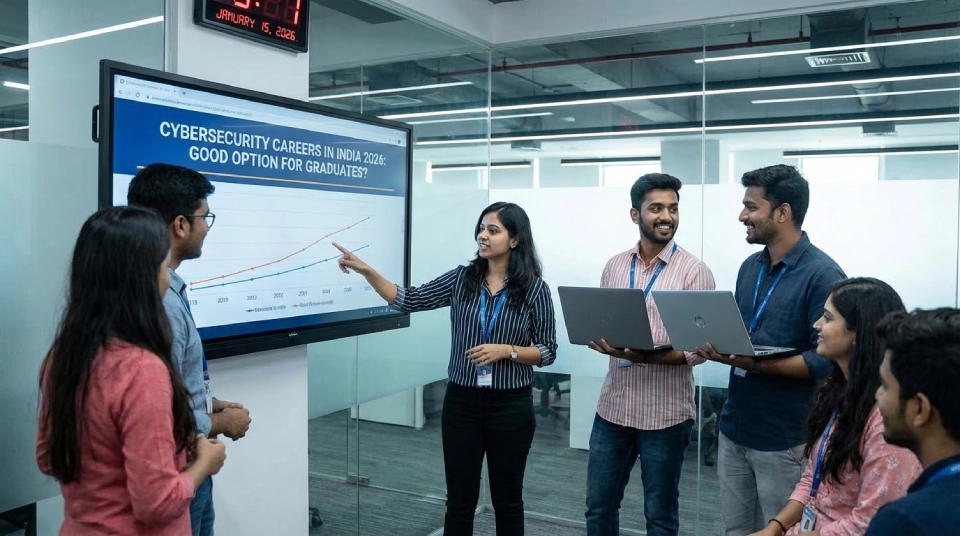
Yes, cybersecurity is one of the best career options for students and fresh graduates in India right now, backed by a shortage of over 1 million security professionals and actively growing demand across every major industry.
India is one of the most targeted countries for cyberattacks globally. This has forced companies across banking, IT services, e-commerce, and government to increase security hiring significantly. According to industry reports, cybersecurity jobs in India 2026 projections show continued growth well above the pace of general IT hiring.
For fresh graduates, this translates into three practical advantages:
- Faster entry: Entry-level roles like SOC Analyst and Vulnerability Assessment Engineer are available to graduates with the right certifications, even without years of experience.
- Better salary growth: Cybersecurity roles grow faster in compensation than general IT support or development roles at the same experience level.
- Specialisation advantage: Cybersecurity is a focused field. Students who skill up early build a career identity that generalises IT graduates simply cannot compete with.
Understanding how to start a cybersecurity career in India means recognising that certifications, not just degrees, are what employers use to filter candidates at the shortlisting stage.
What Are the Most In-Demand Cybersecurity Job Roles for Freshers in India Right Now?
The five most commonly available entry-level cybersecurity jobs in India right now are SOC Analyst, Penetration Tester, Vulnerability Assessment Engineer, Information Security Analyst, and Network Security Engineer.
Each role has a different daily focus and requires a slightly different certification emphasis. Students who identify their target role early can build a much more focused and efficient study plan instead of collecting every certification they come across.
Entry-Level Cybersecurity Roles in India:
| Job Role | Primary Focus | Relevant Certifications | Starting Salary Range |
| SOC Analyst (L1) | Alert monitoring, incident triage | CompTIA Security+, EC-Council CSA | ₹3.5 to ₹6 LPA |
| Penetration Tester | Ethical hacking, vulnerability testing | CEH, CompTIA PenTest+ | ₹4 to ₹7 LPA |
| Vulnerability Assessment Engineer | Scanning, reporting, risk analysis | CompTIA Security+, CEH | ₹4 to ₹6.5 LPA |
| Information Security Analyst | Policy, compliance, risk management | CompTIA Security+, CISM (later) | ₹3.5 to ₹6 LPA |
| Network Security Engineer | Firewall, network protection, IDS/IPS | CompTIA Network+, Security+ | ₹4 to ₹7 LPA |
Information security jobs for freshers are most accessible at the SOC Analyst and Vulnerability Assessment levels because these roles accept candidates with certifications and lab experience in place of prior work history.
Knowing which role aligns with your interests is the most important first decision in building an ethical hacking career in India or any other cybersecurity specialisation.
What Is the Difference Between a Cybersecurity Degree and a Cybersecurity Certification in India?
A cybersecurity degree gives you theoretical knowledge over 3 to 4 years, while a certification gives you role-specific, practical skills in 2 to 6 months and is what most Indian employers actually screen for when shortlisting candidates.
This is the cybersecurity degree vs certification India debate that confuses most students. The practical reality is straightforward.
Degrees:
- Cover broad computer science or IT fundamentals
- Take 3 to 4 years to complete
- Do not directly prepare you for specific cybersecurity tools or workflows
- Are still valued as a baseline qualification by most employers
Certifications:
- Target specific skills and job roles directly
- Take 2 to 6 months to prepare and clear
- Are what hiring managers look for when filtering applications
- Signal hands-on readiness, not just academic exposure
The students who get hired fastest are not always those with the best degrees. They are the ones who combine a degree with at least one or two recognised certifications and can demonstrate practical tool experience during a technical interview.
A degree opens the door. A certification, combined with lab practice, is what gets you through it.
Which Cybersecurity Certifications Should Beginners in India Get First in 2026?
The best first certifications for beginners in India are CompTIA Security+, EC-Council’s CEH (Certified Ethical Hacker), and EC-Council’s CSA (Certified SOC Analyst), chosen based on which job role you are targeting.
There is no single “best” certification for everyone. The right choice depends on whether you want to go into ethical hacking and penetration testing, security operations, or a broader security analyst role. Here is how the most relevant options compare:
Beginner Cybersecurity Certifications Comparison:
| Certification | Level | Best Suited For | Preparation Time | Employer Demand in India |
| CompTIA Security+ | Beginner | All entry-level security roles | 2 to 3 months | Very High |
| EC-Council CSA | Beginner to Intermediate | SOC Analyst roles | 2 to 3 months | High |
| CEH (Certified Ethical Hacker) | Intermediate | Penetration testing, ethical hacking | 3 to 4 months | High |
| CompTIA Network+ | Beginner (foundational) | Network Security Engineer, pre-cert | 1 to 2 months | Medium |
| CompTIA CySA+ | Intermediate | Threat analysis, SOC L2 | 3 to 4 months | Medium to High |
CompTIA Security+ is the safest starting point for most beginners because it is recognised across all cybersecurity job roles and does not require prior experience to attempt. It signals foundational competency to any hiring manager regardless of which role you eventually target.
If your goal is ethical hacking or penetration testing specifically, pair Security+ with certified ethical hacking training as your second step. CEH certification India employers request it regularly for both offensive security and SOC L2 roles.
Avoid jumping to advanced certifications like OSCP or CISSP at this stage. These are designed for professionals with 2 to 3 years of experience and will not be relevant to entry-level hiring decisions.
What Is the Right Cybersecurity Certification Roadmap for Students From Non-Tech Backgrounds in India? words)
Students from non-tech backgrounds need one extra foundational stage before starting certification exams, but the full journey to a first cybersecurity job is still achievable within 9 to 12 months.
The most common mistake non-tech students make is skipping network security fundamentals and jumping straight into Security+ or CEH. Without understanding how networks operate, concepts like packet sniffing, firewall rules, and intrusion detection become very difficult to apply even if you memorise them for the exam.
Certification Roadmap: Tech Background vs. Non-Tech Background:
| Stage | Tech Background (BTech, BSc CS, BCA) | Non-Tech Background (BCom, BA, BCA General) |
| Stage 1 | Skip or quick review of networking basics | CompTIA IT Fundamentals or Network+ (1 to 2 months) |
| Stage 2 | CompTIA Security+ (2 to 3 months) | CompTIA Security+ (2 to 3 months) |
| Stage 3 | CEH or CSA based on target role (3 to 4 months) | CEH or CSA based on target role (3 to 4 months) |
| Stage 4 | Role-specific advanced cert or first job application | Role-specific advanced cert or first job application |
| Total Timeline | 5 to 7 months to first application | 8 to 12 months to first application |
The best cybersecurity certifications for beginners from non-tech backgrounds are not different from those for tech students. The difference is the preparation order and the time needed at each stage.
Non-tech students also benefit significantly from structured training because foundational networking concepts are easier to absorb with guided instruction and lab exercises than through self-study alone.
How Much Do Entry-Level Cybersecurity Professionals Earn in India After Getting Certified?
Entry-level cybersecurity professionals in India earn between ₹3.5 and ₹8 LPA depending on the role, certifications held, and city, with certified candidates consistently earning 30 to 40% more than uncertified peers in the same position.
The cybersecurity salary in India varies most significantly between Tier 1 and Tier 2 cities, but remote work and MNC hiring have started to narrow that gap for certified professionals.
Entry-Level Cybersecurity Salary in India by Role and Location:
| Role | Tier 1 Cities (Mumbai, Bengaluru, Pune) | Tier 2 Cities (Indore, Bhopal, Nagpur) |
| SOC Analyst L1 | ₹4.5 to ₹6 LPA | ₹3.5 to ₹5 LPA |
| Penetration Tester (Junior) | ₹5 to ₹7 LPA | ₹4 to ₹6 LPA |
| Vulnerability Assessment Engineer | ₹4.5 to ₹6.5 LPA | ₹3.5 to ₹5.5 LPA |
| Information Security Analyst | ₹4 to ₹6 LPA | ₹3.5 to ₹5 LPA |
| Network Security Engineer | ₹4.5 to ₹7 LPA | ₹4 to ₹6 LPA |
A penetration testing career in India at the senior level crosses ₹15 LPA, and the path from entry-level to senior typically takes 3 to 5 years with consistent upskilling. Starting with the right certifications and role puts you on the faster end of that progression.

Section 7: What Practical Skills Do Cybersecurity Employers in India Look for Beyond Certifications? (200 words)
Indian cybersecurity employers look for hands-on tool experience, scripting basics, and familiarity with threat frameworks alongside certifications, and candidates who can demonstrate these skills in interviews get shortlisted significantly more often.
Certifications prove you understand the theory. Practical skills prove you can apply it. Here is what employers specifically ask about during technical screening:
Certification Knowledge vs. Practical Skills Employers Want:
| Certification-Based Knowledge | Hands-On Skills Employers Screen For |
| Threat categories and attack lifecycle | Splunk or IBM QRadar log queries |
| Cryptography and access control concepts | Wireshark packet capture and analysis |
| Incident response theory | Python scripting for basic automation |
| Network security protocols | MITRE ATT&CK framework mapping |
| Vulnerability assessment principles | Nmap and Metasploit usage in lab environments |
SIEM tools like Splunk are the most commonly tested practical skill in SOC-related interviews. Free foundational Splunk training is available on Splunk’s official website and takes 6 to 8 hours to complete. Pairing this with your Security+ or CSA preparation adds significant weight to your resume.
Cybersecurity skills for freshers that stand out most to Indian employers are those that show you have worked in a lab environment, not just studied for an exam.
How Long Does It Take to Get a Cybersecurity Job in India After Starting Certification Training as a Fresher?
Most fresh graduates in India can complete foundational certifications and land their first cybersecurity job within 6 to 10 months, provided they combine certification study with consistent hands-on lab practice.
Students who only study for the exam without building practical skills typically spend an extra 3 to 5 months in the job search phase because they struggle at the technical interview stage even after clearing their certifications.
Month-by-Month Timeline from Training to First Job:
| Month | Activity | Milestone |
| Month 1 to 2 | Networking fundamentals (non-tech) or straight to Security+ (tech background) | Foundation complete |
| Month 2 to 4 | CompTIA Security+ study and exam | First recognised certification cleared |
| Month 4 to 6 | Role-specific cert (CSA or CEH) + lab practice with SIEM or pentesting tools | SOC or pentest ready |
| Month 6 to 7 | Resume building, LinkedIn profile, mock technical interviews | Active job search begins |
| Month 7 to 10 | Applications, interview rounds, and offer | First cybersecurity role secured |
This cybersecurity career path timeline is realistic for dedicated students who study consistently. The range between 6 and 10 months depends primarily on how much hands-on lab practice is built into the preparation, not just how fast the certifications are cleared.
Information security jobs for freshers are most accessible at companies that operate 24/7 security operations, such as MSSPs and large BFSI firms, which hire in regular batches throughout the year.
Should You Join a Cybersecurity Training Institute or Self-Study to Start Your Career in India?
For students with existing IT or networking knowledge, self-study is a viable option. For students from non-tech or semi-tech backgrounds, joining a structured training institute delivers faster and more consistent results.
The decision comes down to three practical factors: your existing knowledge base, your access to lab environments, and your exam eligibility requirements.
Self-study works well when:
- You have a BTech or BSc CS background with networking exposure
- You can set up your own virtual lab with Kali Linux and practice environments
- You are comfortable with unstructured timelines and self-accountability
Structured institute training works better when:
- You are from a BCom, BA, or non-tech background with limited IT exposure
- You need pre-configured lab access to practice tools without the setup barrier
- You want EC-Council accredited training that waives the 2-year experience requirement for CEH and CSA exams
- You want placement support and career guidance alongside your certification preparation
A cybersecurity course for beginners that is EC-Council accredited also makes you eligible to sit for CEH and CSA exams without prior work experience, which is a critical advantage for fresh graduates. If you want to explore structured training options with lab access and placement support, Appin’s cybersecurity certification programs cover everything from foundational security to advanced ethical hacking with dedicated career assistance.
What Does a Cybersecurity Career Checklist Look Like Before You Apply for Your First Job in India?
You are ready to apply for your first cybersecurity job when you can confirm readiness across three areas: certifications earned, practical skills demonstrated, and resume quality.
Use this checklist before submitting your first application.
Certification Readiness:
- Cleared at least one recognised certification (CompTIA Security+, EC-Council CSA, or CEH)
- Can explain all core exam domains without referring to notes
- Have a second certification in progress or planned to show continued commitment
Practical Skills Readiness:
- Practiced at least one SIEM tool (Splunk or IBM QRadar) in a lab environment
- Completed basic penetration testing or log analysis exercises using real tools
- Familiar with MITRE ATT&CK framework and can map common attack patterns
- Can walk through a simulated incident response scenario step by step
Resume and Interview Readiness:
- Resume lists certifications, tools used, and lab projects, not just college qualifications
- LinkedIn profile is complete and mentions cybersecurity skills for freshers clearly
- Applied to MSSPs and BFSI companies, the most active hirers for entry-level roles
- Researched the tools and SIEM platforms used by target employers
This checklist reflects what cybersecurity career path decisions ultimately come down to at the application stage. Ticking every box before you apply is far more effective than sending applications the moment you clear your first certification.
Conclusion
Starting a cybersecurity career in India comes down to a clear sequence: understand the role you want, earn the right foundational certifications in order, build practical tool experience alongside your study, and apply with a resume that shows both.
The timeline is achievable. Most dedicated students go from zero to first job offer within 6 to 10 months when they follow a structured plan rather than studying randomly.
If you want lab access, structured curriculum, EC-Council accreditation, and placement support to accelerate your preparation, enquire with Appin Indore to check the next available batch and start your journey on the right foundation.
