

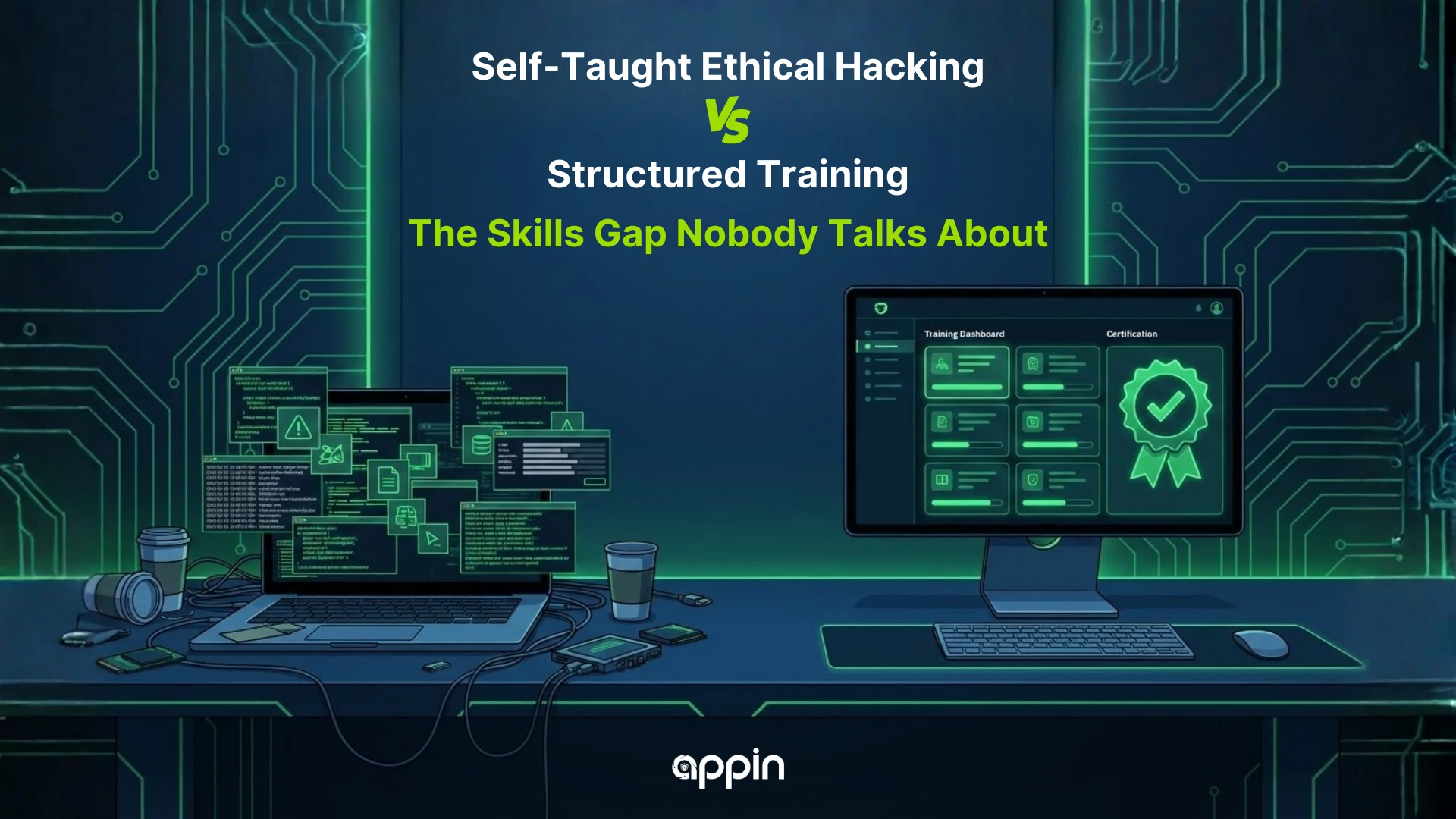
This article compares self taught vs structured ethical hacking paths in India, explains the measurable skills gap, and shows practical steps you can take to close that gap.
What is the real difference between self taught ethical hacking and structured training in India?
The core difference is verification and process; structured training builds and assesses repeatable, employer grade evidence while self study often leaves you with unverified knowledge.
When you compare self taught vs structured ethical hacking, the structured route enforces standard workflows, assessed lab hours, and report templates that hiring teams can verify quickly. Self taught learners often master tools but lack formal assessment, documented lab logs, and consistent reporting formats.
- Self study: tool knowledge, variable practice, limited external validation.
- Structured training: scoped engagements, timed practicals, mentor feedback, and placement support.
- Employer view: recruiters look for reproducible artifacts more than raw tool familiarity.
Which specific technical skills do self taught learners often miss for ethical hacking roles?
Self taught learners often know tools, but they miss disciplined workflows such as consistent recon, exploit validation, persistence checks, and evidence capture.
Common technical gaps include end to end exploitation workflows, timed practical experience, accurate exploit verification, PoC scripting, and realistic environment setup. These are not just tool commands, they are sequences and verification steps employers expect.
- End to end workflows: recon to persistence to cleanup.
- Exploit validation and rollback procedures.
- Timed practicals and repeatable PoC scripts.
- VM management and network topology handling comparable to corporate labs.
Structured programs address these gaps through repeated labs and mentor reviews; for an example of a lab mapped course, see Appin’s certified ethical hacking training.

Which process and professional skills does structured training teach that self learning rarely covers?
Structured training teaches pragmatic professional skills such as scoped testing, legal and ethical compliance, client communication, and formal reporting standards.
Self learners often focus on technical depth while skipping the professional scaffolding that employers value. Key process skills include scope definition, consent handling, risk matrices, and stakeholder facing reports.
- Scope and consent procedures before any testing.
- Engagement planning and risk communication.
- Executive summaries and technical appendices for reports.
- Mock client debriefs and documentation templates.
These process skills are trained through templates, role plays, and supervised debriefs inside structured cybersecurity certification programs.
How does practical lab volume and quality create a measurable skills gap?
The number and quality of supervised, assessed lab hours directly predict whether you can perform under timed, high pressure practical tests used by employers.
Typical market guidance suggests a range of 80–120 assessed lab hours as a practical minimum to reach interview readiness for entry security roles. Labs should include diverse OS images, web apps, and network stacks with reset policies that allow repetition.
| Level | Typical lab hours | Expected outcomes |
|---|---|---|
| Foundation | 20–40 hours | Tool familiarity, basic recon and scanning |
| Working | 40–80 hours | Exploit chaining, PoC scripting, report snippets |
| Job ready | 80–120+ hours | Timed practicals, one page summaries, mock debriefs |
- Lab quality checklist: variety of targets, timed practicals, reset snapshots, and mentor scoring.
- Supervised repetition with feedback converts isolated knowledge into reliable skill.
Example lab heavy tracks are part of CEH style programs; review a lab focused option.
How do employers verify skill: what evidence matters more than certificates?
Employers prefer reproducible artifacts such as one page pentest summaries, PoC code, timed practical scores, and lab logs over standalone certificates.
Certificates help, but recruiters ask for short verifiable work items that show you can do the job. The most effective artifacts are concise and reproducible.
- One page pentest summary with scope, impact, and remediation.
- Lab logs with timestamps and exact commands used.
- Proof of concept scripts or recorded demo videos.
- CTF rankings or timed practical scores with mentor sign off.
Prepare a technical one page for interviews and a demo you can reproduce in five minutes to prove your work.
Can self taught hackers bridge the gap without formal training?
Yes, self taught hackers can bridge the skills gap, but only by intentionally adding assessed labs, documented reports, mentor feedback, and mock practicals to their study plan.
A practical bridging checklist includes managed lab hours, published one page reports, external validation, and participation in ranked challenges. Plan for concentrated work to produce verifiable artifacts.
- Add 80–120 assessed lab hours on a managed platform.
- Produce three one page pentest summaries and one capstone timed practical.
- Join mentor reviews or peer review groups for external validation.
- Participate in CTFs and publish detailed write ups.
- Record a demo and create a PoC repository for interviews.
Target a 6–12 week bridging block if you already know tools. For niche proof points, targeted diplomas can help; see an example at.
What hiring outcomes differ: time to interview, offer rates, and salary impact?
Structured training candidates typically receive faster interview callbacks and higher conversion rates because they offer verifiable evidence and often enter via placement pipelines.
Illustrative market ranges show structured candidates getting interview invitations in 30–90 days after course completion while self taught candidates often take 60–180 days to surface in employer pipelines. Conversion rates and salary impact depend on role and city, but verifiable practical skill typically improves offer rates.
- Time to interview: structured 30–90 days, self taught 60–180 days typical ranges.
- Interview to offer conversion improves when you present reproducible artifacts.
- Entry salary is role and city dependent, but evidence can tilt offers higher within the market range.
How should a student choose between self study and structured training for ethical hacking?
Choose structured training if you need faster, verified placement outcomes; choose self study if you have the time, discipline, and a plan to build assessed evidence independently.
Use this decision checklist to pick the right path based on urgency, budget, discipline, and proof needs.
- Urgency: need a job within 3 months? Prefer structured training.
- Budget: can you invest in a short assessed block or hybrid bootcamp? If yes, structured training speeds results.
- Discipline: can you schedule 80–120 lab hours and get external feedback? If yes, self study plus bridging may work.
- Proof: if you lack portfolio artifacts, choose structured training or a short bridging programme.
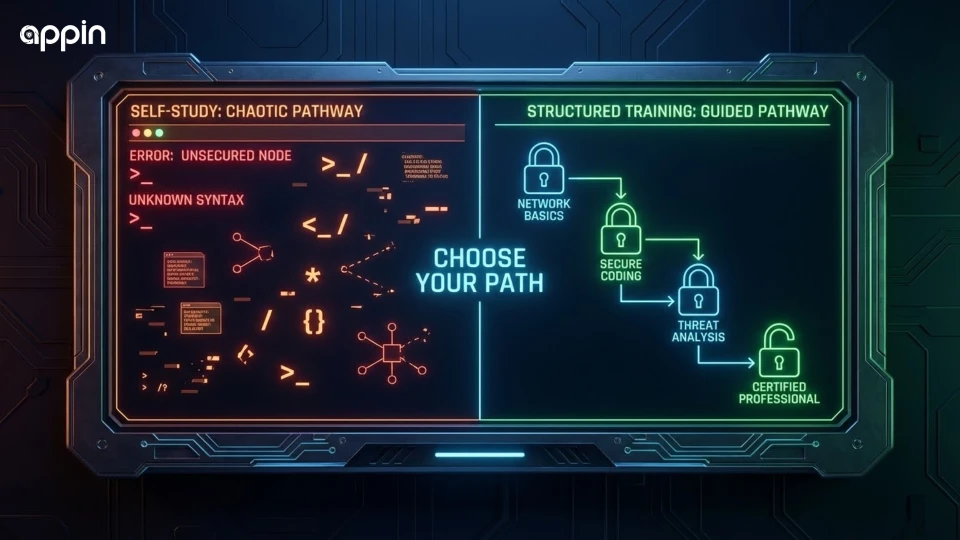
What a hybrid plan looks like: blending self learning with short, assessed training to close the gap fast
A short, assessed training block focused on labs, reporting, and mock practicals converts self study knowledge into employer grade evidence in 4–8 weeks.
Example 6 week hybrid plan with deliverables and milestones helps you focus remaining effort where it matters most.
- Week 1: Orientation, environment setup, foundational labs, and lab logging format.
- Weeks 2–3: Targeted working labs and two lab logs with PoC scripts.
- Week 4: Timed practical simulation and mentor review, revise PoC and logs.
- Week 5: Produce three one page pentest summaries and record a five minute demo.
- Week 6: Mock practicals, placement prep, and refined documentation for interviews.
Deliverables should include at least 80 lab hours, three one page reports, one timed practical score, and a demo recording for interviews.
Case studies: real examples of self taught learners who failed, and those who closed the gap with structured training
Concrete examples show that adding assessed labs and reporting converts knowledge into quick placement wins.
Case study A — Missed evidence: A self taught student mastered many tools but had no lab logs or reports. Recruiters praised enthusiasm but rejected the candidate for lack of repeatable evidence. Time to hire: five months. Lesson: document with timestamps and PoC code.
Case study B — Hybrid success: A learner with strong self study background completed a six week assessed block, finished a timed practical and three one page reports, and received three interview calls. They accepted an SOC analyst role in 45 days. Outcome: faster interview cadence and higher conversion.
Case study C — Niche validation: A candidate used a focused bug bounty diploma to produce verified disclosures and PoC write ups, leading to a security internship within eight weeks. The common factor was measurable artifacts that recruiters could verify quickly.
How Appin’s structured training fills the skills and verification gap for Indian students
Structured programmes provide assessed labs, report coaching, timed practicals, and placement support that directly match employer verification needs.
Appin focuses on producing hireable artifacts: supervised lab hours, mentor reviews, one page pentest summaries, mock practicals, and guided placement outreach. The goal is to transform tool knowledge into repeatable, documented skill that a recruiter can verify in minutes.
If you are self taught and want to accelerate placement, consider a short assessed block or a hybrid route that validates your work and produces employer friendly artifacts. Your priority should be producing verifiable evidence, not just accumulating tool knowledge.
