

What Certifications Should I Get to Start a Career in Cybersecurity (Pen-Testing & Vulnerability Assessment)?
If you want to know which penetration testing certifications India employers actually hire for, the short answer is: CEH first, then build from there based on your target role. But the longer answer matters more, because most students waste months studying for the wrong certifications in the wrong order.
Penetration testing and vulnerability assessment are two of the highest-paying entry-level cybersecurity roles available to fresh graduates in India right now. They are also two roles that many students confuse with each other, which leads to picking certifications that do not match the job they actually want to do.
This guide separates both roles clearly, maps the certifications employers request for each, explains the tools you need to practice, and gives you a realistic timeline from starting your training to landing your first job. Whether you come from a BTech, BCA, BSc, or non-tech background, the roadmap here is built for you.
What Is the Difference Between Penetration Testing and Vulnerability Assessment as Career Paths in India?
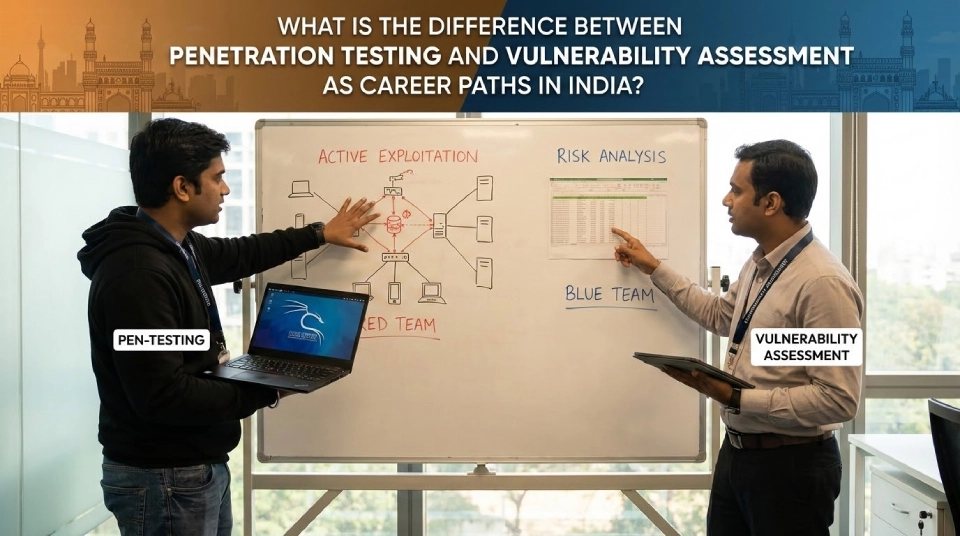
Penetration testing and vulnerability assessment are related but distinct roles, and choosing the wrong certification track for the role you actually want can set your preparation back by months.
Vulnerability Assessment involves systematically scanning systems, networks, and applications to identify security weaknesses. The output is a structured report that documents what vulnerabilities exist, how severe they are, and what should be fixed. The role is largely analytical and tool-driven.
Penetration Testing goes one step further. The tester actively exploits vulnerabilities in a controlled, authorised environment to determine what an attacker could actually achieve. The output shows not just what weaknesses exist but what damage they could cause if left unpatched.
Side-by-Side Role Comparison:
| Feature | Vulnerability Assessment | Penetration Testing |
| Primary Responsibility | Identify and report weaknesses | Exploit weaknesses to prove impact |
| Approach | Automated scanning + manual review | Manual attack simulation + tool-based |
| Common Tools | Nessus, Qualys, OpenVAS | Metasploit, Burp Suite, Nmap |
| Output | Vulnerability report with risk ratings | Penetration test report with proof of exploitation |
| Typical Employers | IT companies, BFSI, government | Security consultancies, MSSPs, red teams |
| Entry-Level Salary Range | ₹3.5 to ₹6 LPA | ₹4 to ₹7 LPA |
Understanding this distinction is the most important first step in your vulnerability assessment career in India or penetration testing journey. The certifications, tools, and daily responsibilities differ enough that students who conflate the two often end up underprepared for the role they actually get hired into.
How Much Do Penetration Testers and Vulnerability Analysts Earn in India at Entry and Senior Levels?
Entry-level penetration testers in India earn between ₹4 and ₹7 LPA, while senior pentesters with advanced certifications and 3 to 5 years of experience earn between ₹12 and ₹20 LPA.
The penetration tester salary in India grows faster than most other IT roles because the skill set is specialised and the supply of qualified candidates remains limited. Vulnerability assessment engineers follow a similar curve, starting slightly lower but growing consistently with experience and certifications.
Salary Comparison: Penetration Tester vs. Vulnerability Assessment Engineer in India:
| Level | Penetration Tester | Vulnerability Assessment Engineer |
| Entry Level (0 to 2 years) | ₹4 to ₹7 LPA | ₹3.5 to ₹6 LPA |
| Mid Level (2 to 5 years) | ₹8 to ₹14 LPA | ₹6 to ₹10 LPA |
| Senior Level (5+ years) | ₹14 to ₹20 LPA | ₹10 to ₹15 LPA |
| Tier 1 City Premium | 20 to 30% above national average | 15 to 25% above national average |
| Remote/MNC Premium | Up to 40% above local market | Up to 30% above local market |
Ethical hacking jobs for freshers at the entry level in India are most commonly available at managed security service providers (MSSPs), IT consulting firms, and large BFSI companies. Starting at ₹4 to ₹5 LPA with a CEH certification and practical tool skills is realistic for most fresh graduates who follow a structured preparation plan.
Which Certifications Do Employers in India Specifically Look for When Hiring Penetration Testers?
For penetration testing roles in India, employers most commonly require CEH (Certified Ethical Hacker) for entry-level and junior positions, with OSCP (Offensive Security Certified Professional) as the benchmark for mid-to-senior roles.
CEH is the most accessible starting point. It is the certification that appears most frequently in Indian job postings for junior penetration testing roles and is accepted by employers across IT services, BFSI, and security consulting. The latest version, CEH v13, now includes AI-driven attack scenarios and updated modules on cloud and IoT security, making it more aligned with what employers are actually hiring for in 2026.
OSCP is considered the gold standard for offensive security professionals globally. It involves a 24-hour practical exam where candidates must compromise a set of machines in a live environment. For entry-level roles, OSCP is not expected, but having it in progress signals serious commitment to any hiring manager.
Penetration Testing Certification Comparison for Indian Job Market:
| Certification | Level | Primary Skills | Exam Format | Approx. Cost | Employer Demand India |
| CEH v13 | Beginner to Intermediate | Ethical hacking, attack techniques, tools | 125 MCQ, 4 hours | ₹35,000 to ₹45,000 | Very High |
| CompTIA PenTest+ | Intermediate | Pen testing methodology, reporting | MCQ + performance-based | ₹28,000 to ₹35,000 | Medium |
| OSCP | Advanced | Hands-on exploitation, real environments | 24-hour practical | ₹80,000 to ₹1,00,000 | High (mid-senior) |
| eJPT (eLearnSecurity) | Beginner | Entry-level pentesting fundamentals | Practical, online | ₹5,000 to ₹8,000 | Low to Medium |
| PNPT | Intermediate | Network pentesting, report writing | Practical, 5 days | ₹15,000 to ₹20,000 | Medium |
For fresh graduates and students in India, the recommended starting point is the ethical hacking certification track built around CEH v13. It is the most recognised, the most requested by employers, and the most structured for students who are new to offensive security concepts. Appin’s CEH v13 AI-powered course is EC-Council accredited and covers the full CEH v13 curriculum with hands-on labs aligned to what the exam actually tests.
Which Certifications Do Employers in India Look for When Hiring Vulnerability Assessment Engineers?
For vulnerability assessment roles in India, employers most commonly look for CompTIA Security+, CEH, and vendor-specific certifications like Qualys VMDR or Tenable Nessus Professional as their primary screening criteria.
Security+ is the most requested baseline certification for VA roles because it covers the foundational threat knowledge, risk management principles, and scanning concepts that underpin every vulnerability assessment workflow. CEH adds significant value on top of Security+ because it teaches the attacker’s perspective, which makes VA reports far more accurate and actionable.
Certifications Relevant to Vulnerability Assessment Roles:
- CompTIA Security+: Foundational requirement for most VA job postings. Covers threat categories, vulnerability scanning principles, and risk management.
- CEH (Certified Ethical Hacker): Adds attacker-side knowledge that improves the quality and depth of vulnerability reports.
- CompTIA PenTest+: Bridges VA and pentest skills, valuable for analysts who want to move into more hands-on testing roles over time.
- Qualys VMDR Certification: Vendor-specific certification for the Qualys vulnerability management platform, requested by employers who use Qualys internally.
- Tenable Nessus Professional: Validates proficiency with Nessus, the most widely deployed vulnerability assessment tool in India’s enterprise market.
Vulnerability assessment tools India employers use most are Nessus and Qualys at the enterprise level, and OpenVAS for smaller environments. Getting hands-on with at least one of these tools before your first interview adds practical credibility that certifications alone cannot provide.
What Is the Right Certification Order for Students Who Want to Enter Penetration Testing in India?
The correct certification sequence for students entering penetration testing in India is: networking fundamentals first, then security fundamentals, then ethical hacking, then practical offensive security.
Jumping straight to CEH or OSCP without foundational knowledge of how networks operate is the most common and expensive preparation mistake students make. Penetration testers work with TCP/IP protocols, routing, firewalls, and network traffic every single day. Without this baseline, even basic lab exercises become difficult to complete, and exam concepts become hard to retain.
4-Stage Penetration Testing Certification Roadmap:
| Stage | Certification | Duration | Milestone Achieved | Required or Optional |
| Stage 1: Foundation | CompTIA Network+ or equivalent networking course | 1 to 2 months | Understand TCP/IP, subnetting, routing, firewalls | Required for non-tech; optional for BTech/BSc CS |
| Stage 2: Security Fundamentals | CompTIA Security+ | 2 to 3 months | Core threat knowledge, cryptography, risk management | Required for all backgrounds |
| Stage 3: Ethical Hacking | CEH v13 | 3 to 4 months | Attack techniques, tools, EC-Council accreditation | Required for all pentest job applications |
| Stage 4: Offensive Practicals | eJPT (beginner) or OSCP (advanced) | 2 to 4 months | Hands-on exploitation in live environments | Strongly recommended for L2 and senior roles |
This sequence of penetration testing certifications in India is designed to build knowledge in the right order so each stage reinforces the one before it.
The network security fundamentals stage is most important for students from BCA, BCom, or non-tech backgrounds. Even a 4 to 6 week focused networking course reduces the difficulty of Security+ and CEH significantly. Students who skip this stage consistently report struggling with the scanning and enumeration modules where networking knowledge is assumed.
What Penetration Testing Tools and Skills Do Employers Expect Before Your First Interview in India?
Indian employers hiring junior penetration testers expect hands-on experience with Nmap, Metasploit, Burp Suite, Wireshark, and Nikto as a baseline, and candidates who can demonstrate these skills in a technical interview consistently get shortlisted over those who only hold certifications.
Certifications prove your knowledge on paper. Tool proficiency proves you can actually do the job. The two together are what move candidates from the application pile to the interview room.
Penetration Testing Tools for Beginners by Domain:
| Domain | Tools to Learn | Where to Practice (Free) |
| Network Scanning | Nmap, Angry IP Scanner | Kali Linux + Metasploitable home lab |
| Exploitation | Metasploit Framework | TryHackMe, Hack The Box free tier |
| Web Application Testing | Burp Suite Community, OWASP ZAP, Nikto | DVWA (Damn Vulnerable Web App) |
| Password Attacks | John the Ripper, Hashcat, Hydra | Kali Linux practice environments |
| Traffic Analysis | Wireshark, Tcpdump | Packet capture labs on TryHackMe |
| Vulnerability Scanning | Nessus Essentials (free), OpenVAS | Free Nessus Essentials licence |
Beyond tools, employers also expect you to understand the OWASP Top 10 vulnerabilities, basic CVE analysis, and how to write a structured penetration test report. Report writing is one of the most overlooked skills by students, yet it appears in almost every junior pentest job description as a core requirement.
Can Fresh Graduates Without a Cybersecurity Degree Become Penetration Testers in India?
Yes, fresh graduates without a cybersecurity degree can become penetration testers in India, provided they hold the right certifications and can demonstrate practical tool skills during technical interviews.
Degree requirements for junior penetration testing and vulnerability assessment roles in India are becoming secondary to certification and lab experience. Employers at MSSPs and security consulting firms in particular evaluate candidates based on what they can do, not just what their degree says.
Students from BCA, BSc, BCom, and even non-tech backgrounds have successfully entered penetration testing careers in India by following a structured certification and lab practice path. The key factors that make this work are:
- Completing at least one recognised certification (CEH or Security+)
- Building a home lab and practicing tools like Nmap, Metasploit, and Burp Suite
- Documenting lab projects and CTF (Capture the Flag) challenge completions on a resume or GitHub
- Being able to walk through a basic attack scenario during a technical interview without prompting
Bug bounty programs in India are also an effective way for students without degrees to build a credible portfolio. Platforms like HackerOne and Bugcrowd allow students to find and report real vulnerabilities legally, and even a few valid bug submissions add significant weight to a resume alongside certifications.
A cybersecurity career without a degree in India is achievable, but it requires replacing the degree signal with certification credentials plus demonstrable practical experience.
How Long Does It Take to Land a Junior Penetration Testing or Vulnerability Assessment Job in India?
Most fresh graduates can complete foundational penetration testing certifications and land their first junior role in India within 8 to 12 months, depending on their starting background and how consistently they combine certification study with hands-on lab practice.
Students from BTech and BSc Computer Science backgrounds typically reach the first job application stage in 6 to 8 months because they can skip or shorten the foundational networking stage. Students from non-tech backgrounds need 10 to 12 months to complete the additional foundational phase before starting the certification sequence.
Month-by-Month Timeline to First Penetration Testing or VA Job:
| Month | Activity | Milestone |
| Month 1 to 2 | Networking fundamentals (non-tech) or Security+ start (tech background) | Foundation or first cert study begun |
| Month 2 to 4 | CompTIA Security+ study and exam | First recognised certification cleared |
| Month 4 to 7 | CEH v13 study, lab practice with Nmap, Metasploit, Burp Suite | Core pentest certification completed |
| Month 7 to 8 | Resume, LinkedIn, CTF documentation, mock interviews | Job search readiness confirmed |
| Month 8 to 12 | Applications, technical interviews, offer | First junior role secured |
The biggest factor separating students who land jobs at 8 months from those who take 12 is lab practice consistency, not intelligence or background. Students who practice tools daily alongside their certification study reach technical interview readiness significantly faster.
Penetration testing certifications in India open doors, but it is the combination of credentials and demonstrable hands-on experience that converts applications into offers.
Should You Join a Training Institute or Self-Study to Prepare for Penetration Testing Certifications in India?
For students with strong networking and Linux knowledge, self-study is a viable path. For students from non-tech or semi-tech backgrounds, structured training delivers faster and more reliable results.
The practical difference comes down to three things: lab access, curriculum structure, and exam eligibility.
Self-study works well when:
- You have a BTech or BSc CS background with Linux and networking exposure
- You can set up your own Kali Linux virtual lab and configure practice targets
- You are comfortable studying at your own pace without guided milestones
Structured institute training works better when:
- You come from a BCA, BCom, or non-tech background with limited networking exposure
- You need pre-configured lab environments where you can practice tools without the setup barrier
- You want EC-Council accredited training that waives the 2-year work experience requirement for CEH exam eligibility
- You want placement support and career guidance alongside your technical preparation
The EC-Council accreditation point is especially important for fresh graduates. Without accredited training, you need 2 years of documented work experience to sit the CEH exam. Accredited training removes this barrier entirely.
If you want lab-based, structured preparation for your first penetration testing role with placement support included, explore Appin’s certified ethical hacking training to check batch schedules and course details.
What Does a Pre-Application Checklist Look Like for a Junior Penetration Testing or VA Role in India?
You are ready to apply for your first penetration testing or vulnerability assessment role when you can confirm readiness across certifications, practical skills, and resume quality.
Use this checklist before sending your first application.
Certification Readiness:
- Cleared at least one recognised certification (CompTIA Security+ or CEH as minimum)
- Can explain all core exam domains without referring to notes
- Have eJPT, OSCP, or a second cert actively in progress to show continued development
Practical Skills Readiness:
- Completed hands-on lab practice with Nmap, Metasploit, and Burp Suite
- Understand and can explain the OWASP Top 10 vulnerabilities with examples
- Completed at least one full attack simulation in a home lab or TryHackMe environment
- Can write a basic structured vulnerability report or penetration test summary
Resume and Interview Readiness:
- Resume lists certifications, tools used, and lab projects, not just college qualifications
- Documented at least one CTF completion or bug bounty attempt on resume or GitHub
- Can walk through a basic attack methodology (reconnaissance through exploitation) during a technical interview
- Researched which tools and platforms are used by your target employer
Completing this checklist puts you in a significantly stronger position than candidates who apply immediately after clearing a certification without building practical depth alongside it. These penetration testing certifications in India open the door, but this checklist is what gets you through it.
Conclusion
Starting a penetration testing or vulnerability assessment career in India comes down to a clear sequence: understand which role you are targeting, earn the right certifications in the correct order, build hands-on tool skills in parallel, and apply with a resume that shows both credentials and practical experience.
The 8 to 12 month timeline is achievable for most dedicated students regardless of background. The roadmap is clear. What makes the difference is following it consistently.
If you want structured training with lab access, EC-Council accreditation, and placement support to start your journey, enquire with Appin Indore to check the next available batch.
