

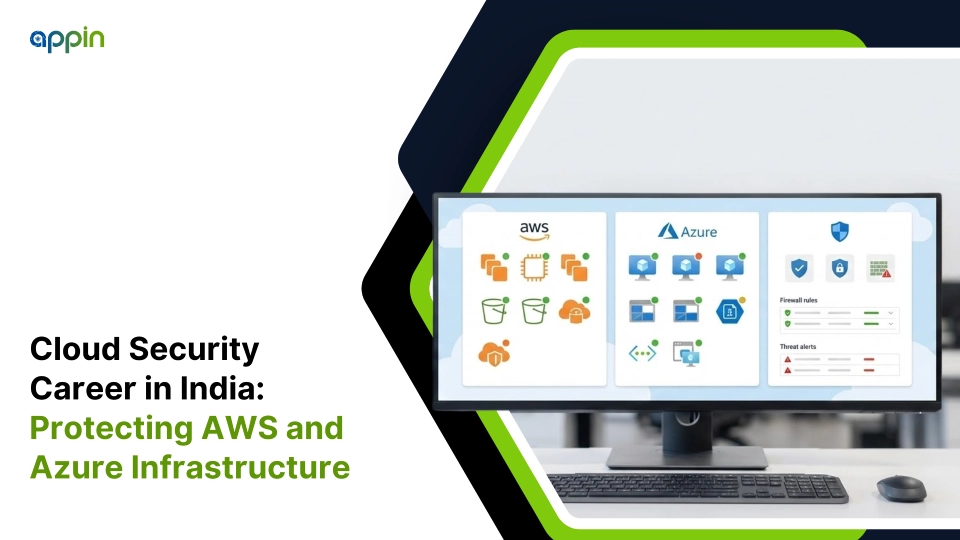
How do I start a Cloud Security career in India to protect AWS and Azure infrastructure?
Cloud security is a growing career with clear entry paths for students and fresh graduates in India. If you want to build a cloud security career India is the phrase to remember as you plan courses, hands on practice, and job hunting. This guide explains the roles, skills, courses, certifications, and practical steps to protect AWS and Azure environments and get hired.
Why is cloud security an in demand career in India?
Cloud security is in demand because most businesses are moving infrastructure to AWS and Azure and need people who can secure that infrastructure. Growth in cloud adoption, stricter data rules, and rising cyber threats all fuel hiring for cloud security roles. Expect demand across startups, product companies, managed service providers, and enterprise teams.

Which cloud security roles should you aim for first?
Aim for entry roles like Cloud Security Engineer, Cloud Security Analyst, or Junior Cloud Engineer that include security responsibilities. These roles focus on monitoring, identity and access management, configuration hardening, and incident response for cloud platforms. As you gain experience, you can move into specialist roles such as Cloud Security Architect, DevSecOps engineer, or Cloud Penetration Tester.
What core skills do employers look for in cloud security candidates?
Employers expect a mix of cloud platform knowledge, security fundamentals, and practical tooling experience. Key skills include:
- Understanding of AWS services such as EC2, S3, IAM, VPC, CloudTrail, and GuardDuty.
- Knowledge of Azure equivalents like Azure AD, Azure VM, Azure Storage, and Azure Security Center.
- Networking basics, secure identity and access management, and encryption concepts.
- Familiarity with container security, IaC (infrastructure as code) tools, and CI CD pipelines.
- Hands on experience with logging, monitoring, and incident response tools.
How should a beginner structure their learning path for AWS security?
Start with AWS fundamentals, then layer security concepts and hands on labs. A practical learning path:
- Learn core AWS services and the shared responsibility model.
- Study IAM best practices, least privilege, and roles and policies.
- Practice encrypting data at rest and in transit using KMS and TLS.
- Configure CloudTrail, CloudWatch, GuardDuty, and VPC Flow Logs for monitoring.
- Build small projects that combine compute, storage, and networking securely.
Repeat these steps in lab environments until you can secure a multi tier app on AWS.
How should a beginner structure their learning path for Azure security?
Begin with Azure basics and then focus on platform security and monitoring. A practical path:
- Learn Azure core services and platform identity with Azure AD.
- Implement role based access control and managed identities.
- Use Azure Security Center and Sentinel for visibility and threat detection.
- Practice secure networking with NSGs, Azure Firewall, and VPN.
- Deploy and test compliance and logging across a demo workload.
Which certifications and practical labs matter for cloud security roles?
Certifications show employers you have structured knowledge, but practical labs are equally important. Recommended certificates and activities:
- Vendor certifications: AWS Certified Security Specialty and Microsoft Certified: Azure Security Engineer.
- Foundational certs: CompTIA Security+ or (ISC)² SSCP for baseline security knowledge.
- Vendor neutral: cloud security certifications India are useful for recruiters when scanning CVs.
- Practical work: build labs, document projects, and maintain a GitHub repo with IaC examples and detection rules.
Mention of certifications should include practical evidence such as lab notes, scripts, and short videos of configuration steps.
Where do ethical hacking and penetration testing fit in a cloud security plan?
Ethical hacking teaches offensive techniques that help you think like an attacker and improve defenses. Complementary skills matter: enroll in certified ethical hacking training to learn penetration testing, vulnerability assessment, and responsible disclosure. Use those methods to test cloud deployments, focusing on misconfigurations, IAM weaknesses, and exposed data stores.

What advanced certifications or courses should you consider later?
After gaining practical experience, advanced certifications validate depth and currency. Consider vendor specialist certs and program level credentials. For example, explore CEH and the newer CEH v13 AI powered course for advanced offensive skill sets. Also look at cloud vendor architect certifications and specialist tracks in cloud security architecture.
Which specialist tracks can accelerate your career and salary?
Specializations with high demand include DevSecOps, cloud threat detection, cloud forensics, and bug bounty hunting. If you enjoy offensive work, a bug bounty diploma program can open freelance and consulting opportunities. Each specialist path requires continuous practice, participation in capturing the flag challenges, and evidence of real results.
How much can beginners expect to earn and how does salary grow in India?
Entry level cloud security roles in India start at a competitive salary compared to general IT roles, with growth based on experience, certification, and demonstrable skills. Early career salaries vary by city and employer but competent junior engineers can expect progressive increases within 12 to 24 months as they show impact on detection, hardening, or automation. Senior cloud security architects and specialists can command significantly higher salaries, especially in major tech hubs.
How do you build a practical portfolio recruiters will notice?
A practical portfolio is the single best hiring differentiator for freshers. Build it like this:
- Publish 3 to 6 short projects showing secure AWS and Azure deployments with IaC.
- Include detection rules, Terraform or ARM scripts, and a demo of monitoring and incident handling.
- Write clear README files and short video walkthroughs of the setup and the security controls.
- Contribute to open source or complete public labs and CTFs, then link to proof on your CV.
How should fresh graduates find their first cloud security job?
Start with internships, small consulting roles, or cloud support positions that touch security functions. Practical steps:
- Apply to entry roles and mention specific labs and certs in the CV.
- Network with alumni, local meetups, and online communities focused on cloud security.
- Use targeted applications to companies that run cloud infrastructure and need security help.
- Prepare for interviews with scenario based answers and live demos of previous projects.
What tools and platforms should you practice daily?
Daily practice helps you move from theory to competence. Practice with:
- AWS console and CLI, Azure portal and CLI, and Terraform or ARM templates.
- Logging and detection tools like CloudWatch, Azure Sentinel, Splunk or ELK.
- Security scanning tools such as ScoutSuite, Prowler, kube-bench for Kubernetes, and open source IDS tools.
- Automation: practice writing scripts to detect misconfigurations and to auto remediate simple policy violations.
How to use training programs and courses smartly
Choose courses that balance structured content with labs and placement support. When evaluating programs, check:
- Lab access duration and whether the labs mirror real production scenarios.
- Instructor experience and placement or hiring assistance.
- Alumni testimonials and sample projects.
If you want structured certification paths, explore cybersecurity certification programs as part of your learning plan.
What next steps accelerate your career in the first 6 months?
A focused 6 month plan produces measurable progress:
- Month 1 to 2: Learn fundamentals of AWS and Azure and complete a beginner cloud security course.
- Month 3: Build two hands-on projects (one AWS, one Azure) that show IAM, monitoring, and encryption.
- Month 4: Gain a relevant certification or prepare for it while documenting labs.
- Month 5: Participate in CTFs, bug bounty platforms, or contribute to an open source security tool.
- Month 6: Apply for internships or junior roles and prepare project demos for interviews.
Is cloud security the right career for you?
Cloud security is a practical and well paid career for people who enjoy systems, automation, and continuous learning. If you want to protect AWS and Azure infrastructure and build a meaningful security role, focus on hands-on labs, clear projects, and targeted certifications. Start small, show impact, and keep learning; that approach will move you from beginner to hireable in months rather than years.
Further reading and resources:
- Look up official AWS and Azure security documentation and practice in free tiers.
- Enroll in targeted vendor courses and pair them with hands-on projects.
- Consider complementary training such as certified ethical hacking training to broaden your perspective.
- For advanced offense skills, explore CEH v13 AI powered course and specialist programs.
- If you want a freelance or specialist path, investigate a bug bounty diploma program and start participating in real bounty programs.
