

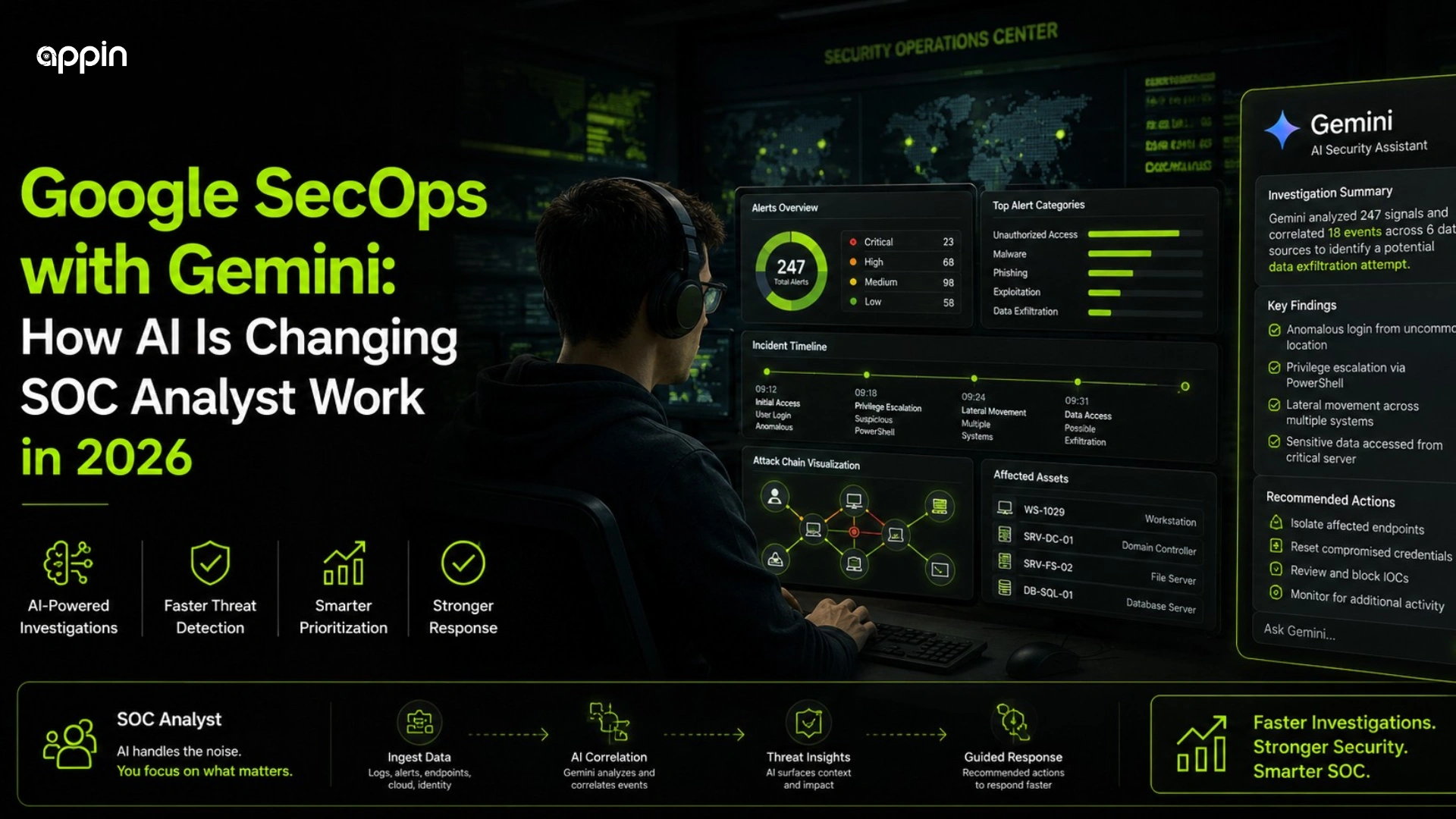
Google SecOps with Gemini: How AI Is Changing SOC Analyst Work in 2026
Google SecOps with Gemini shows how AI is becoming part of modern SOC work, where analysts deal with thousands of logs, alerts, IOCs, dashboards, and investigations.
For students, the big question is not “Will AI remove SOC jobs?” The better question is, “How will AI change what SOC analysts do daily?” Google SecOps with Gemini helps analysts search security data, understand alerts, create detection logic, and work faster with threat intelligence.
This shift is part of a larger change in cyber careers, AI changing cybersecurity jobs gives the wider career picture.
What is Google SecOps with Gemini?
Google SecOps with Gemini is Google’s AI assisted security operations environment that helps teams detect, investigate, and respond to threats faster.
Google SecOps, also called Google Security Operations, brings security data, detection, investigation, response, and threat intelligence into one workflow. Gemini adds AI assistance so analysts can ask questions, generate queries, understand alerts, and create detection rules faster.
In simple words, Google SecOps with Gemini explained for students means this, it supports SOC analysts by reducing manual work and improving investigation speed.
Why is AI changing SOC analyst work in 2026?
AI is changing SOC analyst work because security teams need faster ways to understand alerts, search logs, connect evidence, and reduce repetitive investigation tasks.
SOC teams now handle endpoint data, cloud alerts, identity signals, email threats, network logs, and threat intelligence. Reading everything manually can slow down response.
Google SecOps AI for security operations helps with:
- Alert overload
- Repeated triage steps
- Large log volumes
- Threat hunting support
- Faster search generation
- Better investigation summaries
AI supports analysts, but it does not replace their judgment.
How does Gemini help SOC analysts search security data?
Gemini helps SOC analysts generate search queries from natural language, making log investigation easier and faster.
Instead of remembering every query syntax detail, an analyst can ask a security question in plain language and use Gemini support to create a search direction.
This helps with:
- Natural language questions
- Search query generation
- Faster log investigation
- Easier learning for junior analysts
- Less time remembering syntax
- Human review of generated queries
This is how Gemini helps SOC analysts work faster, especially when they are still learning SIEM search skills.
How does Gemini help with alert triage and investigation?
Gemini helps SOC analysts understand alerts faster by adding context, summarizing activity, and supporting investigation workflows.
Gemini for threat detection and investigation can help analysts move from “alert received” to “what does this mean?” more quickly.
It may support:
- Alert context
- Initial triage
- Related signals
- Suspicious activity summary
- Incident investigation notes
- Escalation clarity
For L1 analysts, this can improve the first review. For L2 analysts, it can support deeper investigation and timeline building.
How does Google SecOps help analysts connect the attack story?
Google SecOps helps analysts connect separate security events into a clearer view of what happened, which asset was affected, and what action may be needed.
A single alert rarely tells the full story. A suspicious login, endpoint alert, unusual command, and risky file download may only make sense when connected.
Google SecOps for cybersecurity teams helps analysts think in timelines:
- What happened first?
- Which user was involved?
- Which device was affected?
- What evidence supports the alert?
- What action should be taken next?
This type of thinking is important for SOC students because context matters more than isolated alerts.
How does Gemini support threat intelligence work?
Gemini can assist with threat intelligence by answering questions about IOCs, threat actors, malware families, and security topics.
Gemini cybersecurity use cases include helping analysts understand whether an IP, domain, hash, or behavior pattern connects to known threat activity.
It can support:
- IOC explanation
- Threat actor summaries
- Malware family context
- TTP understanding
- MITRE ATT&CK awareness
- Incident prioritization
The analyst still has to verify the answer and connect it with the organization’s environment.
How does Gemini help create detection rules?
Gemini can help generate YARA-L detection rules, which supports faster detection engineering inside Google SecOps.
Detection rules help security teams identify suspicious behavior in logs. Gemini can help create a first draft from a natural language prompt.
This helps with:
- YARA-L rule drafting
- Detection logic support
- Faster rule creation
- Analyst review
- Testing before production
- Rule tuning
Beginners should remember that generated rules must be reviewed. A bad rule can create noise or miss real threats.
How does Gemini help junior SOC analysts learn faster?
Gemini helps junior SOC analysts learn faster by explaining alerts, security terms, queries, and threat intelligence in simpler language.
A fresher may see terms like IOC, lateral movement, command line behavior, or false positive and feel confused. AI support can explain these terms in a learning friendly way.
It can help with:
- Understanding suspicious logs
- Learning query structure
- Explaining IOC meaning
- Improving investigation notes
- Building confidence in triage
Still, fundamentals matter. AI can explain, but it cannot practice for you.
How does AI change the work of SOC L1 analysts?
AI changes SOC L1 work by helping analysts understand alerts faster, reduce repetitive triage, and create better escalation notes.
L1 analysts usually handle the first review. AI SOC analyst workflows can help them summarize alert details and prepare cleaner tickets for L2.
AI may help L1 analysts with:
- Alert explanation
- False positive review
- Ticket notes
- Escalation clarity
- Reduced manual lookup
- Better first level context
For more clarity on normal SOC routines, read what a SOC analyst actually does
How does AI change the work of SOC L2 analysts?
AI changes SOC L2 work by supporting deeper investigation, threat hunting, detection logic, and incident timeline creation.
L2 analysts do not only close alerts. They investigate root cause, scope, impact, and response actions. AI can help organize evidence faster.
AI may support L2 analysts with:
- Query support
- Deeper log investigation
- Threat actor context
- IOC enrichment
- Detection rule drafting
- Root cause investigation
- Report preparation
This is how AI is changing SOC analyst work from manual lookup toward judgment based investigation.
How does Google SecOps compare with other AI SOC platforms?
Google SecOps with Gemini is one example of how major security platforms are adding AI support to SOC workflows.
Microsoft also offers AI support for security teams through Security Copilot. To compare the direction of both platforms, read Microsoft Security Copilot
For students, the main learning is simple. Do not memorize only tool names. Learn how SOC teams triage alerts, investigate evidence, write reports, and decide response actions.
Can Gemini replace SOC analysts?
No, Gemini cannot replace SOC analysts because human judgment is still needed for validation, containment decisions, and communication.
AI can make mistakes. It may misunderstand context, miss business logic, or generate a weak query. Analysts must validate the output before acting.
SOC work still needs:
- Business context
- Legal awareness
- Incident judgment
- Communication skills
- Escalation decisions
- Human responsibility
AI supports the analyst, but the analyst owns the decision.
What skills do SOC analysts need in the Gemini era?
SOC analysts still need networking, log analysis, SIEM concepts, threat intelligence, incident response, and critical thinking, even when AI tools are available.
AI tools for SOC analysts in 2026 make fundamentals more important, not less important. You need basics to judge whether AI output makes sense.
Students should learn:
- TCP/IP, DNS, HTTP
- Windows and Linux logs
- SIEM search basics
- MITRE ATT&CK
- Incident response workflow
- Detection rule basics
- Report writing
- AI prompt discipline
A good analyst asks better questions and verifies answers carefully.
What should beginners learn before using AI powered SOC tools?
Beginners should learn security fundamentals before depending on AI powered SOC tools because AI output only makes sense when the analyst understands the basics.
Before using advanced SOC platforms, learn:
- Logs and alerts
- Endpoint basics
- User activity
- Network events
- Threat types
- False positives
- Escalation process
- Report writing
For students in Central India, this means building strong basics first, then learning modern tools step by step.
What are the limitations of Google SecOps with Gemini?
Google SecOps with Gemini is useful, but it still depends on data quality, correct configuration, proper access, and analyst validation.
If the logs are incomplete, the answer may be incomplete. If the analyst asks a poor question, the output may not help.
Limitations include:
- AI may misunderstand context
- Generated queries need review
- Detection rules need testing
- Data quality matters
- Not every alert is solved automatically
- Teams still need process and training
This is why cybersecurity training remains important.
