

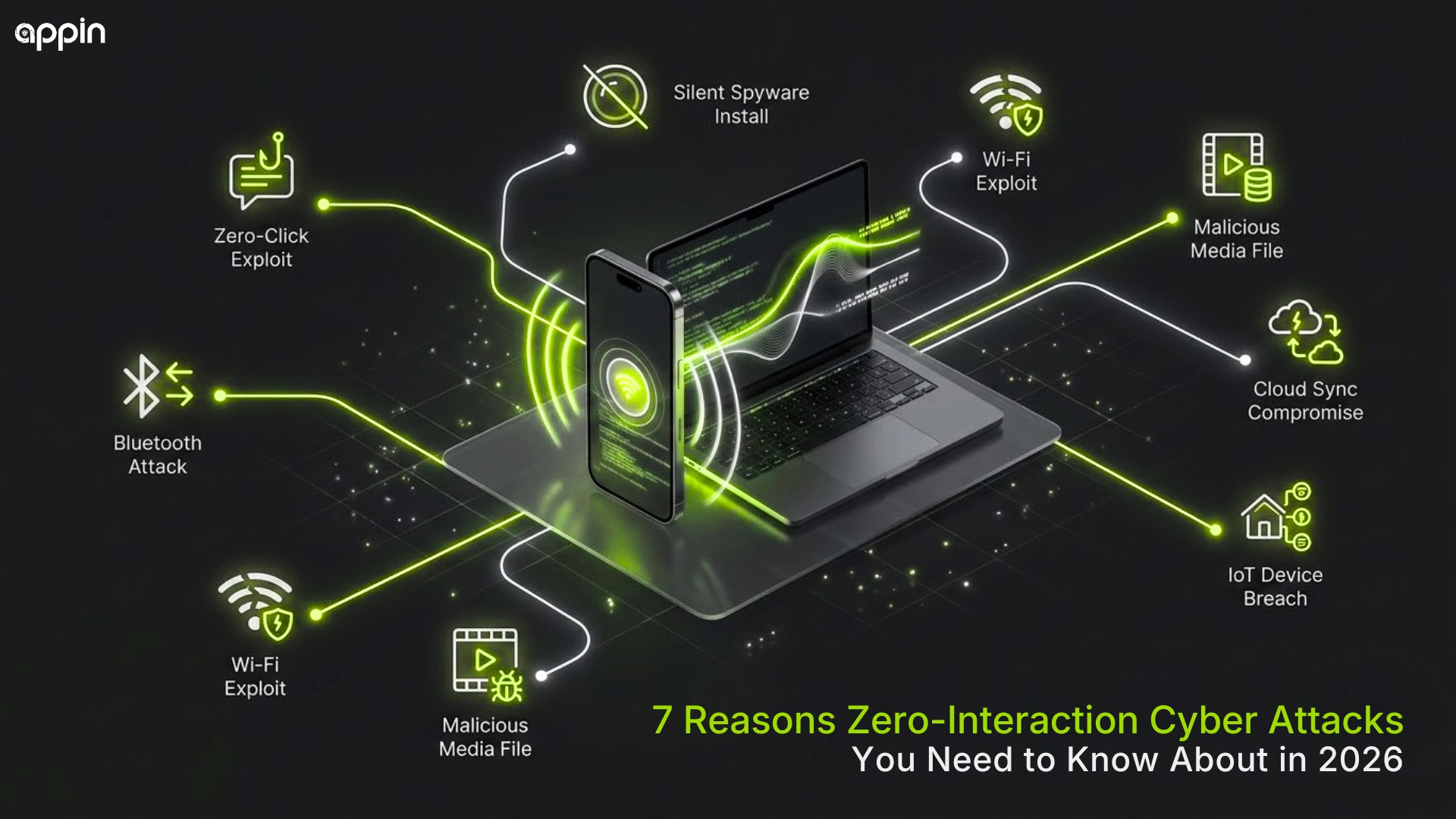
What Are the Zero Click Attacks You Need to Know About in 2026?
Direct answer: Zero click attacks exploit software vulnerabilities to infect devices or steal data without the user clicking links, opening files, or taking any action at all.
Zero click attacks represent the most dangerous category of modern cyber threats because they require absolutely no action from the victim. The attacker finds a flaw in software that processes incoming data, such as a messaging app receiving a text or a browser rendering a web page, and uses that flaw to deliver malware automatically. According to Kaspersky, these attacks often target apps that handle messaging or voice calls because those services are designed to receive data from untrusted sources.
The scale of the problem is growing fast. Google Chrome faced eight actively exploited zero day vulnerabilities in 2025 alone. WhatsApp patched CVE-2025-55177, a zero click spyware flaw that was exploited against journalists and activists. Samsung devices were hit by CVE-2025-21042, a zero day flaw in the Android image processing library that delivered commercial grade spyware called LANDFALL before Samsung could patch it.
Understanding how zero interaction attacks work is essential for anyone who uses a smartphone, connected device, or web browser. The seven attacks below represent the most significant threats circulating right now.

-
Zero Click Messaging App Exploits
Attackers exploit vulnerabilities in messaging apps like WhatsApp and iMessage to install spyware without the victim opening or even seeing the malicious message.
Messaging apps are the primary target for zero click attacks because they constantly receive and process data from unknown sources. In February 2025, Meta confirmed that Paragon Solutions used a zero click exploit to target 90 journalists and activists through WhatsApp. The victim’s phone was compromised simply by receiving a specially crafted message. No click, no open, no action required.
The most famous zero click attack examples in 2026 trace back to NSO Group Pegasus spyware. Citizen Lab documented the FORCEDENTRY exploit, which used a zero day zero click flaw in iMessage to install Pegasus on the phone of a Saudi activist. The attack worked by sending a GIF file through iMessage that triggered a hidden code execution path in Apple image processing software.
Palo Alto Networks Unit 42 researchers also uncovered LANDFALL, a new Android spyware family delivered through a zero day vulnerability in Samsung image processing. The spyware was actively exploited in the wild before Samsung issued a patch in April 2025.
-
AI Powered Voice Call Exploits
Criminals use AI generated voice technology and telecom network vulnerabilities to compromise devices during phone calls without requiring the victim to take any action.
Voice calling systems present another avenue for zero interaction exploits. The CloudZ remote access trojan discovered by Cisco Talos demonstrates how attackers exploit the connection between phones and computers. CloudZ RAT uses a malicious plugin called Pheno that hijacks Microsoft Phone Link to intercept SMS messages and one time passwords from a Windows PC without ever touching the victim mobile device.
The malware monitors local databases where Phone Link stores synchronized data, including text messages, call logs, and notifications. Because the attacker targets the Windows computer rather than the phone directly, the victim has no indication that anything is wrong. SMS based two factor authentication codes are captured silently, enabling account takeover across banking, email, and social media platforms.
These mobile security threats are growing as AI voice cloning technology becomes more accessible. Attackers can now combine voice spoofing with network level exploits to create attacks that feel entirely normal to the victim while silently extracting sensitive data in the background.
-
Malicious Push Notification Attacks
Attackers abuse mobile push notification systems to trigger malicious actions on devices, delivering malware or stealing data through fake system prompts that appear legitimate.
Push notifications are designed to alert users to important updates, but attackers have learned to weaponize this system. A zero click agentic browser attack discovered in late 2025 demonstrated how attackers could use polite email instructions to trigger AI agents that delete real files from Google Drive. The attack required no clicks from the victim. Simply receiving the email and having the browser process it in the background was enough.
On mobile devices, malicious push notifications can trigger background processes that install malware, modify system settings, or exfiltrate data. The notification itself may look like a legitimate system update, security alert, or message from a trusted app. Because users are conditioned to trust push notifications from installed applications, these attacks have a high success rate.
Google patched multiple Chrome zero day vulnerabilities in 2025 that could allow push based exploitation. The eighth Chrome zero day of the year was patched with minimal public disclosure, highlighting how seriously vendors treat these threats.
-
Bluetooth and Nearby Device Exploits
Hackers exploit Bluetooth and wireless protocols to compromise nearby devices without any user interaction, using flaws that allow unauthorized access through the wireless connection.
Bluetooth zero click exploits have become a significant threat to mobile security. In September 2025, Google confirmed a new vulnerability tracked as CVE-2025-48539 in the Android Bluetooth stack, rated 8.0 on the CVSS severity scale. The flaw stems from a race condition in the Bluetooth kernel code that allows attackers with nearby network access to execute arbitrary code without any action from the device owner.
Security researcher Marc Newlin demonstrated earlier how unpatched Android phones could be compromised through Bluetooth by forcing a virtual keyboard to pair with the device. The attack exploited CVE-2023-45866 and related flaws to send malicious keystrokes to the target phone. The victim would have no idea their device had been compromised because no pairing prompt appeared on screen.
SonicWall also disclosed CVE-2024-20017, a nearly maximum severity vulnerability in MediaTek Wi-Fi chipsets with a CVSS score of 9.8. This flaw affected routers and smartphones from manufacturers including Xiaomi, Ubiquiti, and Netgear, enabling remote code execution through Wi-Fi without any user interaction.

-
Smart Device and IoT Auto Exploitation
Connected smart home and IoT devices are attacked automatically through exposed vulnerabilities, allowing criminals to build botnets, steal data, or infiltrate home and corporate networks.
IoT devices have become one of the weakest links in modern cybersecurity. SonicWall recorded a 124% year over year increase in IoT attacks in 2024, and the trajectory continued steepening into 2025. Over 50% of IoT devices contain critical vulnerabilities that hackers can exploit, and one in three data breaches now involves an IoT device according to industry research.
In March 2026, a coordinated law enforcement operation across the United States, Germany, and Canada dismantled four IoT botnets that had collectively infected more than 3 million devices. These botnets were capable of generating distributed denial of service attacks exceeding 31 terabits per second, enough to knock major websites and services offline.
The connected device population reached 21.1 billion globally by the end of 2025, a number projected to hit 39 billion by 2030. Each new device adds another potential entry point for zero interaction attacks. Many IoT devices ship with weak firmware security, default passwords, and no automatic update mechanism, leaving them permanently vulnerable.
-
Cloud Synchronization Attacks
Attackers exploit cloud sync systems that connect devices to spread malware, intercept data, or steal credentials silently as files and messages synchronize across platforms.
Cloud synchronization creates invisible connections between devices that attackers can target. The CloudZ RAT campaign demonstrates this threat clearly. By compromising a Windows PC, attackers gained access to everything synced through Microsoft Phone Link, including SMS messages, call logs, and notifications from the victim Android phone. The phone itself was never directly attacked.
This type of cross device compromise is particularly dangerous because it defeats the purpose of keeping separate devices for separate functions. A user who keeps their banking app on their phone and does financial work on their laptop might assume the separation provides security. Cloud sync bridges that gap and creates a single point of failure.
Bitdefender 2025 IoT Security Report, based on data from 6.1 million smart homes, found that automated attacks exploiting shared cloud infrastructure are rising as more devices interconnect. When one device in a sync chain is compromised, every connected device becomes vulnerable.
-
Zero Interaction Browser and Media Exploits
Direct answer: Malicious web content including images, videos, and hidden code exploits browser rendering flaws to compromise devices automatically when the user visits a webpage.
Web browsers are among the most complex pieces of software on any device, and that complexity creates abundant opportunities for attackers. Google Chrome alone faced eight zero day vulnerabilities that were actively exploited in 2025. These flaws allowed attackers to hijack browsers, steal data, and install malware simply by getting the victim to visit a webpage.
A zero click agentic browser attack discovered by researchers in late 2025 showed how visiting a single webpage could trigger AI agents that interacted with Google Drive and deleted real files. No clicks were required. The browser processed the malicious content in the background and executed the attack sequence automatically.
The distinction between zero day vs zero click attack is important here. A zero day is a vulnerability that the software vendor does not know about. A zero click is an attack that requires no user interaction. An attack can be both, one, or neither. The Chrome zero day vulnerabilities were zero day flaws exploited through zero click methods, making them doubly dangerous because defenders had no prior knowledge and victims had no opportunity to intervene.
Key Takeaways
- Zero click attacks require no user action and exploit software vulnerabilities automatically
- Messaging apps like WhatsApp and iMessage are the primary targets for these attacks
- Google Chrome faced 8 actively exploited zero day vulnerabilities in 2025
- IoT devices with weak firmware represent a growing attack surface with 21.1 billion connected devices globally
- Cloud sync systems can spread compromises across devices without directly attacking any single endpoint
