

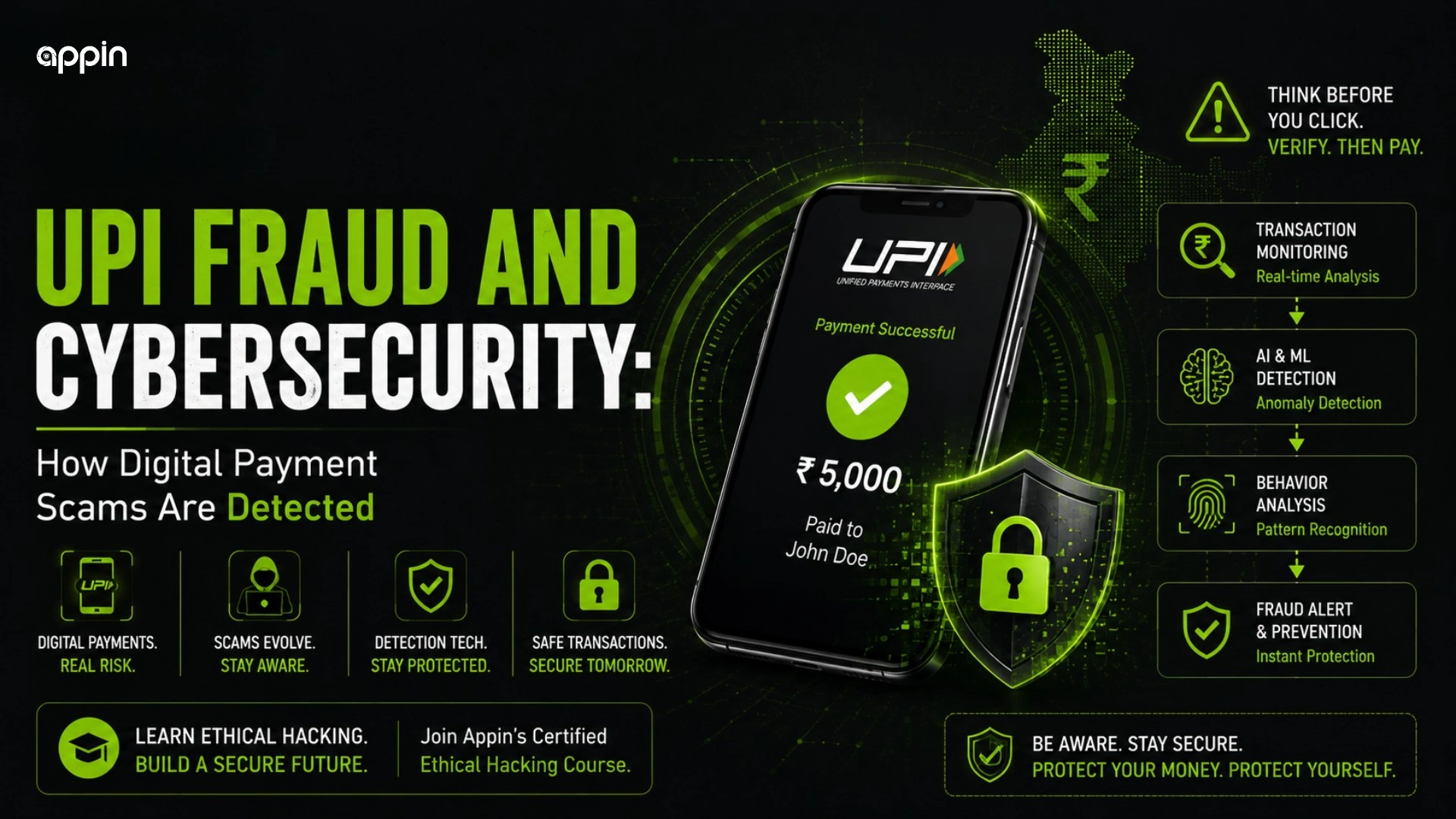
What is UPI fraud in cybersecurity?
UPI fraud is a digital payment scam where cybercriminals trick users into sending money, sharing UPI PINs, approving collect requests, or installing unsafe apps.
A user mistake may happen because of confusion. Cyber fraud happens when attackers intentionally create that confusion through fake calls, messages, links, or identities.
UPI scams spread fast because payments are instant. Once money moves through multiple accounts, recovery becomes harder.
Cybersecurity teams monitor suspicious payment patterns so fraud can be detected quickly.
How do UPI scams usually start?
UPI scams usually start with a fake call, message, link, QR code, app, social media profile, or customer care number.
The first step is rarely technical. Most scams begin with trust, fear, or urgency.
Common starting points include:
- Fake bank calls
- Fake refund messages
- Fake customer care numbers
- Fake marketplace buyers
- Fake job offers
- Fake loan offers
- Fake KYC update messages
- Social media impersonation
Some UPI fraud cases begin with fake loan apps that collect personal data and pressure users into payments. online loan app scams
What are the most common UPI fraud techniques?
Common UPI fraud techniques include collect request scams, QR code scams, fake refunds, KYC phishing, remote access app fraud, and mule account transfers.
UPI cybercrime examples include:
- UPI collect request fraud
- QR code “receive money” scam
- Fake payment screenshot
- Fake customer care number
- KYC update phishing
- Remote screen sharing app scam
- Digital arrest payment demand
- Investment or task scam payment chain
- Mule account routing
The method changes, but the goal is the same. The attacker wants the victim to approve a payment or reveal sensitive information.
How do QR code UPI scams work?
QR code UPI scams work by tricking victims into scanning a code and entering their UPI PIN, which actually authorizes money transfer.
A scammer may say, “Scan this QR code to receive your refund.” The victim scans the code, enters the UPI PIN, and money leaves the account.
The safety rule is simple. Receiving money does not require entering your UPI PIN.
UPI fraud prevention tips should always include this point because QR confusion is still common among users.
How do fake UPI collect requests fool users?
Fake collect requests fool users by making them believe they are receiving money while they are actually approving a payment.
A collect request is a payment request sent to your UPI app. If you approve it with your UPI PIN, money can leave your account.
Scammers use lines like:
- “Accept to receive refund”
- “Approve to complete KYC”
- “Click pay to confirm payment”
- “Enter PIN to receive money”
Users should read the app screen carefully before approving any request.
How do remote access app scams steal UPI money?
Remote access app scams steal UPI money when criminals convince victims to install screen sharing or control apps and then watch sensitive payment actions.
The scam usually starts with a fake support call. The caller says they need to “fix” a refund, wallet, loan, KYC, or bank issue.
Once the victim installs the app, the attacker may see the screen, guide payment steps, observe OTPs, or misuse access.
Never install apps during financial support calls unless you have verified the source through official channels.
What are mule accounts in UPI fraud?
Mule accounts are bank accounts used by cybercriminals to receive, move, or hide stolen money from digital payment scams.
After a scam succeeds, money may be moved quickly across many accounts. This makes tracing and freezing funds harder.
Mule accounts may be fake, rented, misused, or opened using stolen identity details. Detecting these accounts is important because they connect many fraud cases.
Banks and law enforcement look for unusual account behavior, repeated incoming transfers, fast withdrawals, and links between suspicious accounts.
How do banks and cybersecurity teams detect suspicious UPI activity?
Banks and cybersecurity teams detect suspicious UPI activity by monitoring transaction patterns, device behavior, account history, location signals, and known fraud indicators.
This is how UPI fraud is detected in simple terms. Security systems compare current activity with normal behavior and known fraud patterns.
UPI scam detection methods may include:
- Unusual transaction amount
- Sudden transaction frequency
- New device or location
- Multiple payments to new beneficiaries
- Risky account patterns
- Mule account links
- Failed login or PIN attempts
- Fraud risk scoring
A single signal may not prove fraud. Multiple signals together create stronger suspicion.
How does AI help detect UPI fraud faster?
AI helps detect UPI fraud faster by finding unusual payment patterns, suspicious account networks, and behavior that may not be visible through manual review.
In digital payment fraud in India, speed matters. Fraud money can move quickly, so detection systems must act fast.
AI can help with:
- Pattern detection
- Risk scoring
- Mule account detection
- Payment velocity checks
- Repeated scam indicators
- Transaction network analysis
- Faster alerts for banks and payment apps
AI does not replace investigators. It helps them notice suspicious behavior faster.
How does cybersecurity make UPI payments safer?
Cybersecurity in digital payments makes UPI safer through authentication, transaction monitoring, fraud alerts, device checks, encryption, awareness, and incident response.
Payment cybersecurity is not one control. It is a combination of systems, rules, and user habits.
UPI security may include:
- UPI PIN protection
- Device binding
- App security checks
- Fraud monitoring
- Risk alerts
- Secure routing
- User warnings
- Cybercrime reporting support
Attackers may also trick users into approving login requests or security prompts before taking over accounts. MFA fatigue attack
What warning signs should users notice before making a UPI payment?
Users should notice urgency, unknown links, payment pressure, QR codes to receive money, UPI PIN requests, remote app instructions, and fake customer care claims.
Watch for these red flags:
- “Pay now or account will block”
- “Scan this QR to receive money”
- “Share OTP or UPI PIN”
- Unknown app link
- Fake customer care number from search
- Payment screenshot without bank confirmation
- Too good to be true offer
- Pressure to keep it secret
With AI generated audio and video, payment scams can look more believable than normal phishing messages. deepfake scams in India
What should you do if you become a victim of UPI fraud?
If you become a victim of UPI fraud, immediately contact your bank, report through 1930 or cybercrime.gov.in, save evidence, and request transaction blocking or freezing.
Do not delete chats, call logs, screenshots, or transaction messages. Evidence helps investigation.
Take these steps:
- Call bank or payment app support
- Dial 1930 quickly
- File a complaint on the National Cyber Crime Reporting Portal
- Save UPI IDs, phone numbers, transaction IDs, and screenshots
- Change passwords if account access is compromised
- Revoke suspicious app permissions
- Inform family or workplace if needed
For cyber fraud India cases, fast reporting can improve the chance of blocking further movement of funds.
What can cybersecurity students learn from UPI fraud cases?
Cybersecurity students can learn how social engineering, transaction monitoring, fraud detection, mule accounts, OSINT, and incident response work in real cases.
Students often search how hackers misuse UPI apps, but the safe learning focus should be how attackers manipulate users and how defenders detect fraud.
UPI fraud cases teach:
- Social engineering tactics
- Phishing and vishing
- Fraud pattern analysis
- Digital evidence collection
- Financial cybercrime investigation
- AI in fraud detection
- Incident reporting workflows
- SOC and cyber forensics relevance
This makes UPI fraud a useful case study for cybersecurity learners.
How can Appin help students learn digital payment security?
Appin helps students understand digital payment security through authorized training labs, ethical hacking concepts, defensive fraud awareness exercises, cybercrime awareness, incident response basics, and fraud detection learning.
At Appin Indore, students can build cybersecurity fundamentals, social engineering awareness, ethical hacking foundation, SOC analyst basics, digital forensics awareness, and practical tool knowledge.
Students can explore CEH v13, CHFI, Bug Bounty Diploma, Diploma in Information Security, and the 6 month Diploma in IT Security and Ethical Hacking.
Appin Technology Lab also provides career guidance and placement assistance for students and freshers building cybersecurity careers.
Why Digital Payment Fraud Detection Matters for Cybersecurity Students
UPI fraud and cybersecurity are closely connected because digital payment scams involve social engineering, fake identities, risky apps, mule accounts, and suspicious transaction patterns.
Cybersecurity helps make UPI safer through monitoring, alerts, authentication, fraud detection, and user awareness. For students, UPI fraud cases are a strong way to understand real cybercrime and digital payment security.
Start your cybersecurity journey with Appin Indore and build practical ethical hacking, SOC, and digital fraud awareness skills through authorized training labs, defensive fraud awareness exercises, and expert guidance.
