

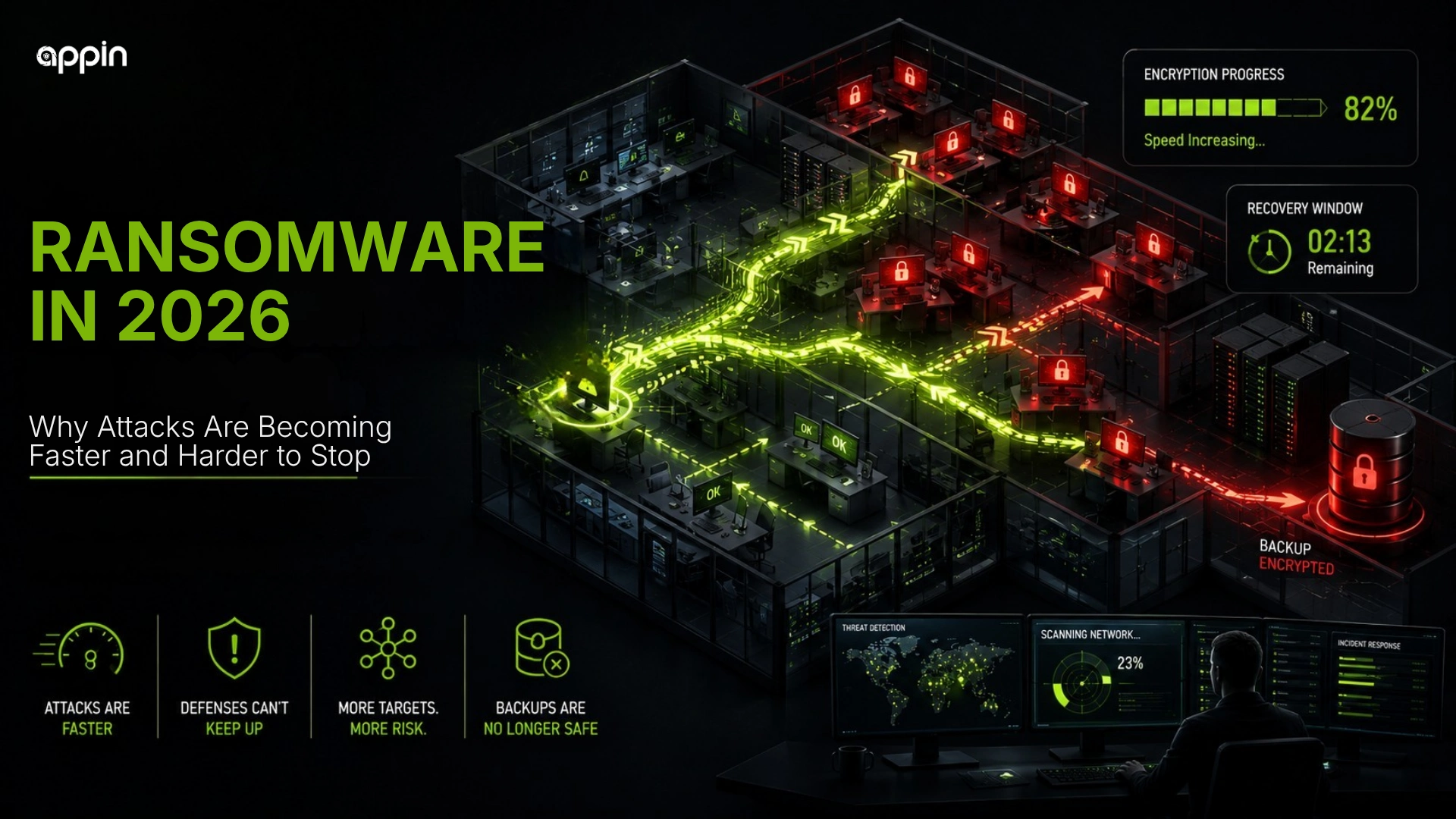
Why Ransomware Is Changing So Fast in 2026
Ransomware in 2026 is faster and harder to stop because attackers now combine stolen credentials, exposed services, data theft, AI assisted deception, and extortion pressure.
CERT-In’s India Ransomware Report 2024 says ransomware operators are using faster attack velocity and multi-faceted extortion strategies that combine data encryption, data exfiltration, reputational threats, and pressure tactics.
Older ransomware was often imagined as malware that quietly entered a system and locked files after days of activity. Modern ransomware attacks can move faster, steal data earlier, abuse real logins, and pressure organizations before defenders fully understand what happened.
This blog explains why ransomware is changing, how attacks usually begin, how security teams detect early signs, and what students should learn from this threat.
What makes ransomware in 2026 different from older attacks?
Ransomware in 2026 is different because attackers often combine encryption, data theft, credential abuse, extortion, and faster movement across systems.
CERT-In’s India Ransomware Report 2024 supports this shift by highlighting data exfiltration, reputational threats, pressure tactics, and faster ransomware operations.
Earlier ransomware focused mainly on locking files and asking for payment. Modern ransomware attack methods are broader.
Attackers may now:
- Steal data before encryption
- Use stolen employee credentials
- Abuse cloud or remote access
- Threaten public leaks
- Target backups
- Move quickly through internal systems
- Pressure customers, partners, or employees
Speed gives attackers more time to steal, spread, and negotiate before defenders react.
Why are ransomware attacks becoming faster in 2026?
Ransomware attacks are becoming faster because attackers use automation, stolen credentials, exposed services, AI assisted phishing, and ready made ransomware tools.
CERT-In’s report highlights exposed database instances, ESXi servers, NAS devices, weak IAM policies, compromised credentials, exposed RDP, brute force attacks, and public cloud storage misconfigurations as ransomware risk areas.
If you are asking why ransomware attacks are increasing, the answer is not only “better malware.” The bigger reasons are weak access controls, poor patching, exposed remote systems, and social engineering at scale.
Ransomware 2026 trends include:
- Ransomware as a service
- Automated scanning
- Initial access brokers
- Credential theft
- Phishing at scale
- Remote access abuse
- Faster data exfiltration
- Misconfigured cloud or SaaS access
Attackers do not always need to break in technically. Sometimes they simply log in with stolen details.
How do attackers usually enter an organization?
Attackers usually enter through phishing, stolen passwords, exposed remote access, unpatched software, third party vendors, or compromised employee accounts.
This is how ransomware attacks work in many cases. The first step is usually access, not encryption.
Common entry points include:
- Phishing emails
- Fake login pages
- VPN or RDP exposure
- Stolen credentials
- Software vulnerabilities
- Vendor account compromise
- Weak MFA or no MFA
- Social engineering calls
CISA’s #StopRansomware Guide specifically recommends patching internet facing systems, securing RDP, applying MFA, and logging RDP attempts because these areas often create ransomware exposure.
Why are stolen credentials dangerous in ransomware attacks?
Stolen credentials are dangerous because attackers can log in like real users and move faster without triggering obvious malware alerts.
A malware alert may look suspicious. A real employee login may look normal unless security teams check location, device, time, and behavior.
Credential based risk includes:
- Password reuse
- Credential phishing
- Dark web credential leaks
- Session token theft
- MFA fatigue attacks
- Legitimate login abuse
- Harder detection
This is why companies need strong identity security, not only antivirus.
How is AI making ransomware more effective?
AI can make ransomware campaigns more effective by helping attackers create convincing phishing, impersonation messages, faster reconnaissance, and stronger social engineering.
NCSC’s 2025 AI threat assessment says cyber threat actors are already using AI to enhance victim reconnaissance, vulnerability research, exploit development, social engineering, basic malware generation, and processing exfiltrated data.
AI does not magically run a full attack by itself. But it can help cybercriminals write better messages, translate scams, personalize emails, and imitate trusted communication styles.
AI may support:
- More believable phishing emails
- Personalized impersonation
- Faster company research
- Better grammar and language
- Voice or deepfake support
- Stronger social engineering
Employee awareness matters because one trusted looking message can become the starting point of a larger attack.
What is double extortion in ransomware?
Double extortion means attackers steal data before or during ransomware deployment and threaten to leak it if the victim does not pay.
CERT-In’s ransomware report directly connects modern ransomware with data exfiltration and reputational threats. CISA’s guidance also treats ransomware and data extortion together when explaining prevention, response, and recovery.
This changed ransomware defense. Backups are still important, but they do not solve the full problem if attackers already stole customer records, employee data, contracts, or financial documents.
Modern ransomware is not limited to encrypting files because many attackers now steal data before locking systems. double extortion ransomware
What is triple extortion in ransomware?
Triple extortion adds more pressure by targeting customers, partners, suppliers, or the public after stealing data from the organization.
Attackers may contact customers, threaten partners, create media pressure, or use DDoS attacks to force attention.
Triple extortion may involve:
- Customer notification threats
- Partner pressure
- DDoS attacks
- Public leak threats
- Regulatory fear
- Reputation damage
The goal is to make the organization feel pressure from many sides.
Why are backups not enough against ransomware in 2026?
Backups are still important, but they are not enough because attackers now steal data, threaten leaks, and target backup systems directly.
CISA recommends regular backups, offline or cloud backups, and recovery planning. But CISA also frames ransomware together with data extortion, which means recovery is only one part of defense.
A company may restore files from backup, but stolen data can still create damage. Attackers may also try to delete, encrypt, or access backups before launching the visible attack.
Stronger backup planning includes:
- Offline backups
- Immutable backups
- Recovery testing
- Backup access control
- Separate admin accounts
- Incident response planning
- Data theft monitoring
A backup that has never been tested is only an assumption.
How do attackers move inside a network so quickly?
Attackers move quickly by abusing admin tools, stolen credentials, remote access software, scripts, and misconfigured permissions.
CERT-In’s report says ransomware groups abuse legitimate tools and operating system binaries such as PowerShell and Command Prompt. It also notes abuse of remote monitoring and management tools such as AnyDesk, ScreenConnect, and Splashtop.
This stage is called lateral movement. It means attackers move from one system to another inside the organization.
Common methods include:
- Privilege escalation
- PowerShell misuse
- Remote management tools
- Weak access controls
- Shared admin passwords
- Poor network segmentation
- Lack of monitoring
Before ransomware becomes visible, security teams often look for unusual data movement inside the network. data exfiltration
Why are small and mid sized businesses at risk?
Small and mid sized businesses are at risk because they often have limited security teams, weak monitoring, outdated systems, exposed remote access, and poor incident response preparation.
CERT-In’s India Ransomware Report 2024 says ransomware actors target organizations of every size, from global enterprises to small and medium sized businesses. The same report points to access control gaps, patch management gaps, and monitoring gaps as common weaknesses.
Many Indian businesses depend on digital payments, cloud apps, email, shared drives, and remote access. But not every business has 24 by 7 monitoring.
Common gaps include:
- Limited cybersecurity budget
- Weak patching
- Few tested backups
- No ransomware playbook
- Employees not trained for phishing
- Vendor and cloud exposure
- No clear reporting process
Attackers often look for weak preparation, not only large brand names.
How do cybersecurity teams detect ransomware early?
Cybersecurity teams detect ransomware early by monitoring unusual logins, file changes, privilege escalation, data movement, and suspicious endpoint activity.
Ransomware detection in cybersecurity depends on noticing behavior before encryption spreads widely.
Early warning signs include:
- Unusual login behavior
- Mass file modification
- Suspicious PowerShell use
- New admin accounts
- Large data transfers
- Endpoint alerts
- SIEM correlation
- Threat intelligence indicators
Early detection gives defenders time to isolate systems and reduce damage.
How can organizations strengthen ransomware defenses?
Organizations can strengthen ransomware defenses through MFA, patching, endpoint protection, network segmentation, backups, employee training, and incident response readiness.
CISA’s #StopRansomware guidance recommends timely patching, securing RDP, applying MFA, logging RDP attempts, maintaining backups, and preparing response steps. CERT-In also highlights access control, patch management, monitoring, and restricted access to exposed assets as important defensive areas.
Ransomware prevention for companies is not one tool. It is a layered defense plan.
Key steps include:
- Strong MFA
- Patch management
- Endpoint detection and response
- Email security
- Least privilege access
- Network segmentation
- Immutable backups
- Phishing awareness
- Incident response drills
Companies are also moving toward stricter access controls because ransomware often spreads through trusted logins and internal systems. zero trust security
What should employees learn to prevent ransomware?
Employees should learn to detect phishing, avoid suspicious attachments, verify urgent requests, report strange activity, and protect passwords.
Many ransomware incidents begin with normal looking emails or login pages. Employees are not expected to be security experts, but they should know red flags.
Important habits include:
- Check sender details
- Avoid unexpected attachments
- Do not share passwords
- Verify urgent payment or file requests
- Report strange popups
- Take MFA prompts seriously
- Inform IT quickly
Fast reporting can stop a small issue from becoming a larger cyber attack.
What can cybersecurity students learn from ransomware attacks?
Cybersecurity students can learn how real incidents combine phishing, malware, credential theft, lateral movement, data theft, and incident response.
A ransomware attack explained for beginners is not only about file encryption. It is a full chain of actions from entry to impact.
A cybersecurity students guide to ransomware should include:
- Malware basics
- Social engineering
- Network defense
- Log analysis
- Endpoint investigation
- Incident response
- Digital forensics
- Backup and recovery planning
- SOC analyst relevance
Students should also understand how a malware attack is investigated safely inside labs, not on real systems without permission.
How can Appin help students learn ransomware defense?
Appin helps students understand ransomware defense through authorized training labs, defensive cybersecurity concepts, ethical hacking foundations, incident response awareness, and responsible investigation practices.
At Appin Indore, students can learn cybersecurity fundamentals, phishing awareness, malware basics, network attacks and defense, SOC concepts, VAPT relevance, ransomware defense basics, and safe evidence handling.
Students can explore CEH v13, CHFI, Bug Bounty Diploma, Diploma in Information Security, and the 6 month Diploma in IT Security and Ethical Hacking.
Appin Technology Lab also provides mentor led training, career guidance, and placement assistance for cybersecurity learners who want to build legal, defensive, and job focused skills.
Why Ransomware Defense Needs More Than Backups
Ransomware in 2026 is faster and harder to stop because attackers use stolen credentials, exposed services, automation, AI assisted deception, data theft, and extortion pressure.
CERT-In supports this shift by highlighting faster attack velocity, data exfiltration, reputational pressure, exposed services, weak access controls, patching gaps, monitoring gaps, and living off the land techniques. CISA supports layered defense through MFA, patching, backup planning, RDP control, and incident response readiness. NCSC supports the claim that AI is making parts of cyber intrusion more effective and efficient.
Strong defense requires more than antivirus or backups. Organizations need monitoring, access control, employee awareness, tested recovery, data theft detection, and incident response planning.
Start your cybersecurity journey with Appin Indore and build practical ransomware awareness, ethical hacking, SOC, and incident response skills through authorized training labs, defensive cybersecurity concepts, responsible investigation practices, and expert support.
