

Why SOC Analyst Tools Need AI to Survive Alert Overload
Why Are SOC Analyst Tools Powered by AI Becoming Essential?
Security operations centers receive an overwhelming number of alerts every single day. A 2025 study by Prophet Security found that organizations process an average of 960 alerts daily, with large enterprises handling over 3,000. Most of these alerts turn out to be false positives or benign notifications that waste valuable analyst time. SOC analyst tools powered by AI have become the most practical solution to this growing crisis.
These tools use machine learning to filter out noise, prioritize genuine threats, and automate repetitive investigation steps. Organizations that adopt them report significant improvements in response speed and analyst morale. The demand for smarter SOC analyst tools continues to rise as attack volume increases and cybersecurity talent remains scarce.
Key points about the alert crisis:
- The average SOC analyst received 4,484 alerts per day in 2025 (Tines research)
- Nearly 67% of all alerts go completely uninvestigated
- 71% of SOC analysts report exhaustion from constant alert pressure
- Organizations with AI powered tools cut investigation time from 40 minutes to under 3 minutes per alert (Dropzone AI)
How Does Alert Overload Affect Security Teams?
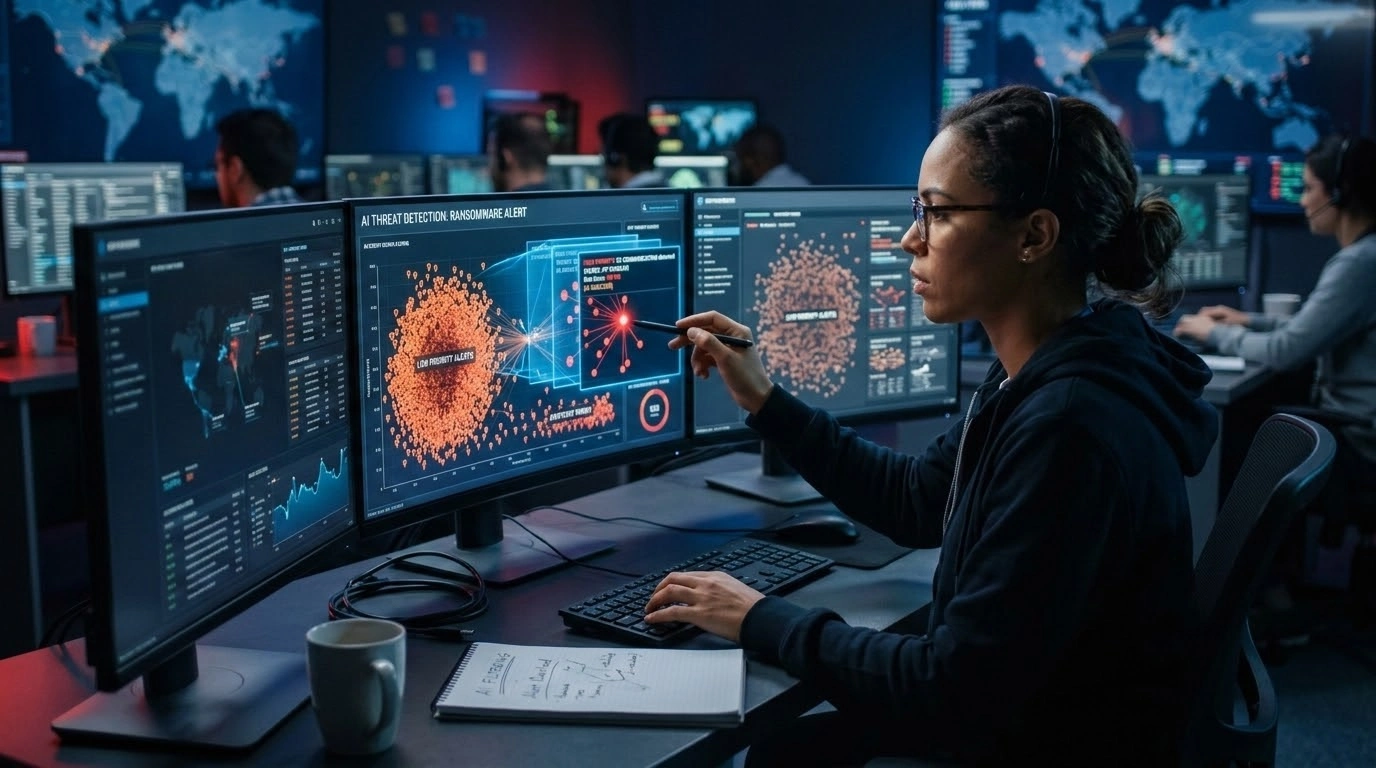
Alert overload creates a dangerous cycle that weakens the entire security posture. When analysts face thousands of daily notifications, their ability to distinguish real threats from false alarms deteriorates rapidly. This condition, known as alert fatigue cybersecurity professionals experience daily, leads to missed critical alerts and slower incident response times.
A study from Techspective in 2026 revealed that the average organization generates 4,330 alerts per day but investigates only 37% of them. That means roughly two out of every three alerts receive zero attention. Analysts working under these conditions often experience chronic stress and burnout. In fact, 69% of cybersecurity professionals reported that fatigue and burnout worsened between 2023 and 2024 (Sophos). D3 Security found that 64% of analysts are considering leaving their roles within a year.
Key points about the impact:
- 25 to 30% of alerts go uninvestigated purely due to volume overload (Cymulate)
- 57% of organizations have turned off security detections because teams lack capacity to review them
- Analysts take an average of 70 minutes to fully investigate a single alert
- Chronic understaffing compounds the problem amid a 4.8 million global cybersecurity talent shortage
How Do AI Tools for SOC Analysts Reduce False Positives?
AI systems cut through alert noise by analyzing patterns across massive datasets that no human could review manually. Modern platforms evaluate each alert against historical threat data, user behavior baselines, and network context to determine which warnings deserve attention. AI tools for SOC analysts have transformed what used to take hours of manual correlation into a process that finishes in seconds.
These platforms apply behavioral analysis to understand what normal activity looks like for each user and device. When something deviates from the established baseline, the system flags it with a risk score instead of generating a generic alert. This approach eliminates the bulk of false positives before they ever reach an analyst queue. Threat prioritization engines then rank remaining alerts by severity, ensuring the most dangerous threats get handled first.
Key points about false positive reduction:
- AI driven alert filtering removes up to 80% of noise before human review
- Behavioral analysis learns normal patterns and flags only genuine anomalies
- Risk based scoring helps analysts focus on high severity threats immediately
- Organizations using process integrated architectures report false positive drops of 60 to 80%
Which AI Powered SIEM Tools 2026 Are Leading the Market?
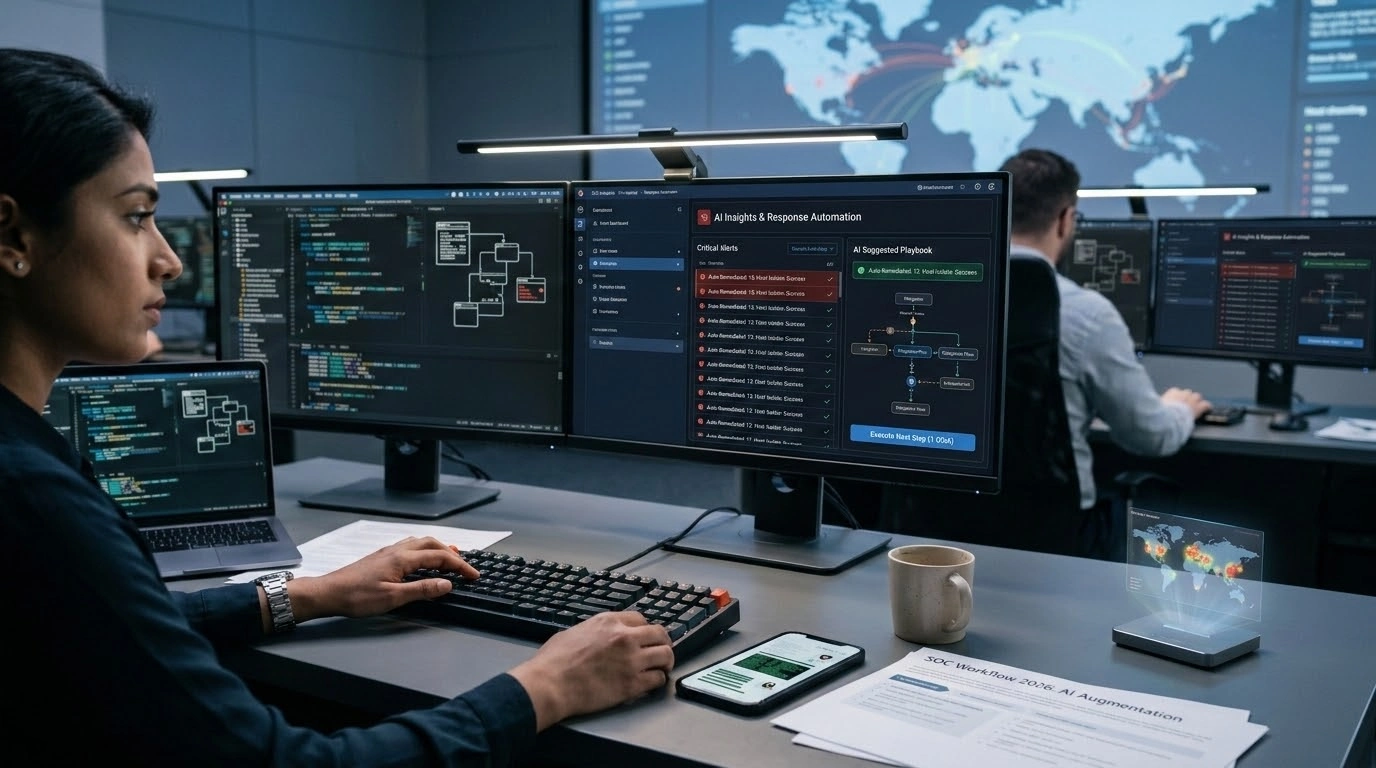
The SIEM landscape has shifted dramatically with AI integration becoming a standard feature rather than an add on. Microsoft Sentinel, Splunk Enterprise Security, and IBM QRadar now embed machine learning directly into their alert correlation engines. These platforms ingest logs from endpoints, networks, and cloud services, then use SIEM AI capabilities to surface the signals that truly matter. Modern platforms can automatically stitch related alerts into single incident narratives.
SOAR (Security Orchestration Automation and Response) platforms like Swimlane and Torq complement SIEM systems by automating response workflows. AI threat intelligence platforms such as Reliaquest and CrowdStrike Falcon add another layer by enriching alerts with real world threat context. The SOAR market alone reached $1.87 billion in 2025 and is projected to hit $4.42 billion by 2030 (Mordor Intelligence), showing how rapidly teams are adopting automation.
Key tools SOC teams are deploying:
- Microsoft Sentinel with AI powered threat analytics and Kusto Query Language
- Splunk Enterprise Security with machine learning based anomaly detection
- IBM QRadar with automated investigation and X Force threat intelligence
- Swimlane and Torq for automated playbook driven response workflows
How Does AI Automation Improve SOC Analyst Productivity?
AI automation handles the repetitive tasks that consume most of a Tier 1 analyst workday. Instead of manually checking IP addresses, running enrichment queries, or copying data between dashboards, analysts delegate these steps to AI agents that complete them in seconds. Platforms like Dropzone AI have demonstrated the ability to reduce alert investigation time from 40 minutes to just 3 minutes, enabling teams to process ten times more alerts without adding headcount.
Automated threat correlation is another major productivity booster. When multiple alerts relate to the same attacker or campaign, AI systems link them together automatically. This prevents analysts from investigating the same incident multiple times from different angles. Swimlane predicts that by 2026, AI will handle over 90% of Tier 1 triage work, allowing human analysts to shift into supervisory and strategic roles.
Key productivity improvements:
- Alert investigation time drops from 40 minutes to under 3 minutes with AI automation
- Automated enrichment eliminates manual IOC lookups and context gathering
- AI agents correlate related alerts into single incident narratives automatically
- Teams report 10x capacity gains without additional hiring
What Skills Do Analysts Need Alongside AI?
Even with advanced automation, human expertise remains irreplaceable in security operations. Analysts need strong threat analysis skills to validate AI findings, interpret complex attack patterns, and make judgment calls that machines cannot. Understanding how to handle alert overload in SOC environments now includes knowing which AI recommendations to trust and when to escalate.
Cloud security awareness has become essential as organizations migrate workloads to AWS, Azure, and Google Cloud. Analysts must understand cloud logging, identity management, and cross cloud threat patterns. Incident response expertise is equally critical because AI can detect and contain threats, but humans must coordinate communication, legal requirements, and business recovery. Gartner projects that by 2028, AI will automate more than 50% of Level 1 SOC responsibilities, making hybrid AI and cybersecurity skills the most valuable credential in the field.
Skills that matter most in 2026:
- Threat analysis and AI assisted investigation knowledge
- Cloud security fundamentals across major platforms
- Incident response coordination and communication
- Hybrid skills combining cybersecurity expertise with AI tool management
What Are the Limitations of AI in SOC Operations?
AI systems are powerful but far from perfect. False confidence in automation is one of the biggest risks teams face. When analysts trust AI outputs without verification, they can miss sophisticated attacks designed to evade detection models. Dark Reading reported that cybersecurity leaders who tested AI in their SOCs for six months discovered significant gaps in accuracy, especially when dealing with novel attack techniques.
AI model inaccuracies stem from training data limitations. Models trained on historical threats may fail to recognize new attack patterns that look nothing like past incidents. Complex attack scenarios that span multiple systems and timeframes often confuse automated systems. Human validation remains essential at every stage, from alert triage to incident containment. Organizations that treat AI as a replacement rather than a multiplier put themselves at greater risk.
Key limitations to understand:
- AI models trained on historical data miss novel attack techniques
- False confidence leads analysts to skip manual verification
- Complex multi stage attacks still require human judgment to investigate
- 92% of security professionals say SOAR tools demand intensive programming skills (ESG)
How Will AI Change the Future Role of SOC Analysts?
The SOC analyst role is shifting from manual monitoring to strategic analysis. AI agents now handle the bulk of Tier 1 alert triage, freeing human analysts to focus on threat hunting, adversary simulation, and security architecture decisions. This evolution mirrors what happened in manufacturing when robotics automated repetitive assembly tasks while creating demand for higher skilled engineering roles.
Demand for hybrid AI and cybersecurity skills is accelerating. Analysts who can configure AI
models, interpret their outputs, and identify blind spots will command premium salaries and leadership positions. The role is becoming less about staring at dashboards and more about directing AI systems, validating their work, and making strategic security decisions. Gartner estimates that AI will automate over 50% of Level 1 responsibilities by 2028, but this creates opportunities for analysts willing to evolve their skill sets.
Key shifts to expect:
- AI handles 90% or more of Tier 1 triage by 2026 (Swimlane prediction)
- Analysts transition from reactive monitoring to proactive threat hunting
- Hybrid AI and security skills become the most sought after qualifications
- Strategic oversight and business context become the primary human value add
Key Takeaways
- SOC teams process an average of 960 alerts daily, with large enterprises facing over 3,000
- 67% of alerts go uninvestigated because manual analysis cannot keep up with volume
- AI powered tools reduce alert investigation time from 40 minutes to under 3 minutes
- Human validation remains essential despite advances in automation
- Hybrid AI and cybersecurity skills will define the next generation of SOC roles
