

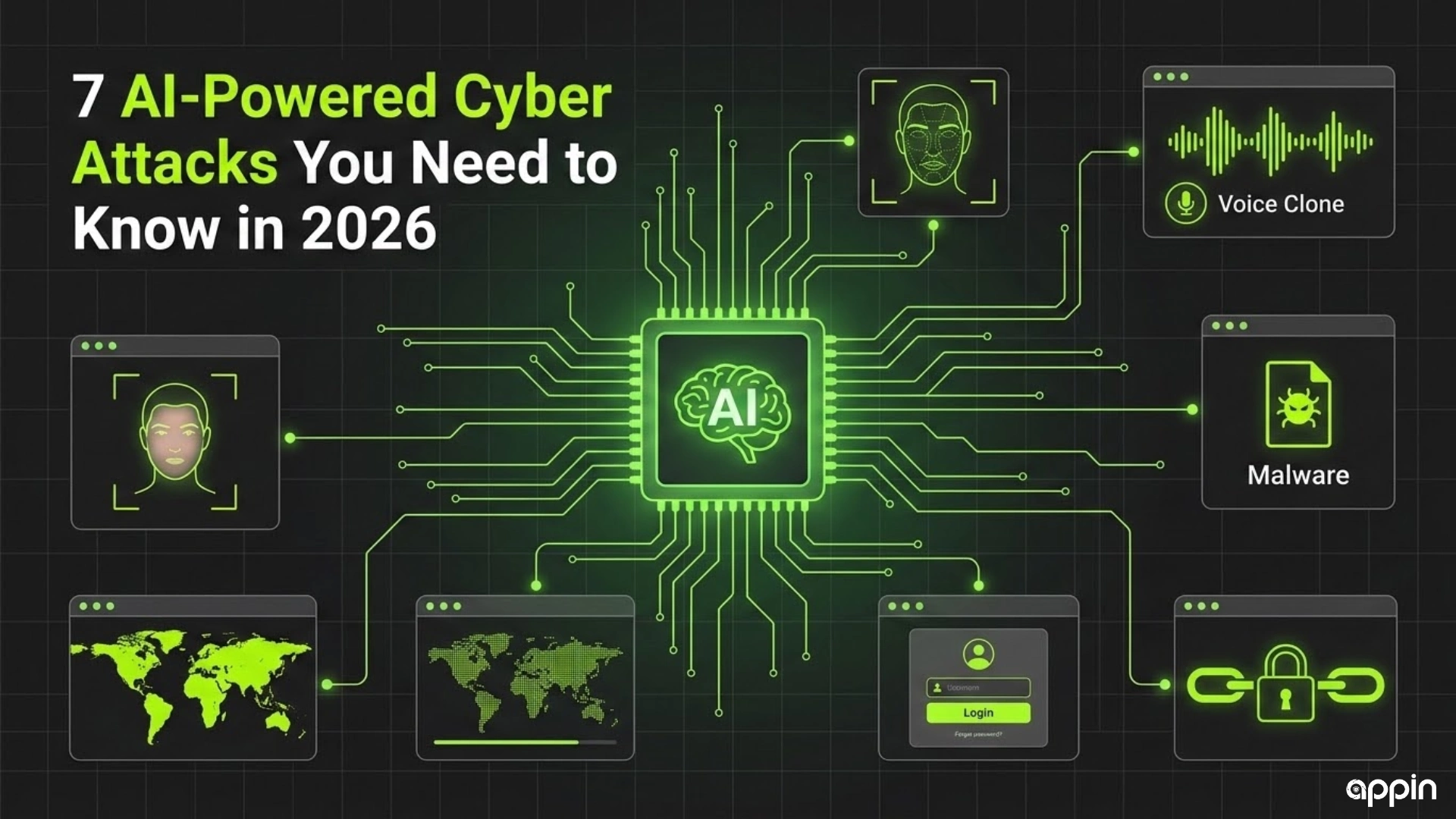
7 AI Cyber Attacks You Need to Know in 2026
What Are the Most Dangerous AI Cyber Attacks in 2026?
The seven most dangerous AI cyber attacks in 2026 include AI generated phishing, deepfake voice and video scams, AI password cracking, adaptive malware, automated social engineering, AI vulnerability scanning, and fake content campaigns. Criminals now use AI tools to launch faster, harder to detect attacks at scale.
AI cyber attacks have become the top concern for security teams worldwide. According to CrowdStrike, attacks from AI enabled adversaries jumped 89% in 2025, and 87% of security professionals report seeing more AI driven threats heading into 2026. These numbers show that AI is no longer a future risk. It is the present reality for every business connected to the internet.
Global cybercrime damages are projected to hit $10.5 trillion in 2026. Organizations face an attack every 39 seconds, and 95% of all breaches are financially motivated. Understanding how AI is used in cyberattacks is no longer optional. It is essential for protecting your business, your data, and your customers.

-
AI Generated Phishing Emails
Hackers use AI to craft phishing emails that read like real messages from coworkers or trusted brands. These emails have perfect grammar, personalized details, and a convincing tone. AI phishing now achieves a 54% success rate, compared to just 12% for traditional phishing attacks.
AI tools can scrape a target’s digital footprint in seconds. They learn writing styles, job
titles, recent projects, and even company news. The result is an email that feels genuine and safe. Employee detection rates for AI generated phishing have dropped to roughly 16%, down from 40% to 50% in previous years.
Businesses lost millions to these attacks in 2025. A single convincing phishing email can give hackers access to entire company networks. Training employees to spot AI generated scams is now harder than ever because the old warning signs like bad grammar and spelling errors no longer apply.
- 14x surge: AI generated phishing attacks by end of 2025
- 54% success rate: for AI phishing compared to 12% for traditional methods
- 16% detection rate: users can barely spot AI generated phishing emails
-
Deepfake Voice and Video Attacks
AI can now clone human voices and create realistic video footage of real people. Criminals use this technology to impersonate CEOs, managers, or family members during phone calls and video meetings. Victims transfer money or share sensitive data believing they are talking to someone they trust.
Deepfake fraud attempts spiked 3000% in 2023, and the numbers keep climbing. Online deepfake files surged from roughly 500,000 in 2023 to about 8 million in 2025. Human detection rates for high quality video deepfakes stand at just 24.5%, meaning most people cannot tell the difference.
In one 2026 case, a group linked to North Korea used an AI generated deepfake of a CEO to trick a victim into compromising their computer security during a spoofed video call. Financial losses from AI assisted fraud in the US alone reached $12.5 billion in 2025.
- 8 million deepfakes: files online in 2025, up from 500K in 2023
- 24.5% detection rate: humans barely detect high quality video deepfakes
- $12.5 billion: US financial fraud losses involving AI in 2025
-
AI Powered Password Cracking
AI tools can now predict and crack passwords much faster than older methods. Instead of blindly guessing every combination, AI learns from leaked password databases and human habits. It predicts likely passwords based on names, dates, seasons, and common word patterns.
Research shows that 85.6% of real world passwords were cracked in under 10 seconds by AI powered tools. Nearly 88% of all passwords fall within one month of cracking time. A predictable 11 character password like Summer2025! cracks instantly, while a random 11 character password takes about 2000 years.
This means password strength matters more than ever. Simple changes like adding a number or special character to a common word no longer provide real protection. Businesses must enforce stronger password policies and adopt multi factor authentication to stay safe from AI hacking attempts.
- 85.6% cracked: passwords broken in under 10 seconds by AI tools
- 88% within a month: nearly all passwords fall within one month cracking time
- Pattern prediction: AI learns human habits instead of using brute force
-
Adaptive AI Malware
Traditional malware follows fixed instructions. Adaptive AI malware changes its behavior in real time to avoid detection. It can modify its own code, switch attack methods, and hide inside normal system processes. Security tools that rely on known signatures struggle to catch it.
CrowdStrike reported a 42% increase in zero day vulnerabilities exploited before public disclosure in 2025. Much of this was driven by AI malware that adapts to each target environment. The average eCrime breakout time dropped to just 29 minutes, giving security teams almost no time to respond.
IBM found that 82% of detections were malware free in 2025. Attackers used living off the land techniques combined with AI to compromise systems without dropping malicious files. This makes AI powered cyber threats 2026 one of the hardest challenges for security teams worldwide.
- 29 minutes: average eCrime breakout time in 2025
- 82% malware free: detections involved no malicious file drops
- 42% increase: zero day exploits before public disclosure
-
Automated Social Engineering Campaigns
AI chatbots now run social engineering attacks on thousands of people at once. These bots hold natural conversations, build trust over time, and manipulate victims into sharing passwords, clicking links, or transferring money. ISACA named AI driven social engineering as the top cyber threat for 2026.
In 2025, 33% of organizations saw an increase in attempts to influence internal behavior. Another 47% reported more single message attacks designed to trick employees. AI chat scams have become so convincing that victims often do not realize they are talking to a bot until the damage is done.
Fake customer support is one of the most common forms. A victim receives a text or email about a problem with their account. They click a link and end up in a chat with an AI bot that collects their login details, credit card information, or personal data. Cybersecurity 2026 strategies must account for this growing threat.
- 63% of professionals: rank AI social engineering as top 2026 threat
- 33% of organizations: saw increased internal influence attacks
- 47% reported: more single message attack attempts
-
AI Based Vulnerability Discovery
Hackers use AI tools to scan software, networks, and systems for weaknesses much faster than manual methods. AI can analyze millions of lines of code in minutes and find security gaps that human testers might miss. This makes AI in ethical hacking a double edged sword.
While AI helps defenders find and fix vulnerabilities, the same tools are available to attackers. AI penetration testing tools can chain exploits together, reason about application behavior, and find attack paths that traditional scanners have missed for years. The total disclosed vulnerabilities increased 16% in the first half of 2025 compared to 2024.
Organizations that rely only on annual security audits are at high risk. Continuous AI powered scanning and testing is now necessary to keep up with attackers who use the same technology to find and exploit weaknesses before defenders can patch them.
- 16% increase: disclosed CVEs in H1 2025 vs H1 2024
- 161 vulnerabilities: exploited by threat actors in H1 2025
- Years of missed flaws: AI pentest tools find bugs traditional scanners missed

-
AI Generated Fake Content and Disinformation
AI creates fake news articles, social media posts, and images at massive scale. These campaigns damage brand reputation, manipulate stock prices, and mislead the public. NewsGuard found that AI enabled fake news sites increased tenfold in 2023, and the problem has only grown since.
The global cost of fake news and disinformation reached an estimated $78 billion in 2025. AI chatbots relay false claims in 35% of cases, up from 18% the previous year. This makes it harder for people to find trustworthy information online and for businesses to protect their brand image.
For businesses, fake content can mean fabricated product reviews, false company announcements, or fake executive statements. These attacks damage customer trust and can lead to real financial losses. Monitoring online mentions and using AI detection tools has become a necessary part of brand protection.
- 10x growth: AI enabled fake news sites in 2023
- $78 billion: estimated global cost of fake news in 2025
- 35% false claims: AI chatbots relay false information regularly
Key Takeaways
- AI cyber attacks are growing 89% year over year, with damages projected at $10.5 trillion globally in 2026
- AI phishing achieves a 54% success rate because emails now have perfect grammar and personal details
- Deepfake voice and video scams cost victims $12.5 billion in the US alone during 2025
- AI password cracking breaks 85.6% of passwords in under 10 seconds using pattern prediction
- Adaptive AI malware evades 82% of traditional detection methods
- AI social engineering is the top ranked cyber threat by 63% of security professionals
- Businesses must adopt AI driven defense tools and continuous monitoring to stay protected
