

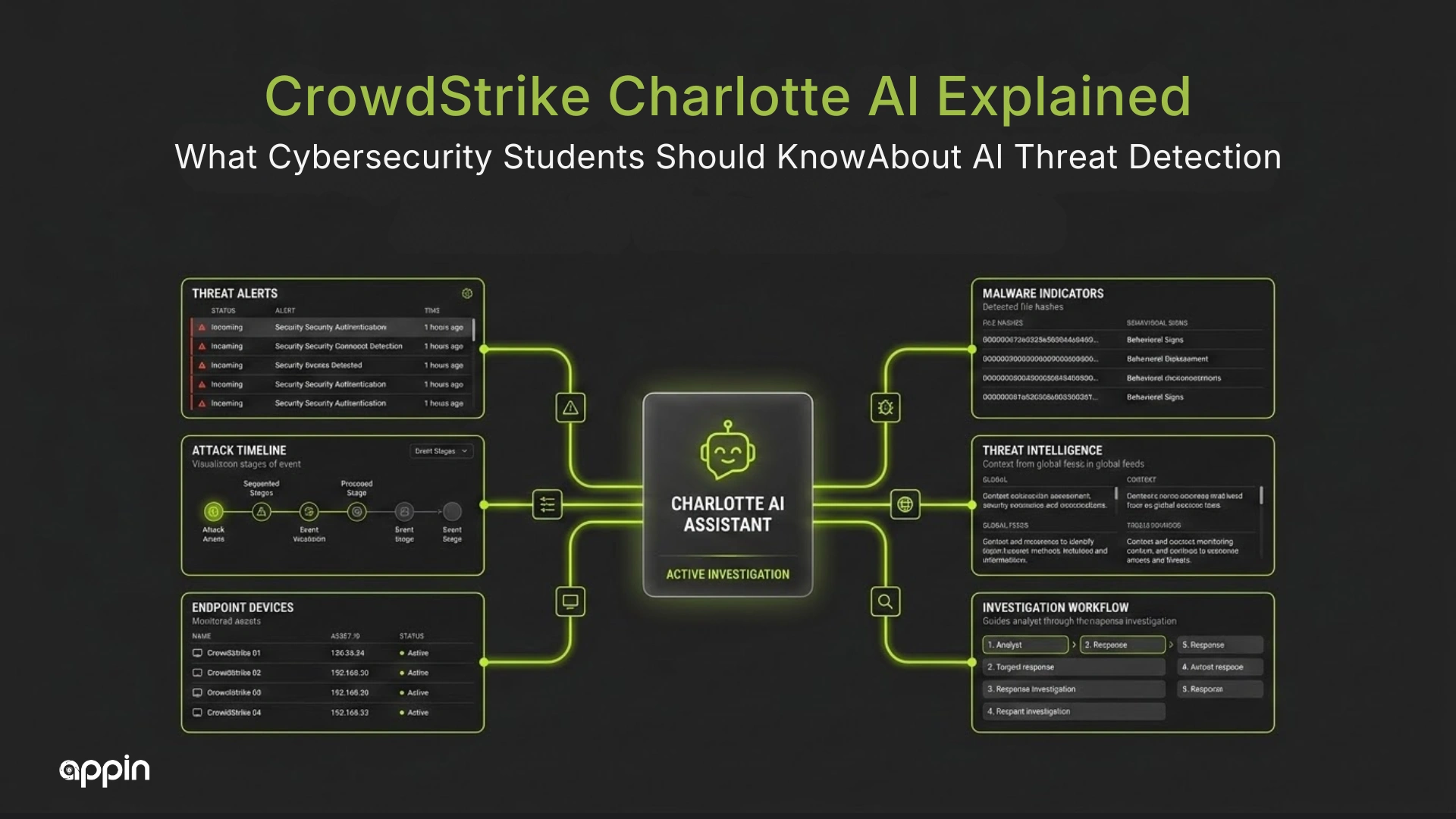
CrowdStrike Charlotte AI Explained: What Cybersecurity Students Should Know About AI Threat Detection
CrowdStrike Charlotte AI is an AI security analyst built for the CrowdStrike Falcon platform, and students should understand it because AI threat detection is becoming part of modern SOC work.
If you are preparing for cybersecurity jobs, this matters because security teams now handle thousands of alerts, endpoint signals, suspicious files, login events, and investigation tasks. AI can help analysts move faster, but it does not remove the need for human judgment.
This is part of the bigger shift in cybersecurity careers, AI changing cybersecurity jobs explains that broader change for students.
What is CrowdStrike Charlotte AI?
CrowdStrike Charlotte AI is an agentic AI security analyst inside the Falcon platform that helps teams investigate, triage, and respond to threats faster.
In simple words, it works like an AI assistant for security teams. It can help analysts understand detections, reduce repetitive triage work, summarize findings, and support investigation workflows.
CrowdStrike positions Charlotte AI as part of its AI native security platform. For students, the important point is not only the tool name. The important point is how AI is becoming part of SOC investigation work.
Why is AI being used in threat detection?
AI is being used in threat detection because security teams need faster ways to handle large volumes of alerts, logs, and endpoint activity.
A SOC analyst may see alerts from laptops, servers, cloud systems, user accounts, and email tools. Checking every signal manually takes time.
AI can help with:
- Alert prioritization
- Pattern recognition
- False positive reduction
- Faster summaries
- Incident context
- Repeated task automation
This is why AI cybersecurity tools for students are worth understanding early. They show how real security teams are changing their workflows.
What does agentic AI mean in cybersecurity?
Agentic AI in cybersecurity means AI that can follow goals, use security data, take structured steps, and support workflows under human control.
A normal chatbot may only answer questions. Agentic AI is designed to assist with a task flow, such as triaging detections, gathering evidence, or summarizing an incident.
That does not mean the AI should act without oversight. In cybersecurity, response actions can affect real systems, so analysts must verify outputs before acting.
For beginners, agentic AI means support with workflow, not permission to trust automation blindly.
How does Charlotte AI help security teams detect threats faster?
CrowdStrike Charlotte AI helps teams detect threats faster by supporting detection triage, reducing manual review, and helping analysts focus on alerts that matter.
Detection triage is the process of deciding whether an alert is suspicious, false positive, or urgent. If this step is slow, real incidents can take longer to investigate.
Charlotte AI can support teams by:
- Reviewing detection context
- Summarizing alert details
- Helping reduce false positives
- Prioritizing important detections
- Supporting analyst decision making
For students, this is a good example of AI threat detection skills for freshers. You need to understand how alerts are reviewed, not only how tools are named.
Step 1: How are security alerts collected from the Falcon platform?
Security alerts are collected from the Falcon platform when endpoint, identity, cloud, or activity signals show possible suspicious behavior.
The Falcon platform collects security data from protected systems. These detections may include suspicious processes, unusual file behavior, identity signals, or possible attacker activity.
A beginner can imagine this like a college lab network where many computers send security alerts to one dashboard. The analyst then needs to decide which alert needs attention.
AI helps organize this data, but the analyst still needs basic security understanding.
Step 2: How does Charlotte AI triage which alerts matter most?
Charlotte AI triage helps identify which detections may need analyst attention first.
Not every alert means a real attack. Some alerts come from normal admin tools, software updates, or harmless user activity.
AI triage can help sort detections by context, severity, and behavior. This reduces the time analysts spend reviewing repeated low value alerts.
For SOC roles, this is where SOC analyst AI skills matter. Analysts must understand why an alert was prioritized and whether the AI summary makes sense.
Step 3: How are false positives reduced before analysts investigate?
False positives are reduced by checking alert context before sending every detection for deeper investigation.
A false positive is an alert that looks risky but is not truly malicious. For example, an IT admin running a script may look suspicious, but it may be approved work.
AI can help compare alert details with known behavior, context, and related signals. This reduces noise and lets analysts spend more time on real risk.
Still, false positive reduction needs human review because business context matters.
Step 4: How does AI help analysts understand the attack context?
AI helps analysts understand attack context by connecting signals into a clearer story of what may have happened.
Instead of seeing only one alert, analysts need to know the bigger picture. Was there suspicious login activity? Was a file executed? Did a process connect to an unknown domain? Was any user account affected?
Charlotte AI style workflows can help summarize:
- What triggered the alert
- Which device was affected
- Which user was involved
- What behavior looked suspicious
- What evidence supports the detection
- What should be reviewed next
This is where AI in SOC analyst jobs becomes important.
Step 5: Why do analysts review recommendations before taking action?
Analysts review recommendations because AI can support investigation, but humans are responsible for final decisions.
AI may summarize evidence or suggest next steps, but response actions should not be taken blindly. Blocking a file, isolating a device, or escalating an incident can affect real business work.
Human oversight is needed for:
- Validation
- Business context
- Legal responsibility
- Communication
- Incident response decisions
- Final approval
AI can speed up investigation, but the analyst owns the judgment.
What is detection triage in cybersecurity?
Detection triage is the process of reviewing security alerts to decide which ones are real, urgent, false, or need escalation.
In a SOC, triage is often the first major task. L1 analysts usually check alerts first, while L2 analysts investigate deeper cases.
If you want to understand how L1 and L2 responsibilities differ, read SOC analyst L1 vs L2
This is important because AI tools may assist both levels differently. L1 may use AI for faster triage, while L2 may use it for deeper investigation.
How does AI threat detection help SOC analysts?
AI threat detection helps SOC analysts by reducing manual work, improving alert context, and speeding up investigation.
A SOC analyst does not only “watch alerts.” They must read logs, understand user activity, check endpoint behavior, write tickets, and escalate clearly.
AI can help with:
- Alert explanation
- Triage support
- Evidence summaries
- Timeline creation
- False positive review
- Incident notes
- Response suggestions
This supports the future of SOC analyst with AI, where analysts spend less time on repeated checks and more time on judgment.
How does Charlotte AI compare with other AI security platforms?
Charlotte AI is one of several AI powered security platforms helping SOC teams investigate threats faster.
Microsoft Security Copilot and Google SecOps with Gemini are also examples of AI assisted security operations. Students can compare these tools to understand how the industry is changing.
For platform comparison, read Microsoft Security Copilot and Google SecOps with Gemini
The common lesson is simple. AI helps analysts search, summarize, triage, and report faster, but the fundamentals remain important.
What can cybersecurity students learn from Charlotte AI?
Cybersecurity students can learn that modern SOC work is moving toward AI assisted triage, investigation, detection, and response.
AI tools for cybersecurity beginners are useful to study because they show how real teams manage large security data. Students do not need direct access to every enterprise tool to learn the workflow.
You can still learn the foundations through:
- SOC alert examples
- Log analysis practice
- Endpoint security concepts
- Incident timeline writing
- False positive review
- Threat intelligence basics
- Report writing
These are practical AI threat detection skills for freshers.
What skills do students need to work with AI security tools?
Students need cybersecurity fundamentals, log understanding, tool practice, AI output validation, and communication skills to work with AI security tools.
The best cybersecurity skills for 2026 are not only AI prompts. They are security basics plus the ability to verify AI output.
Focus on:
- Networking basics
- Windows and Linux logs
- Endpoint security concepts
- SIEM basics
- Incident response workflow
- Threat intelligence basics
- Report writing
- AI prompt discipline
- Manual validation
If you are asking how to become an SOC analyst with AI skills, start with fundamentals, then learn how AI supports investigation.
What are the risks and limitations of AI in threat detection?
AI in threat detection can make mistakes, misunderstand context, miss evidence, or create overconfidence if analysts trust it blindly.
Risks include:
- False confidence
- Wrong summaries
- Missed context
- Poor data quality
- Over reliance on automation
- Weak human review
- Privacy and governance concerns
Cybersecurity jobs in the AI era will still need professionals who can ask good questions, verify answers, and explain decisions clearly.
