

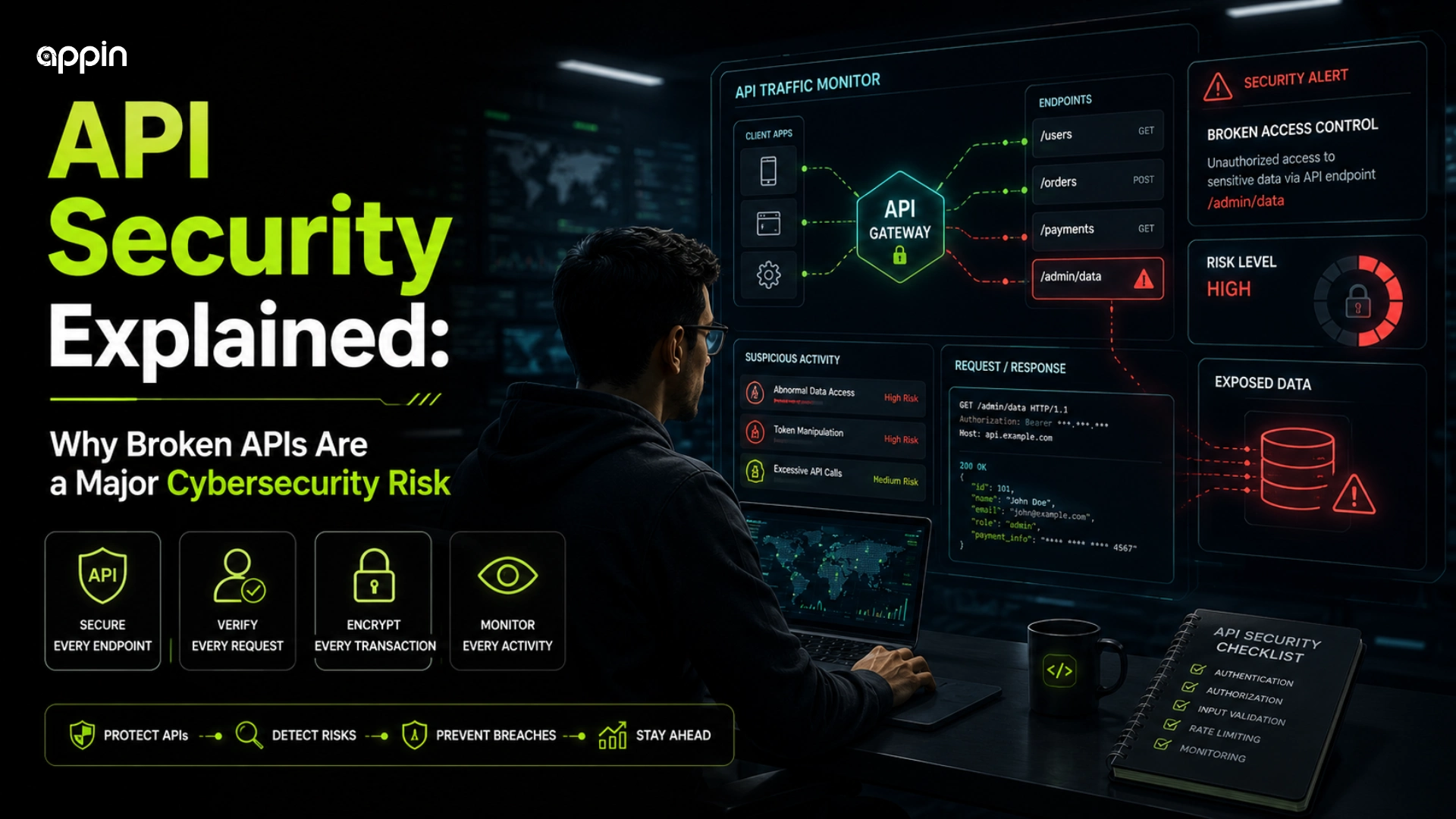
What is API security in cybersecurity?
API security means protecting the connections that allow applications, servers, mobile apps, and third party systems to exchange data safely.
An API is like a messenger between systems. For example, a food delivery app may use APIs to fetch restaurant lists, show order status, verify payment, and update delivery location.
API security is important in:
- Websites
- Mobile apps
- SaaS platforms
- Banking apps
- Healthcare systems
- E-commerce platforms
- Cloud dashboards
- Third party integrations
Application security protects the full app. API security focuses on the data exchange points that connect the app to backend systems.
Why are broken APIs a major cybersecurity risk?
Broken APIs are risky because they can expose sensitive data, allow unauthorized access, and give attackers a direct path into business systems.
A broken API cybersecurity risk can affect many users at once. If one weak endpoint exposes invoice, order, or customer data, thousands of records may be at risk.
This is why broken APIs are dangerous:
- APIs often handle sensitive data
- Attackers can bypass the visible app screen
- Weak APIs can leak user records
- Broken APIs can allow account takeover
- Business logic can be abused
- One weak API can affect many users
A broken API can expose customer records, payment data, or internal business information without a visible website attack. data exfiltration
How do attackers find insecure APIs?
Attackers find insecure APIs by studying app traffic, mobile app requests, public documentation, hidden endpoints, and predictable URL patterns.
API attacks in cybersecurity often begin with observation. Attackers may look at how the website or mobile app communicates with backend servers.
They may study:
- API endpoints
- Browser developer tools
- Mobile app traffic
- Public API documentation
- Old API versions
- Predictable URLs
- Request parameters
- Error messages
A hidden API is not automatically safe. If the mobile app can call it, attackers may also discover and test it.
What are the most common API security vulnerabilities?
Common API security vulnerabilities include broken authentication, broken authorization, broken object access, weak resource controls, and insecure business flows.
Common API vulnerabilities explained in simple terms means these are repeated mistakes that allow unsafe access, data leakage, or misuse of application functions.
Important risks include:
– Broken authentication
– Broken object level authorization
– Broken object property level authorization
– Broken function level authorization
– Unrestricted resource consumption
– Unrestricted access to sensitive business flows
– Security misconfiguration
– Injection attacks
– Poor logging and monitoring
An API vulnerability becomes serious when it exposes data, changes access, or allows actions that the user should not perform.
How does broken authentication affect API security?
Broken authentication happens when APIs do not properly verify who the user is before allowing access.
Authentication answers one question: “Who are you?” If this step is weak, attackers may misuse tokens, sessions, or login flows.
Examples include:
- Weak login protection
- Stolen tokens
- Poor session handling
- Missing MFA support
- Predictable tokens
- Token leakage
- Account takeover risk
APIs should never trust a request only because it looks normal. Identity must be verified properly.
How does broken authorization expose business data?
Broken authorization happens when a logged in user can access data or actions they should not be allowed to access.
Authorization answers a different question: “Are you allowed to do this?” A user may be logged in but still not allowed to view another customer’s profile or invoice.
Examples include:
- Viewing another user’s profile
- Accessing another customer’s order
- Changing account details without permission
- Normal users accessing admin functions
- Role based access failure
- Unauthorized file downloads
API security also connects with zero trust because companies cannot assume every internal request is safe. zero trust security for beginners
What is BOLA in API security?
BOLA, or Broken Object Level Authorization, is an API vulnerability where attackers change an object ID and access another user’s data.
For example, imagine this API request:
/api/orders/1001
If a user changes 1001 to 1002 and sees another user’s order, that is a serious authorization failure.
BOLA can happen with:
- User IDs
- Order IDs
- Invoice IDs
- Ticket IDs
- Document IDs
- Account IDs
The server must check whether the logged in user is allowed to access that exact object. Frontend hiding is not enough.
What is Broken Object Property Level Authorization?
Broken Object Property Level Authorization happens when an API exposes or allows changes to object properties that the user should not be allowed to see or modify.
In simple words, the user may be allowed to access one record, but not every field inside that record. The API must control both the object and its properties.
For example, a shopping app may show your order status and delivery address. But the same API response should not expose internal notes, admin flags, hidden user IDs, discount rules, or payment related fields.
This issue includes two older API risk ideas:
– Exposing properties users should not see
– Allowing users to modify properties they should not control
Earlier, these were often discussed as “Excessive Data Exposure” and “Mass Assignment.” In OWASP’s 2023 API Security Top 10, they are combined under Broken Object Property Level Authorization.
This can expose:
- Personal information
- Internal IDs
- Tokens
- Payment related details
- Admin fields
- Hidden backend data
- Account role settings
- Approval or status fields
The backend should filter sensitive fields before sending responses and must block users from changing protected properties. The frontend should not be trusted to hide sensitive fields.
How do weak rate limits make APIs unsafe?
Weak rate limits make APIs unsafe because attackers can repeat requests quickly for brute force, scraping, OTP abuse, or credential stuffing.
Rate limits control how often a user or system can make requests. Without limits, APIs can be abused at scale.
Weak rate limits can lead to:
- Brute force login attempts
- OTP guessing
- Account enumeration
- Data scraping
- Password reset abuse
- Bot driven attacks
- Resource exhaustion
Monitoring also matters because high request volume may be an early sign of abuse.
How can API misconfiguration create security gaps?
API misconfiguration can expose debug data, old endpoints, unnecessary methods, weak CORS settings, or sensitive error messages.
A configuration mistake may look small, but it can reveal important information to attackers.
Common gaps include:
- Debug mode exposure
- Verbose error messages
- Open CORS policy
- Unused API versions
- Test endpoints left public
- Missing security headers
- Poor server configuration
Security teams should review configurations before release and during regular testing.
How do insecure APIs expose sensitive business data?
Insecure APIs can expose customer data, employee records, payment details, health information, business documents, and internal system data.
For a business, API leakage is not just a technical problem. It can become a trust, compliance, and reputation issue.
Sensitive data may include:
- Customer profiles
- Invoices and orders
- Payment related information
- Internal reports
- HR records
- Vendor data
- Documents
- System logs
This is why APIs must be protected like core business systems.
How is API security tested by ethical hackers?
Ethical hackers test API security by reviewing endpoints, checking authentication, testing authorization, analyzing responses, and validating business logic safely.
API security testing for students must happen only in legal labs, training platforms, bug bounty scopes, or authorized company environments.
Testing may include:
- API documentation review
- Request and response analysis
- Token testing
- Role based access testing
- Parameter manipulation
- Rate limit testing
- Error handling review
- Responsible reporting
The goal is to find weaknesses safely and help fix them.
What tools are used for API security testing?
API security testing often uses tools that help inspect, send, modify, and analyze API requests and responses.
Common tools include:
- Burp Suite
- OWASP ZAP
- Postman
- Browser developer tools
- API documentation tools
- Logs and SIEM tools
Tools support testing, but they do not replace skill. A student must understand HTTP, authentication, authorization, and business logic.
How can organizations secure APIs throughout the application lifecycle?
Organizations can secure APIs by building security into design, development, testing, deployment, monitoring, and incident response.
API security should not start after the app is live. It should be included from planning to monitoring.
Important steps include:
- Secure API design
- Strong authentication
- Role based authorization
- Input validation
- Rate limiting
- Data minimization
- Secure code reviews
- API testing before release
- Monitoring and logging
- Regular VAPT
As companies connect AI assistants with business systems, API security becomes even more important. AI agent security
Why is API security important for mobile apps and cloud platforms?
API security is important for mobile apps and cloud platforms because most mobile and cloud services depend heavily on API communication.
A mobile app is often only the visible layer. The real data comes from backend APIs.
API security matters for:
- Mobile apps
- Cloud dashboards
- SaaS platforms
- Partner integrations
- Payment systems
- Healthcare apps
- HR systems
- Customer portals
One exposed API can create a large scale data risk.
What can cybersecurity students learn from API security?
Cybersecurity students can learn web security, authentication, authorization, data exposure, business logic testing, and secure application thinking through API security.
API security for beginners is a strong learning area because it connects practical testing with real business impact.
Students should learn:
- HTTP requests and responses
- Tokens and sessions
- OWASP API risks
- Web security basics
- VAPT methodology
- Report writing
- Secure coding awareness
- Bug bounty relevance
Many beginners search how hackers exploit APIs, but the safe learning path is authorized testing, lab practice, and responsible reporting.
How can Appin help students learn API security practically?
Appin helps students learn API security through ethical hacking training, web application security concepts, hands-on labs, real tools, and career focused guidance.
At Appin Indore, students can build cybersecurity fundamentals, ethical hacking foundation, web application security knowledge, vulnerability assessment basics, Burp Suite workflow awareness, and SOC or VAPT career readiness.
Students can explore CEH v13, CHFI, Bug Bounty Diploma, Diploma in Information Security, and the 6 month Diploma in IT Security and Ethical Hacking.
Appin Technology Lab also provides mentor led learning, career guidance, and placement assistance for students and freshers.
Why API Security Matters for Modern Cybersecurity Careers
API security explained in one line: APIs must be protected because they carry sensitive business data between apps, users, and servers.
When APIs are broken, attackers may access data, abuse functions, or bypass normal application controls. Strong API security requires authentication, authorization, validation, monitoring, testing, and continuous improvement.
Start your cybersecurity journey with Appin Indore and build practical API security, web application testing, ethical hacking, and VAPT skills through authorized training labs, defensive cybersecurity concepts, responsible investigation practices, and expert support.
