

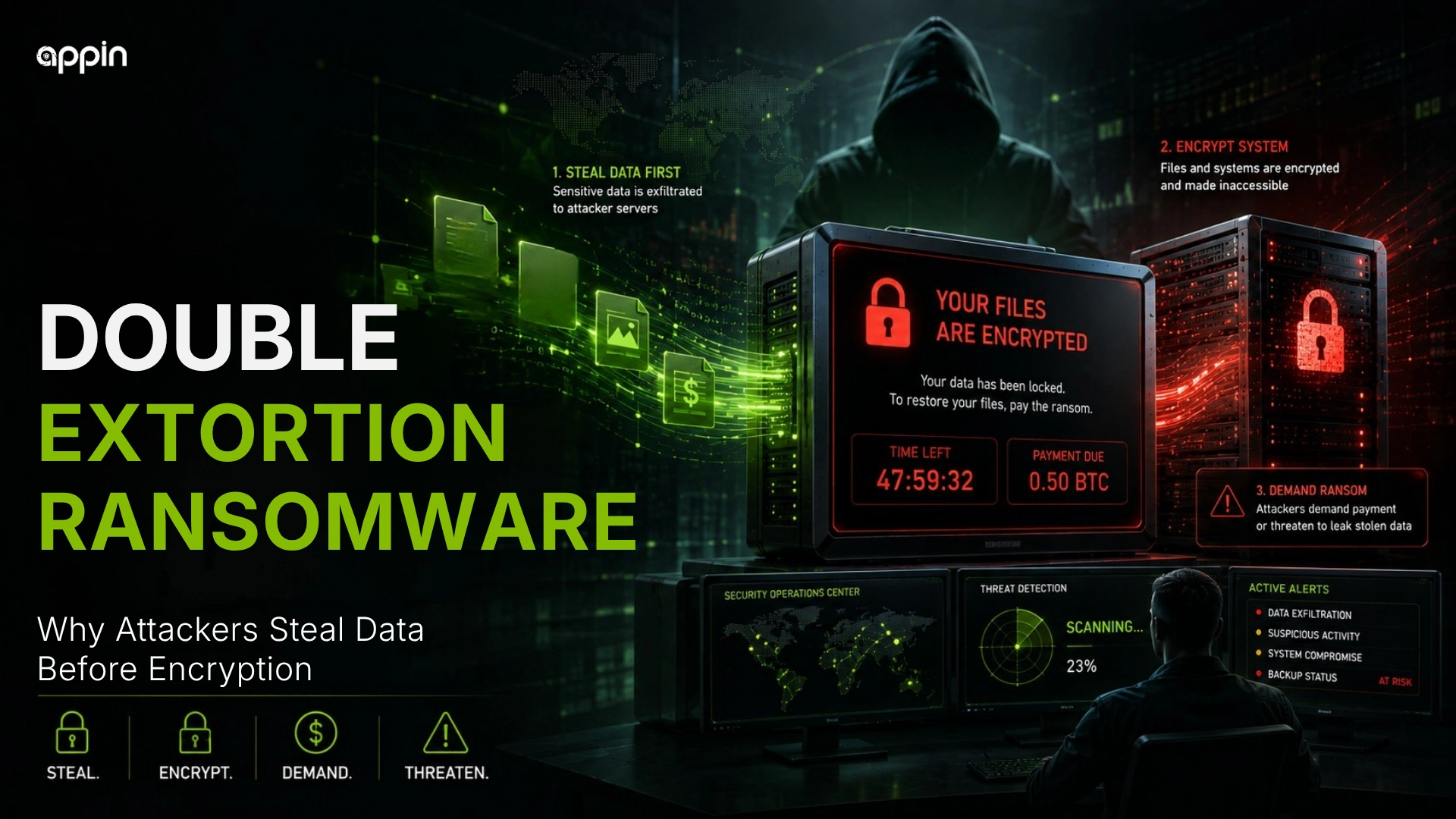
Double Extortion Ransomware Explained: Why Attackers Steal Data Before Encryption
Double extortion ransomware simply means attackers do not only lock files, they also steal sensitive data and threaten to leak it.
Older ransomware mostly focused on encryption. If the victim had clean backups, the pressure reduced. Double extortion changed that because attackers can still threaten customers, employees, partners, and reputation even when systems can be restored.
This blog explains how double extortion works, why attackers steal data before encryption, how security teams detect early signs, and what cybersecurity students can learn from this modern ransomware method.
What is double extortion ransomware?
Double extortion ransomware is a cyberattack where attackers steal data first, then encrypt systems, and use both data leakage and file locking to pressure the victim.
Traditional ransomware mainly attacked availability, which means the organization could not access files or systems. Double extortion ransomware attacks both availability and confidentiality.
The two pressure points are:
- Files are encrypted, so work stops.
- Data is stolen, so leak pressure begins.
This creates legal, financial, and reputation risk for the organization.
Why do attackers steal data before encryption?
Attackers steal data before encryption because stolen data gives them extra leverage even if the victim can restore files from backups.
This is why attackers steal data before encryption in many modern cases. Backups can help recover systems, but they cannot erase leaked customer records, HR files, contracts, or emails.
Stolen data creates pressure through:
- Public exposure risk
- Customer data concerns
- Employee privacy issues
- Partner and vendor pressure
- Compliance worries
- Reputation damage
Double extortion is one of the biggest reasons ransomware attacks feel more damaging than older file locking attacks. ransomware in 2026
How does a double extortion ransomware attack usually start?
A double extortion ransomware attack usually starts with phishing, stolen credentials, exposed remote access, unpatched software, or a compromised vendor account.
A ransomware attack often begins quietly. The visible encryption stage may come later.
Common entry points include:
- Phishing emails
- Fake login pages
- Stolen passwords
- VPN or RDP abuse
- Software vulnerabilities
- Third party compromise
- Weak MFA controls
Attackers want initial access first. After that, they search for useful systems and sensitive files.
What happens before the ransomware encryption begins?
Before encryption begins, attackers often explore the network, steal credentials, find sensitive files, and quietly move data outside the organization.
This is how double extortion ransomware works before the final stage becomes visible.
The early phase may include:
- Internal reconnaissance
- Privilege escalation
- Searching file shares
- Finding databases
- Looking for backups
- Compressing files
- Staging data
- Data exfiltration
The first warning sign is often silent data movement before the final encryption stage begins. data exfiltration detection
What type of data do attackers steal in double extortion attacks?
Attackers usually steal data that can create maximum pressure, such as customer records, employee files, financial documents, contracts, source code, and confidential emails.
Data theft ransomware focuses on information that creates fear or business damage.
A data leak attack may involve:
- Customer personal data
- Employee HR records
- Financial statements
- Legal documents
- Vendor contracts
- Intellectual property
- Credentials and access tokens
- Internal emails and chats
The more sensitive the data, the more pressure attackers can create.
How does stolen data increase extortion risk?
Attackers use stolen data by threatening public leaks, contacting customers, exposing sensitive documents, or listing the victim on ransomware leak sites.
This is the ransomware extortion part of the attack. The goal is not only technical damage, but business pressure.
Double extortion attack examples may include:
- Leak site threats
- Countdown timers
- Sample data leaks
- Customer notification pressure
- Media and reputation pressure
- Compliance fear
- Repeated payment demands
Cyber extortion works because victims fear what will happen after the data becomes public.
Why are backups not enough against double extortion ransomware?
Backups are not enough because they help restore encrypted files but cannot undo stolen data exposure.
Backups solve recovery, not leakage. If attackers already copied sensitive data, restoring systems does not remove the privacy and reputation risk.
Ransomware encryption and data leak pressure means organizations need both recovery and detection.
Good defense needs:
- Backups
- Access control
- Data loss prevention
- Monitoring
- Data classification
- Incident response
- Legal and compliance planning
A backup plan is important, but it is not a complete ransomware strategy.
How can cybersecurity teams detect data theft before encryption?
Cybersecurity teams can detect data theft by monitoring unusual file access, large data transfers, suspicious compression, abnormal login behavior, and outbound network traffic.
Data exfiltration in ransomware attacks often leaves signals before encryption begins.
Useful detection signs include:
- Large file downloads
- Unusual access to sensitive folders
- New archive files
- Data transfer to unknown destinations
- Suspicious cloud uploads
- Off hours account activity
- Unusual admin tool use
- SIEM and EDR alerts
If attackers exploit weak application connections, broken APIs can become one route for data exposure. API security explained
What early warning signs suggest a double extortion attack?
Early warning signs include unusual logins, privilege escalation, mass file access, suspicious PowerShell use, disabled security tools, and unexpected data transfers.
Security teams should treat strange behavior as a possible chain, not an isolated event.
Warning signs include:
- New admin accounts
- Failed MFA attempts
- Remote access from unusual locations
- Endpoint protection tampering
- Large outbound traffic spikes
- Backup access attempts
- File share enumeration
- Unknown tools on systems
Early detection can stop attackers before encryption spreads.
How does incident response change in double extortion ransomware?
Incident response changes because teams must handle both system recovery and stolen data risk at the same time.
In older file locking incidents, the main question was recovery. In double extortion, teams must also ask what data was accessed, copied, or exposed.
Incident response may include:
- Containing infected systems
- Stopping data movement
- Identifying accessed data
- Preserving evidence
- Notifying legal or compliance teams
- Communicating with stakeholders
- Restoring safely from backups
- Preventing reinfection
This is why incident response planning matters before an attack happens.
How can organizations reduce double extortion risk?
Organizations can reduce double extortion risk by combining access control, monitoring, encryption, backups, segmentation, employee training, and incident response planning.
No single tool can stop every attack. Defense must reduce both access and impact.
Important controls include:
- MFA everywhere
- Least privilege access
- Network segmentation
- EDR and SIEM monitoring
- Data classification
- DLP controls
- Immutable backups
- Patch management
- Phishing awareness
- Incident response drills
The goal is to detect suspicious access before stolen data becomes extortion pressure.
Why does employee awareness matter in double extortion defense?
Employee awareness matters because phishing, fake login pages, and social engineering are common ways attackers get the first access needed for ransomware.
Employees are often the first line of reporting. A quick report can help security teams check suspicious emails, strange login prompts, or unexpected file requests.
Employees should learn:
- Phishing detection
- Password safety
- MFA prompt awareness
- Suspicious attachment reporting
- Fake vendor email checks
- Urgent document request verification
- Internal reporting steps
A trained employee can stop one small mistake from becoming a major incident.
What can cybersecurity students learn from double extortion ransomware?
Cybersecurity students can learn how modern ransomware combines phishing, credential theft, lateral movement, data exfiltration, encryption, and incident response.
Modern ransomware tactics explained through double extortion give students a full view of how real cyber incidents unfold.
Students can learn:
- Attack chain understanding
- Log analysis
- Endpoint investigation
- Malware basics
- Data exfiltration detection
- Threat intelligence
- Digital forensics
- Incident response workflows
- SOC analyst relevance
This makes double extortion ransomware a useful case study for students who want to work in SOC, incident response, cyber forensics, or ethical hacking.
How can Appin help students learn ransomware defense practically?
Appin helps students understand ransomware defense through authorized training labs, defensive cybersecurity concepts, ethical hacking foundations, incident response awareness, and responsible investigation practices.
At Appin Indore, students can learn cybersecurity fundamentals, malware and phishing awareness, network attacks and defense, SOC basics, VAPT relevance, ransomware defense basics, and safe evidence handling.
Students can explore CEH v13, CHFI, Bug Bounty Diploma, Diploma in Information Security, and the 6 month Diploma in IT Security and Ethical Hacking.
Appin Technology Lab also provides mentor led learning, career guidance, and placement assistance for students and freshers who want to build legal, defensive, and job focused cybersecurity skills.
Why Double Extortion Ransomware Needs Early Detection
Double extortion ransomware creates two problems at the same time: locked systems and stolen data.
Encryption can stop daily work, but stolen data creates longer pressure through leak threats, compliance risk, and reputation damage. Strong defense requires early detection, access control, monitoring, backups, employee awareness, and a tested incident response plan.
Start your cybersecurity journey with Appin Indore and build ransomware awareness and defensive incident response skills through authorized training labs and expert guidance..
