

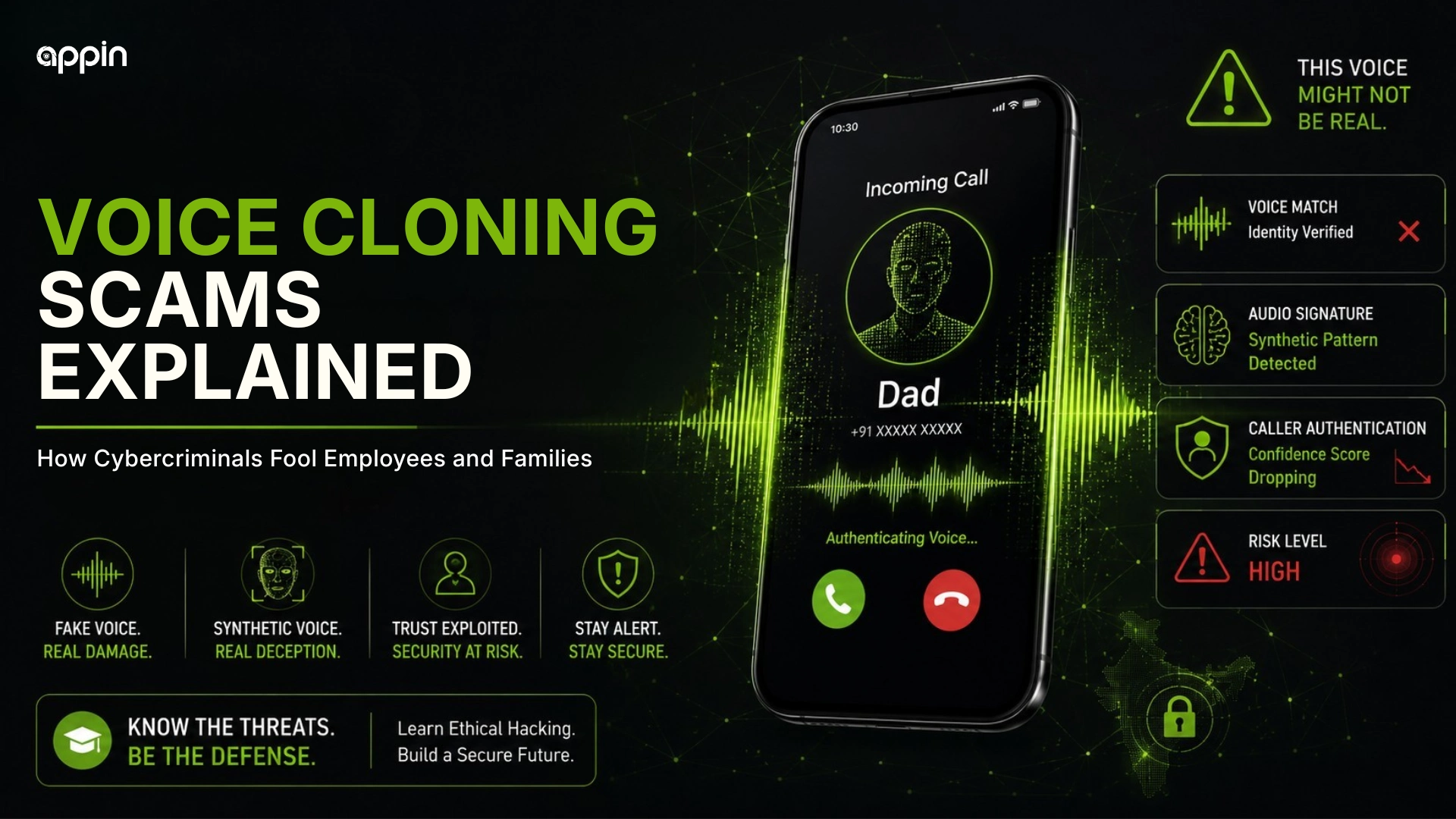
What are voice cloning scams?
Voice cloning scams are cyber frauds where criminals use AI generated audio to copy someone’s voice and trick victims into unsafe action.
In simple words, a scammer tries to make fake audio sound like a real person. The goal may be to get money, OTPs, passwords, documents, approvals, or private information.
For beginners, the idea is simple. The fraud works because the victim trusts the voice before checking the request.
A normal scam call may come from an unknown person. A cloned voice call feels more personal because it sounds like someone you already know.
Why Fake AI Voices Are Becoming a Real Cybersecurity Concern
Voice cloning scams are becoming dangerous because cybercriminals can now copy a familiar voice and use it to create panic, trust, and urgency.
Imagine a parent in Indore receiving a call that sounds like their child saying, “I am in trouble, please send money now.” Or an employee receives a voice note that sounds like the boss asking for a quick vendor payment.
The voice feels real, but the request is fake. This blog explains how cloned voice fraud works, how families and employees can verify sensitive requests, and how cybersecurity learning helps prevent voice based fraud.
How do cybercriminals misuse cloned voices?
Cybercriminals misuse cloned voices by collecting audio samples and using AI tools to imitate a person’s speech style.
Audio can come from videos, reels, podcasts, online meetings, public speeches, interviews, or social media clips. The more public voice content a person has online, the easier it becomes to imitate their speaking pattern.
The basic process behind how voice cloning scams work is:
- The attacker collects voice samples.
- AI creates a voice model.
- A fake script is prepared.
- The scammer adds urgency or emotion.
- The victim receives a call or voice note.
- The victim is pressured to act quickly.
This is why students should understand digital footprint. Public content can be misused by cybercriminals for impersonation.
How do cloned voice scams fool families?
Cloned voice scams fool families by copying the voice of a child, sibling, parent, or friend and creating panic through an emergency story.
AI voice cloning fraud in India can target parents with stories about accidents, hospital bills, police trouble, college emergencies, hostel issues, or urgent travel payments.
Common fake voice call scam examples include:
- “I had an accident, send money now.”
- “Police caught me, do not tell anyone.”
- “My phone is damaged, send money to this UPI ID.”
- “I need urgent help, please do it fast.”
These frauds work because emotion reduces verification. A worried parent may act before calling the real person.
Voice based fraud is closely related to deepfake scams because both use synthetic media to make fake communication look or sound real. deepfake scams in India
How do fake AI voices fool employees?
Fake AI voices fool employees by impersonating managers, founders, HR teams, vendors, or clients to request payments, files, credentials, or approvals.
A voice cloning scam for employees may arrive as a voice note from a “boss” asking for urgent payment approval. The attacker may pretend the request is confidential.
Workplace examples include:
- Fake manager voice note
- Urgent vendor payment request
- Payroll change request
- Confidential file request
- Password or OTP request
- Fake meeting follow up
- Vendor bank detail change
Hierarchy pressure works in offices because employees may hesitate to question senior people. That is exactly what attackers exploit.
In workplace attacks, a cloned voice may pressure an employee to approve a login, transfer funds, or ignore normal verification steps. MFA fatigue attack
What social engineering tricks make cloned voice fraud effective?
Cloned voice fraud works because cybercriminals use fear, urgency, authority, secrecy, and familiarity to stop victims from thinking clearly.
The voice is only one part of the scam. The real attack is psychological pressure.
Common tricks include:
- Fear: “I am in danger.”
- Urgency: “Do it right now.”
- Authority: “This is your boss.”
- Secrecy: “Do not tell anyone.”
- Familiarity: known name or voice
- Pressure: limited time
This is why cybersecurity is not only about tools. It also includes understanding human behavior.
What warning signs help identify an AI voice scam?
Warning signs include urgent money requests, unusual wording, emotional pressure, secrecy, unknown numbers, refusal to verify, and requests for OTPs or passwords.
If you want to know how to detect AI voice fraud, look for behavior first, not only voice quality.
Watch for:
- Sudden emergency
- New or unknown number
- Caller avoids normal callback
- Voice sounds flat or unnatural
- Odd pauses or repeated phrases
- UPI, OTP, password, or document request
- Request does not match normal behavior
- Pressure to keep it secret
A fake voice can sound convincing, but the request usually feels rushed.
How can families verify a suspicious voice call?
Families can verify suspicious calls by pausing, calling the real person on a trusted number, asking a private question, and using a family code word.
Do not transfer money immediately because the caller sounds familiar. First verify.
Use this family safety checklist:
- Call back using the saved contact.
- Ask a personal question only the real person knows.
- Create a family emergency code word.
- Confirm with another family member.
- Do not trust caller ID alone.
- Save evidence if fraud is suspected.
- Never share OTPs or banking details.
A fake voice scam becomes weaker when families follow a fixed verification rule.
How can employees verify sensitive voice requests?
Employees should verify sensitive voice requests through official channels, written approvals, callback procedures, and two person approval workflows.
An AI call scam in the workplace should never be approved only because the voice sounds familiar. Finance, HR, IT, and admin teams need a clear process.
Employees should:
- Confirm through official email or ticketing system.
- Call back using the company directory number.
- Avoid approving payments on voice notes.
- Use two person approval for finance requests.
- Verify vendor bank detail changes separately.
- Report suspicious calls to IT or security.
- Follow the incident process.
Good process protects employees from pressure.
What should you do if you receive a suspected AI voice scam call?
If you receive a suspected AI voice scam call, stop the conversation, do not share information, save evidence, verify through another channel, and report it.
If money was sent, act quickly. Time matters in cyber fraud reporting.
Do this:
- End or pause the call.
- Do not reveal OTP, password, or bank details.
- Save caller details and screenshots.
- Save audio or chat if possible.
- Inform family, manager, or security team.
- Contact the bank if money was sent.
- Report financial cyber fraud through 1930.
- File a complaint on cybercrime.gov.in.
Many voice based fraud cases end with the victim being pushed toward instant digital payment. UPI fraud and cybersecurity
How can organizations prevent voice based cyber fraud?
Organizations can prevent voice based cyber fraud by combining awareness training, payment controls, identity verification, and incident response procedures.
Businesses should assume that voice alone is not enough proof. A senior person’s voice note should not bypass normal controls.
Useful controls include:
- Employee awareness sessions
- CEO fraud simulation training
- Payment approval workflows
- Vendor change verification
- Callback policy
- Restricted access to sensitive files
- Reporting culture
- Cybersecurity monitoring
The goal is not to panic employees. The goal is to make verification normal.
Why are cloned voice scams difficult to detect?
Cloned voice scams are difficult to detect because people naturally trust familiar voices, especially during emotional or urgent situations.
Poor call quality can hide small voice errors. Scammers also keep calls short so victims do not get enough time to notice problems.
Human detection alone is not enough. The verification process matters more than guessing whether the voice sounds fake.
How does cybersecurity help prevent voice based fraud?
Cybersecurity helps prevent voice based fraud by teaching people how social engineering works, how to verify requests, and how to respond to incidents.
This topic connects with voice phishing, account protection, incident response, evidence collection, and secure communication policies.
Cybersecurity training helps people understand:
- Why urgency is a red flag
- Why OTPs must not be shared
- Why official channels matter
- How evidence should be saved
- How cyber fraud should be reported
- How families and workplaces can reduce risk
What can cybersecurity students learn from fake AI voice fraud?
Cybersecurity students can learn how AI is changing cybercrime, why human behavior matters, and how defenders design verification controls.
Voice cloning cybersecurity risk connects with many useful career topics:
- Vishing attacks
- AI enabled impersonation
- OSINT and digital footprint
- Social engineering psychology
- Incident reporting
- Cyber forensics basics
- SOC awareness
- Security policy design
This is a strong topic for students because it shows that modern cybersecurity is about people, process, and technology together.
How can Appin help students learn about AI voice fraud and cyber defense?
Appin helps students learn to recognize and defend against AI enabled cyber threats through authorized training labs, ethical cybersecurity training, and expert guidance at Appin Indore.
At Appin Indore, students can learn ethical hacking concepts, defensive cybersecurity concepts, social engineering awareness, incident response basics, SOC and VAPT relevance, and AI driven cyber threat awareness.
Students can explore CEH v13, CHFI, Bug Bounty Diploma, Diploma in Information Security, and the 6 month Diploma in IT Security and Ethical Hacking.
Appin Technology Lab also provides career guidance and placement assistance for students and freshers who want to build real cybersecurity skills through responsible investigation practices and practical learning.
